
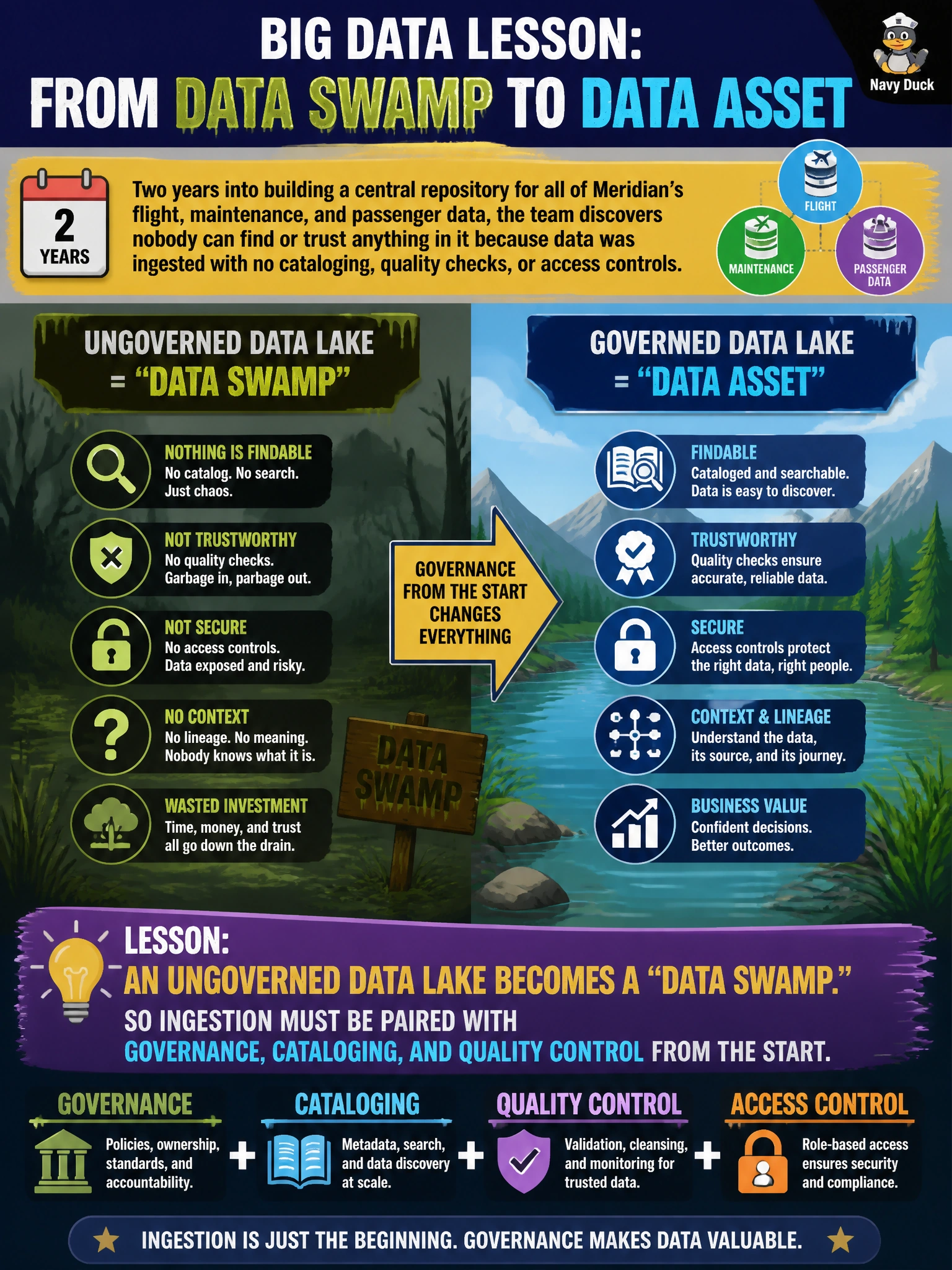
Two years into building a central repository for all of Meridian's flight, maintenance, and passenger data, the team discovers nobody can find or trust anything in it because data was ingested with no cataloging, quality checks, or access controls. What lesson from prior Big Data implementations does this illustrate?
Select an answer to reveal the explanation.
Short Explanation
A data lake with no rules is just a data swamp — everything's in there, nobody can find it, and nobody trusts it. The lesson from a decade of Big Data projects is that ingestion without governance is a liability, not an asset.
Full Explanation
A well-documented lesson from Big Data implementations is that dumping data into a repository without governance, cataloging, and quality controls produces a 'data swamp' — technically centralized but practically unusable and untrustworthy. Meridian's scenario is a textbook case: volume without discipline. Option B overreacts with an irrelevant, extreme alternative that ignores the real fix, which is governance, not abandoning the architecture. Option C misdiagnoses the root cause as a storage capacity problem when the actual failure is process and metadata management — adding disks does nothing for cataloging or trust. Option D is a dangerous misconception; no platform automatically guarantees data quality, which is exactly why data governance (Task 2 of this domain) exists as a distinct, required discipline. For the exam, connect this lesson forward: the fix is establishing data stewardship, lineage documentation, and a data management plan — the very topics tested next in this domain.