
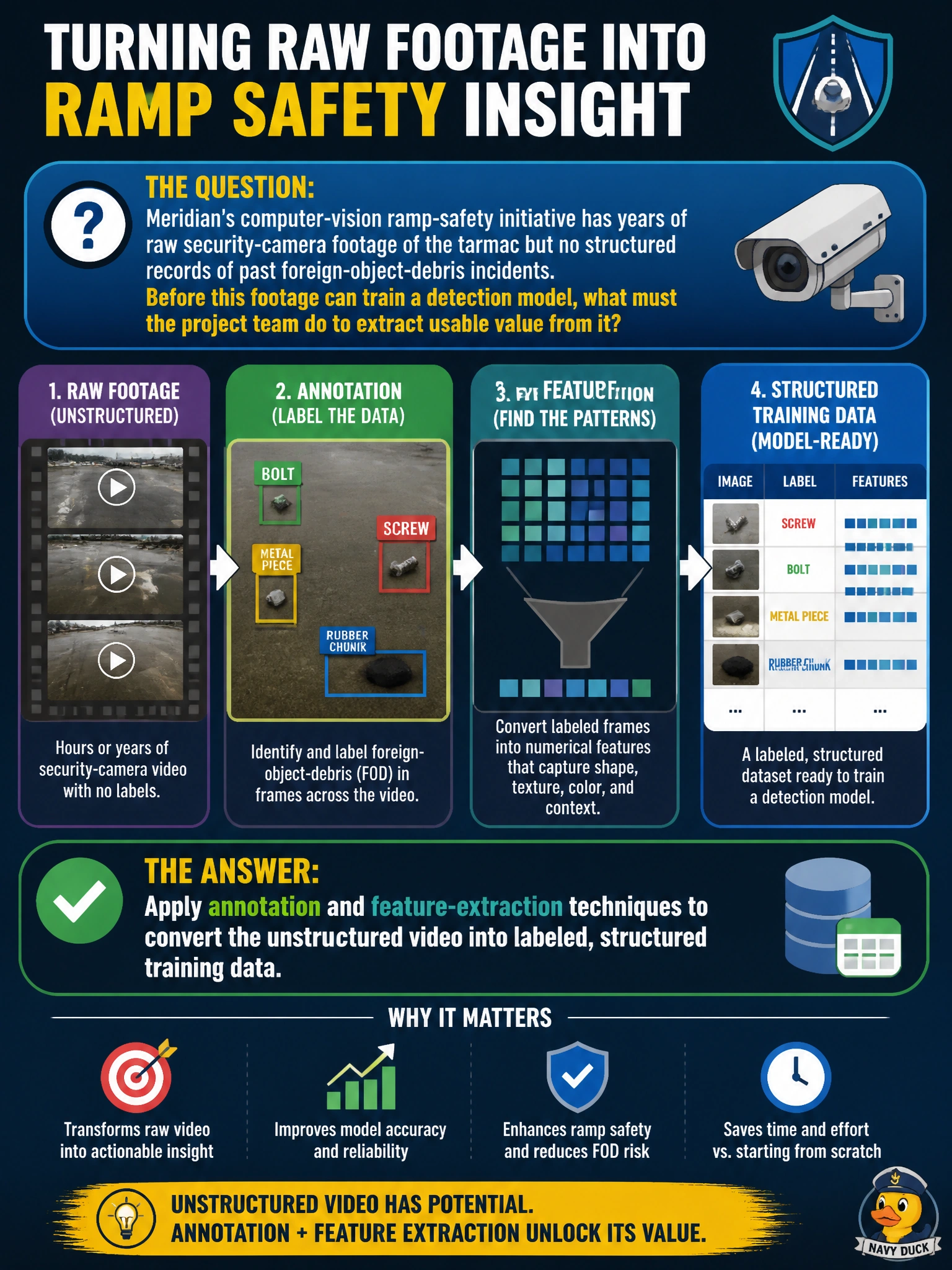
Meridian's computer-vision ramp-safety initiative has years of raw security-camera footage of the tarmac but no structured records of past foreign-object-debris incidents. Before this footage can train a detection model, what must the project team do to extract usable value from it?
Select an answer to reveal the explanation.
Short Explanation
Unstructured data — video, images, free-text logs — doesn't teach a model anything until someone labels it. Think of raw ramp footage as ore: it has value, but only after you extract and refine it into something structured a model can learn from.
Full Explanation
A large share of enterprise data, including video like Meridian's tarmac footage, is unstructured — it has no predefined schema. To extract value for a supervised computer-vision model, the team must annotate frames (labeling foreign-object debris, mishandled bags, safety-zone intrusions) and extract features, converting unstructured content into structured, labeled training examples. Option A is wrong and reflects a common misconception CPMAI explicitly wants PMs to debunk: unstructured data is not unusable, it just requires preparation. Option C ignores that raw video pixels are not directly meaningful training labels — a model needs annotated ground truth to learn what 'FOD' looks like. Option D over-corrects by discarding the visual signal entirely, which defeats the purpose of a computer-vision use case. The exam-relevant takeaway: extracting value from unstructured resources is a distinct, named skill in the Data for AI domain, and it's the necessary bridge between raw unstructured data and the labeled datasets Domain II's Data Preparation phase requires.