
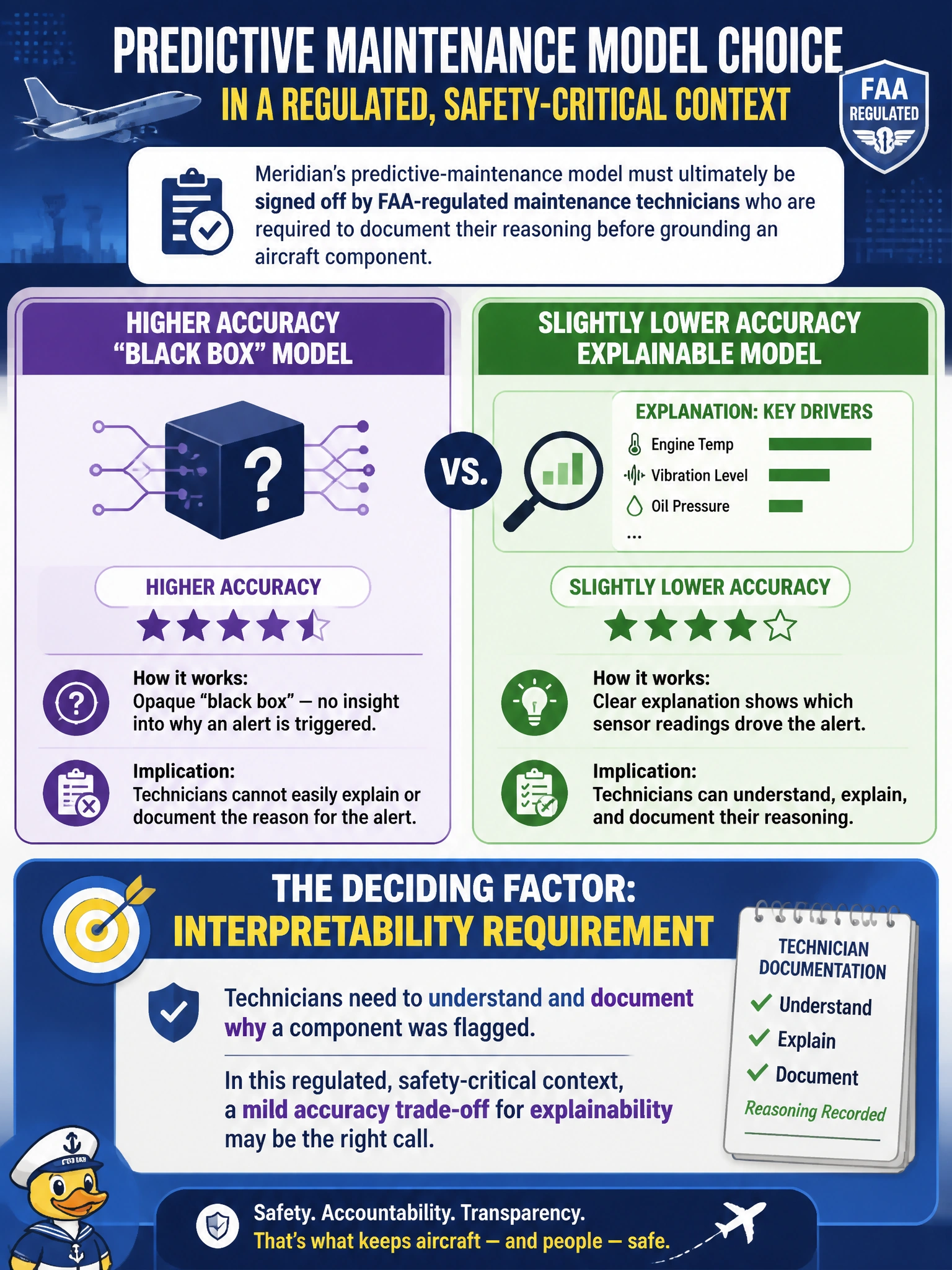
Meridian's predictive-maintenance model must ultimately be signed off by FAA-regulated maintenance technicians who are required to document their reasoning before grounding an aircraft component. A highly accurate but "black box" model is available, alongside a slightly less accurate model whose flagged predictions come with a clear explanation of which sensor readings drove the alert. Which factor should most heavily influence the model-development requirement here?
Select an answer to reveal the explanation.
Short Explanation
In a world where a mechanic has to write down why a part got grounded, "the model said so" doesn't fly. A touch less accuracy for a model that can actually explain itself is often the right trade in a regulated, safety-critical context.
Full Explanation
Defining AI model-development requirements means weighing accuracy against other real needs of the deployment context, and here interpretability is a legitimate, heavily-weighted requirement: FAA-regulated technicians who must document their reasoning before grounding a component need to understand why a model flagged an issue, not just trust a black-box score, so accepting a small accuracy trade-off for explainability can be the right project-management call. Always defaulting to the highest raw accuracy ignores this real regulatory and operational need — accuracy in isolation isn't the only requirement that matters, especially in safety-critical, human-sign-off contexts. Interpretability is not confined to Trustworthy AI alone; while Trustworthy AI treats transparency and explainability as a dedicated pillar, interpretability is also a legitimate Model Development requirement whenever the deployment context (like technician documentation obligations) demands it — the two domains reinforce each other rather than being mutually exclusive. Ruling out machine learning entirely in favor of only rule-based systems overcorrects: CPMAI doesn't ban ML from regulated contexts, it asks the team to choose an approach — including explainable ML techniques — that satisfies the real interpretability requirement, not to abandon machine learning altogether.