
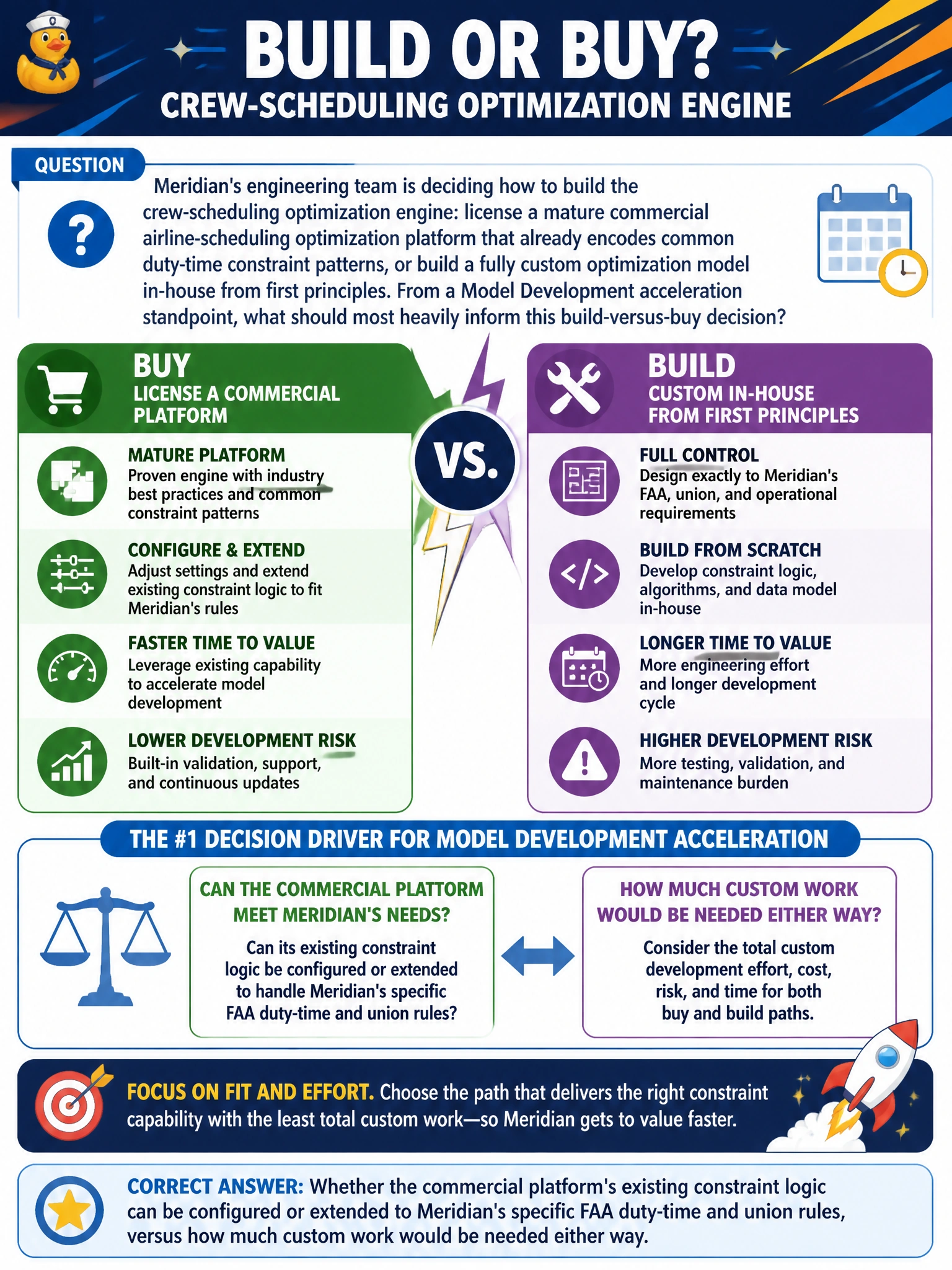
Meridian's engineering team is deciding how to build the crew-scheduling optimization engine: license a mature commercial airline-scheduling optimization platform that already encodes common duty-time constraint patterns, or build a fully custom optimization model in-house from first principles. From a Model Development acceleration standpoint, what should most heavily inform this build-versus-buy decision?
Select an answer to reveal the explanation.
Short Explanation
This is a fit question before it's a cost question: does the commercial platform's constraint logic actually bend to Meridian's real duty-time and union rules, or would 'buy' quietly turn into 'build a workaround anyway'?
Full Explanation
Incorporating pretrained models and existing components effectively means judging fit, not just headline cost: the deciding factor should be whether the commercial platform's existing constraint logic can genuinely be configured or extended to Meridian's specific FAA duty-time rules and union agreements, versus how much custom development either path would still require — a platform that needs heavy rework to fit Meridian's rules may not actually save the time it promises. Choosing purely on year-one cost ignores fit entirely; a cheaper platform that can't represent Meridian's actual constraints could cost far more later in workarounds, compliance risk, or a failed rollout. Claiming CPMAI never allows incorporating a commercial platform as an acceleration shortcut contradicts the methodology directly — leveraging existing tools and components appropriately is an explicit competency. Claiming custom in-house building is always outdated is the opposite overcorrection — CPMAI doesn't crown either build or buy as universally correct; it asks the team to make a reasoned trade-off based on fit, cost, and timeline for the specific project, exactly like the airline-hype-avoidance and vendor-mismatch cautions elsewhere in the methodology.