
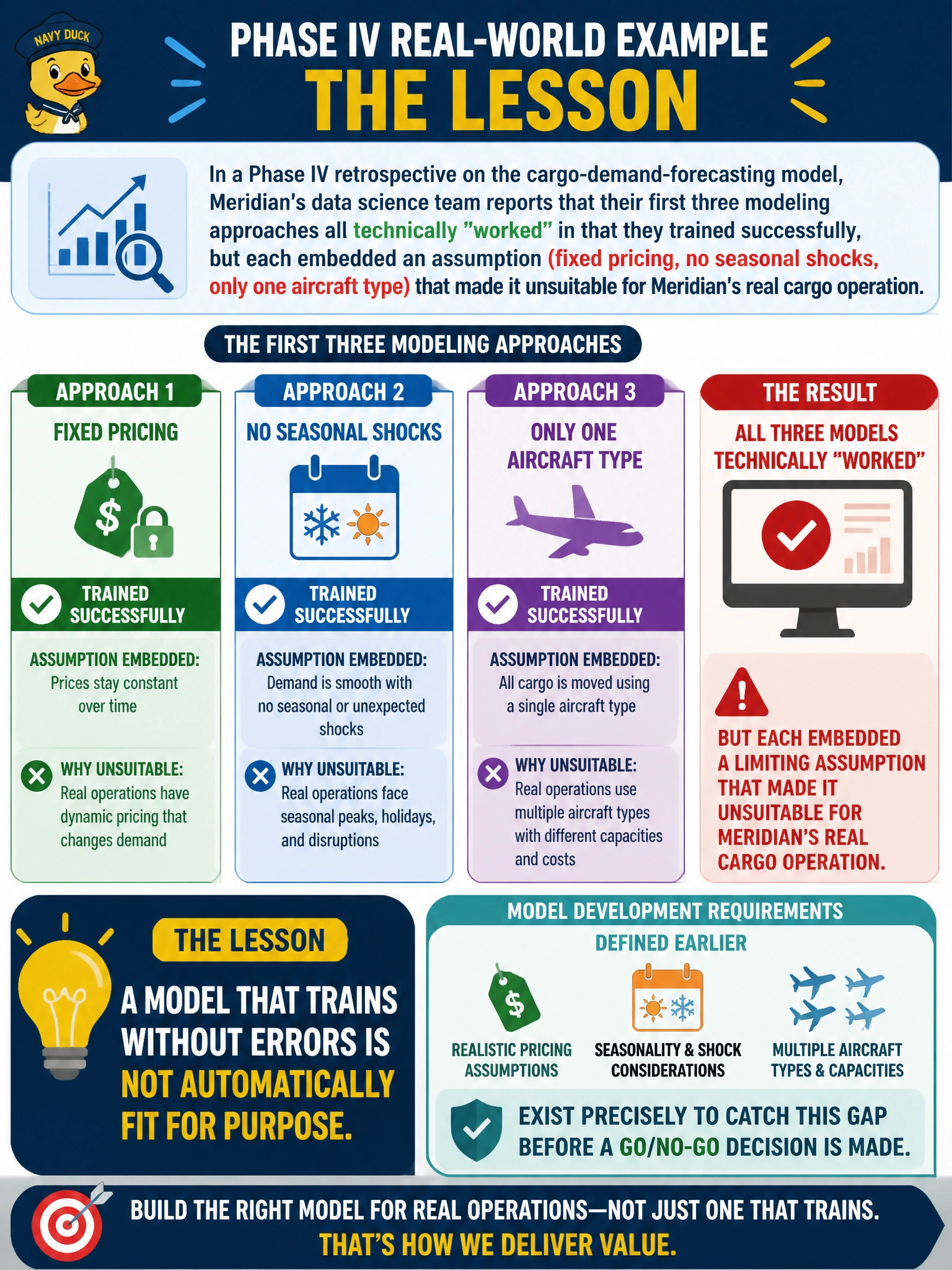
In a Phase IV retrospective on the cargo-demand-forecasting model, Meridian's data science team reports that their first three modeling approaches all technically "worked" in that they trained successfully, but each embedded an assumption (fixed pricing, no seasonal shocks, only one aircraft type) that made it unsuitable for Meridian's real cargo operation. What lesson does this real-world Phase IV example best illustrate?
Select an answer to reveal the explanation.
Short Explanation
"It ran without crashing" is not the same as "it does the job." This is exactly why model-development requirements get written down first — so a model that trains cleanly but ignores seasonality doesn't sail through to evaluation unchallenged.
Full Explanation
A well-documented real-world CPMAI Phase IV pattern is that a model can complete training successfully — no runtime errors, output produced — while still failing to satisfy the actual business requirements, because its underlying assumptions don't match reality. Fixed pricing, ignoring seasonal shocks, and covering only one aircraft type are exactly the kind of simplifying assumptions that make a technically-functioning model useless for Meridian's real cargo operation, and this is precisely why the model-development requirements defined earlier (prediction targets, tolerances, scope) exist: to give the team something concrete to check the model against before it's allowed to proceed toward evaluation and a Phase IV Go/No-Go. Judging Model Development solely by whether training completes without errors is the mistake this scenario is warning against — technical completion and business fitness are different questions, and CPMAI's requirements-first approach exists to keep them from being conflated. Calling this a coding-practices failure misdiagnoses the problem: nothing in the scenario suggests bugs or bad code; the issue is that the modeling approach embedded unrealistic business assumptions, a methodology and requirements problem, not a software-engineering one.