
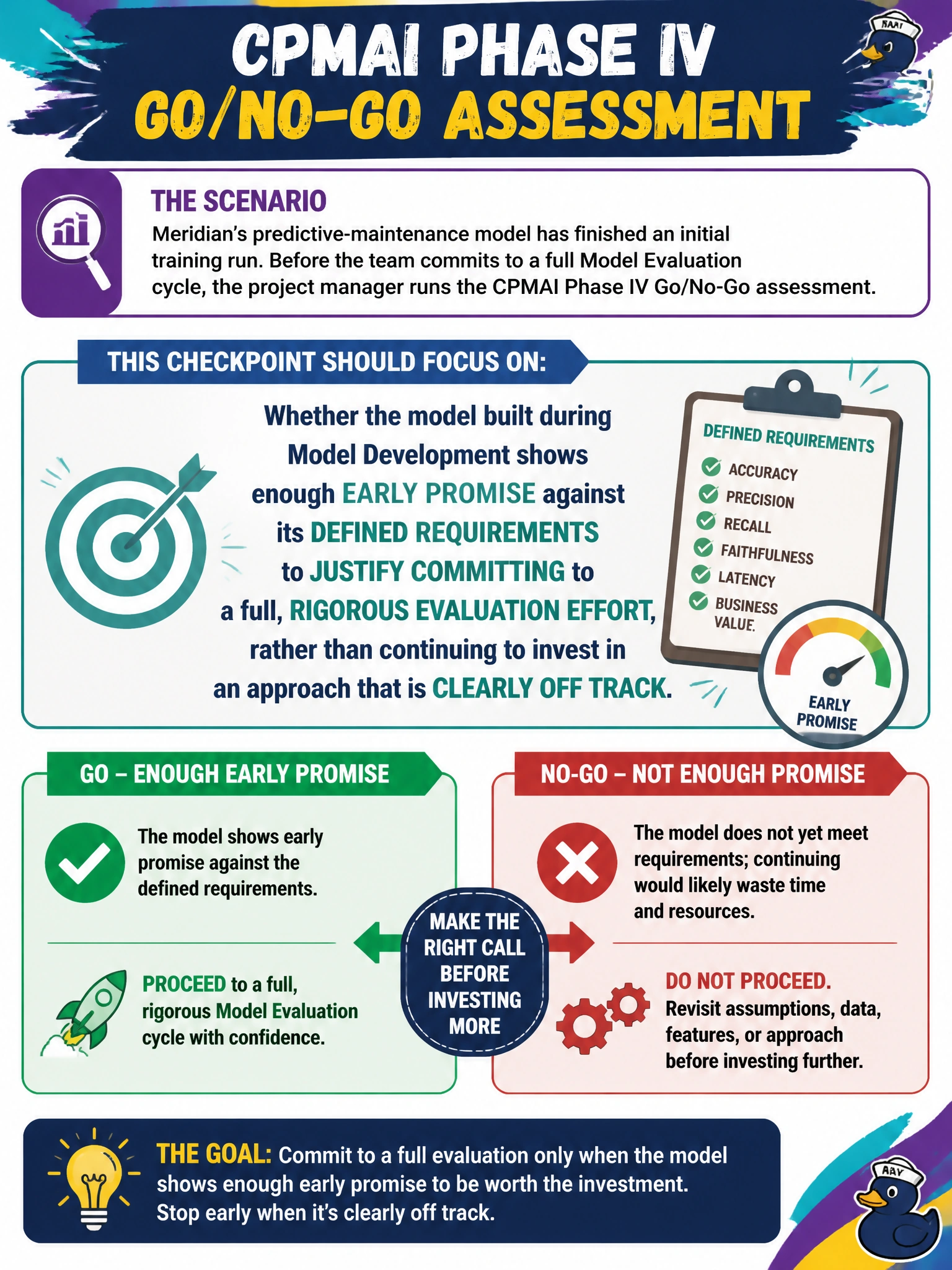
Meridian's predictive-maintenance model has finished an initial training run. Before the team commits to a full Model Evaluation cycle, the project manager runs the CPMAI Phase IV Go/No-Go assessment. What should this checkpoint focus on?
Select an answer to reveal the explanation.
Short Explanation
Phase IV's Go/No-Go is a sanity check on the freshly built model, not the final verdict. It's asking "does this look promising enough to be worth a full evaluation," not "has it already beaten the old process."
Full Explanation
The Phase IV (Model Development) Go/No-Go assessment checks whether the model produced so far shows enough early, credible promise against the requirements set during Model Development to justify committing resources to a full, rigorous Model Evaluation cycle — it's a checkpoint against sunk-cost continuation, not a final performance verdict. Union contract ratification is an organizational labor-relations matter entirely unrelated to evaluating model readiness, even though union consultation matters elsewhere in the project's stakeholder management. Requiring the model to already outperform every legacy process sets the bar in the wrong phase — that kind of head-to-head performance comparison against existing operations is the job of Model Evaluation (and later, production monitoring against business KPIs), not a Phase IV checkpoint on a freshly trained model that hasn't been rigorously evaluated yet. The near-identical distractor about "early, credible promise" omits the crucial second half of the point — that the checkpoint exists specifically to prevent continued investment in an approach that is clearly not working, which is the actual decision-forcing function of a Go/No-Go gate; without that framing it's just a description of what's being looked at, not what the gate decides.