
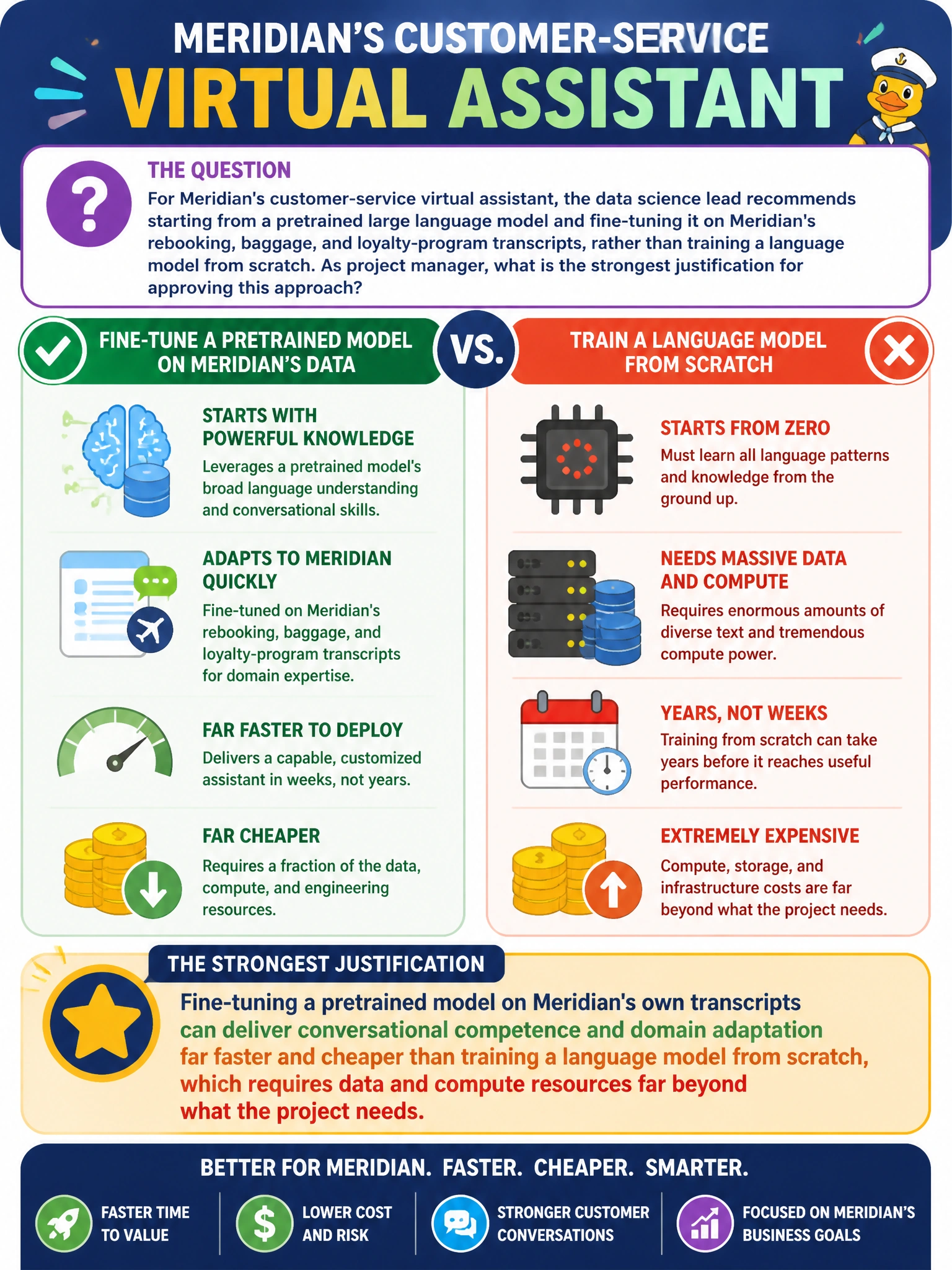
For Meridian's customer-service virtual assistant, the data science lead recommends starting from a pretrained large language model and fine-tuning it on Meridian's rebooking, baggage, and loyalty-program transcripts, rather than training a language model from scratch. As project manager, what is the strongest justification for approving this approach?
Select an answer to reveal the explanation.
Short Explanation
You don't need to reinvent language itself to teach a chatbot about baggage claims. Fine-tuning a pretrained model on Meridian's own transcripts gets domain competence fast, without the data and compute bill of training an LLM from zero.
Full Explanation
Incorporating pretrained models and generative AI effectively is a named CPMAI Model Development competency, and the strongest justification here is practical: fine-tuning adapts an already-capable language model to Meridian's specific domain (rebooking, baggage, loyalty terminology) using a comparatively small, targeted dataset and modest compute, versus training a foundation model from scratch, which demands data and infrastructure at a scale wildly disproportionate to a single airline's customer-service chatbot. Claiming pretrained models are always more accurate in every situation overstates the case — fine-tuning wins here on cost and speed for this use case, not as a universal law; some specialized problems genuinely need custom modeling. Saying training from scratch is technically impossible outside a major lab is also too absolute — it's possible, just enormously resource-inefficient for this project's needs, which is the actual argument for not doing it. Claiming fine-tuning eliminates the need for human review is dangerous and wrong: a generative assistant handling rebooking and account actions still needs ongoing monitoring, escalation paths to human agents, and evaluation — fine-tuning changes how the model was built, not whether it needs oversight once live.