
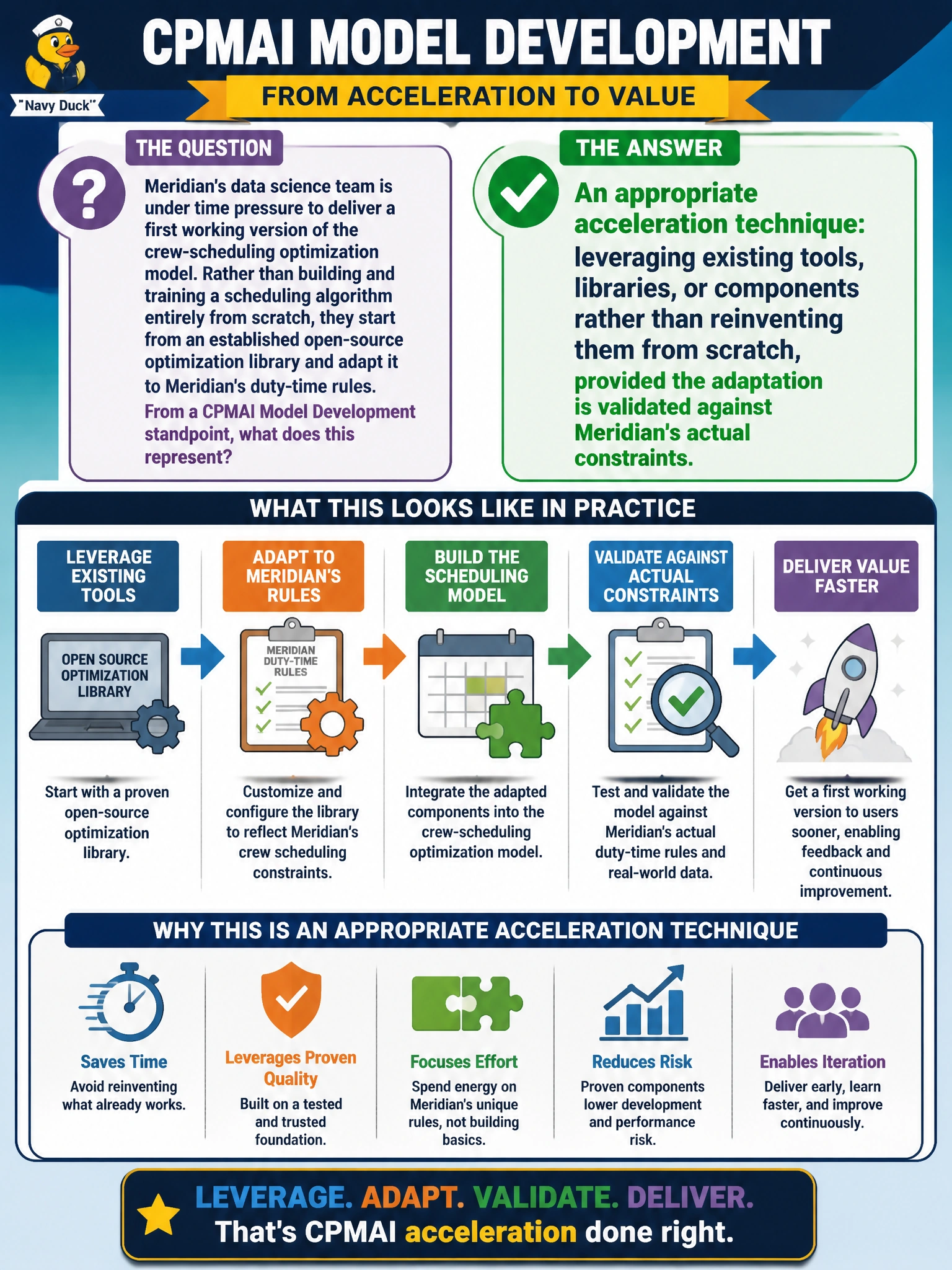
Meridian's data science team is under time pressure to deliver a first working version of the crew-scheduling optimization model. Rather than building and training a scheduling algorithm entirely from scratch, they start from an established open-source optimization library and adapt it to Meridian's duty-time rules. From a CPMAI Model Development standpoint, what does this represent?
Select an answer to reveal the explanation.
Short Explanation
CPMAI wants you accelerating development with sensible shortcuts, not reinventing the wheel for style points. Starting from a proven library and validating it against Meridian's real duty-time rules is exactly the kind of shortcut the methodology encourages.
Full Explanation
Accelerating development with appropriate shortcuts is a named CPMAI Model Development competency, and adapting an established optimization library to Meridian's specific duty-time rules — rather than building a scheduling algorithm from first principles — is a textbook example, as long as the team validates the adapted approach against Meridian's actual operational constraints rather than trusting it blindly. There is no CPMAI requirement to build everything from scratch; in fact the opposite is true — CPMAI explicitly favors incorporating existing tools, pretrained components, and generative AI where they fit, because reinventing solved problems wastes time without improving outcomes. This work belongs to Model Development, not Data Preparation — Data Preparation is about getting input data ready, while selecting and adapting the modeling approach itself (including which existing components to build on) is squarely a Model Development activity. Calling it a deployment decision confuses using an external library during building with deploying the finished model into production infrastructure — those are different phases; adapting a library happens well before the model is ready for Operationalization.