
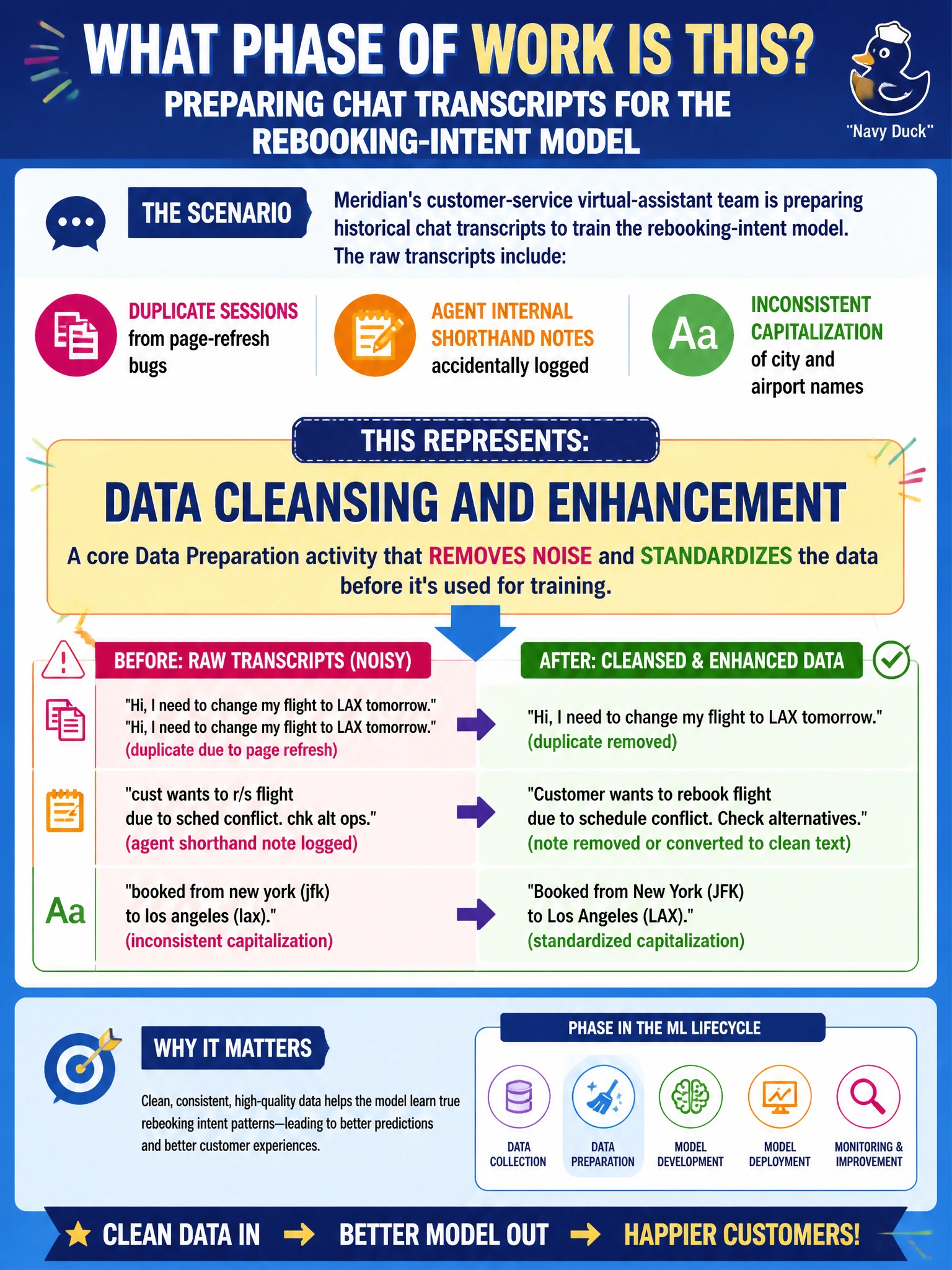
Meridian's customer-service virtual-assistant team is preparing historical chat transcripts to train the rebooking-intent model. The raw transcripts include duplicate sessions from page-refresh bugs, agent internal shorthand notes accidentally logged, and inconsistent capitalization of city and airport names. What phase of work does resolving these issues represent?
Select an answer to reveal the explanation.
Short Explanation
Deduping sessions, stripping stray notes, and standardizing city names is textbook cleansing and enhancement — the unglamorous Data Preparation work that keeps garbage from becoming the model's training signal.
Full Explanation
Removing duplicate records, stripping out irrelevant content that was accidentally captured, and standardizing inconsistent formatting are exactly what CPMAI's data cleansing and enhancement activity covers within Data Preparation — this is the practical work that turns messy raw transcripts into a dataset a model can learn reliable patterns from, directly serving the "garbage in, garbage out" principle. Model iteration refers to refining or retraining a model based on evaluation results after it has already been trained and assessed — that's a Model Evaluation-phase activity, not the upstream cleanup of source data before training ever starts. Data governance concerns organization-wide policy, stewardship roles, and lineage tracking; it can set the standards these cleansing rules follow, but the hands-on act of deduplicating and standardizing individual transcript records is Data Preparation work, not governance itself. Deferring cleanup to Operationalization gets the sequence backwards and is actually dangerous: training a model on duplicated, inconsistent, noisy transcripts and only fixing the data after deployment means the flawed model is already making rebooking decisions on live customers before anyone addresses the root data quality problem.