
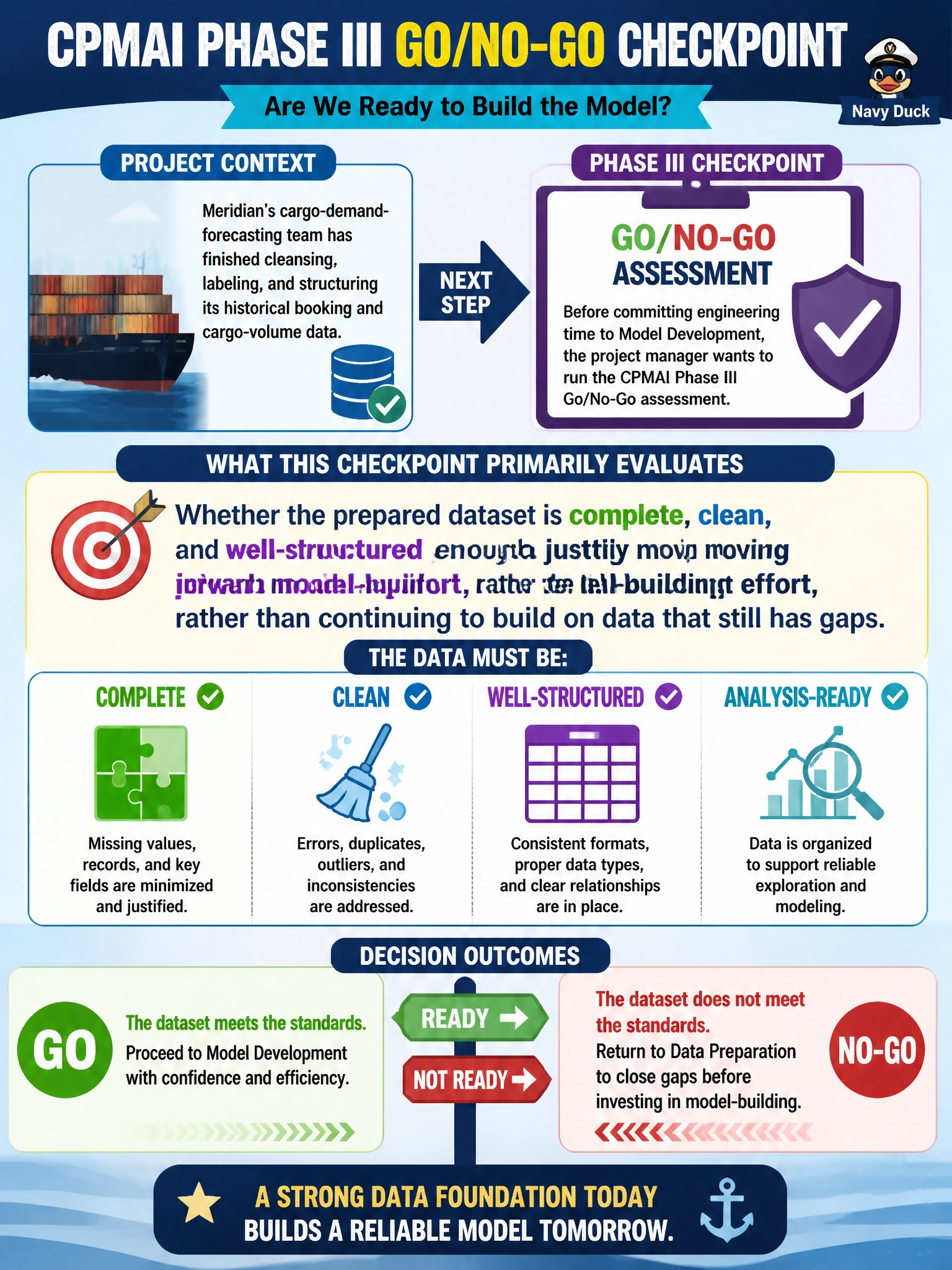
Meridian's cargo-demand-forecasting team has finished cleansing, labeling, and structuring its historical booking and cargo-volume data. Before committing engineering time to Model Development, the project manager wants to run the CPMAI Phase III Go/No-Go assessment. What should this checkpoint primarily evaluate?
Select an answer to reveal the explanation.
Short Explanation
Phase III's Go/No-Go is the last checkpoint before real modeling effort begins — it's asking "is the prepared data actually good enough to build on?" not "does the model work?" (there is no model yet).
Full Explanation
The Phase III (Data Preparation) Go/No-Go assessment evaluates whether the prepared dataset — after cleansing, labeling, and structuring — is genuinely ready to support Model Development, protecting the team from sinking engineering effort into building on data that still has quality or completeness gaps. Evaluating accuracy against a holdout test set is impossible at this point in the lifecycle because no model has been trained yet; that belongs to the Phase V (Model Evaluation) Go/No-Go, much further downstream. Approving a marketing budget for a new cargo route is a business/finance decision entirely outside the CPMAI data-and-model lifecycle — it might inform Business Understanding but has nothing to do with checking whether prepared data is ready. Checking whether a deployed model still meets production KPIs describes ongoing production monitoring after Operationalization, not a pre-Model-Development checkpoint. Recognizing what each phase's Go/No-Go actually inspects — by matching the checkpoint's content to what has and hasn't happened yet in the lifecycle — is the core skill this family of questions tests; Phase III's is squarely about data readiness, nothing about the model itself since none exists yet.