
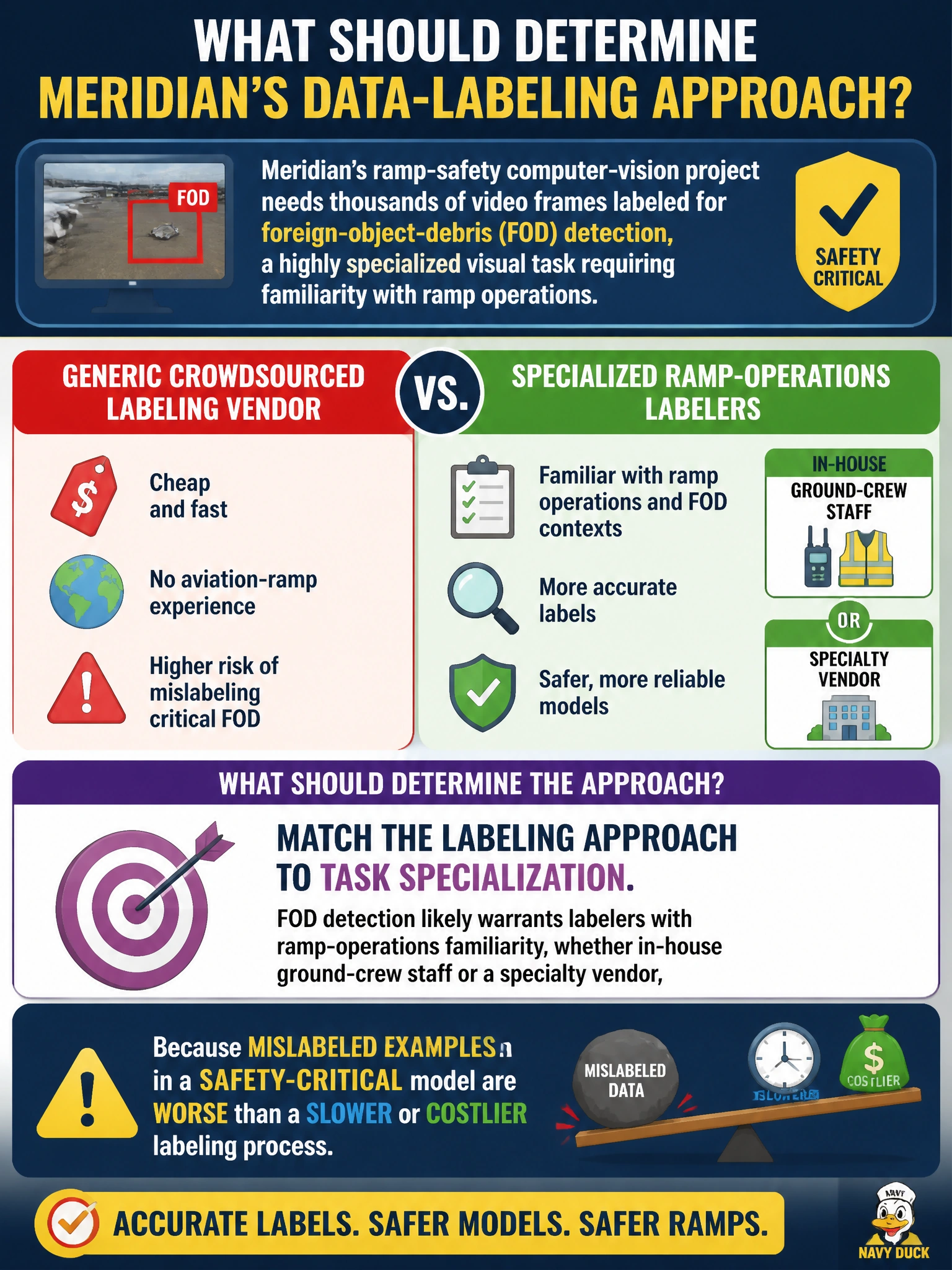
Meridian's ramp-safety computer-vision project needs thousands of video frames labeled for foreign-object-debris (FOD) detection, a highly specialized visual task requiring familiarity with ramp operations. A generic crowdsourced labeling vendor is cheap and fast but has no aviation-ramp experience. What should determine Meridian's data-labeling approach?
Select an answer to reveal the explanation.
Short Explanation
Labeling decisions are a data-quality decision, not just a price-shopping exercise. FOD on a ramp isn't something a generic crowdsourced worker can reliably recognize — get it wrong here and the model learns to miss the exact hazards it exists to catch.
Full Explanation
Determining data-labeling requirements means matching the labeling approach to what the task actually demands — accuracy, domain expertise, and consistency — not defaulting to whichever vendor is cheapest. Foreign-object-debris detection is specialized enough that generic crowdsourced labelers, unfamiliar with what ramp debris actually looks like against a runway or apron background, are likely to produce inconsistent or wrong labels; Meridian should weigh in-house ground-crew expertise or a specialty vendor against the added cost, because for a safety-critical system the cost of bad labels (a model that misses real hazards or over-triggers on harmless objects) outweighs the savings from cheap labeling. Choosing purely on cost and treating quality as a Model Evaluation concern is backwards — bad labels corrupt the model at the training stage, long before evaluation catches anything, and evaluation can't fully undo a flawed ground truth. Skipping labeling entirely in favor of unsupervised clustering abandons the goal: clustering can group similar-looking frames but can't tell Meridian which cluster is actually "FOD" without labeled ground truth to anchor it, so it doesn't solve the labeling requirement, it avoids it.