
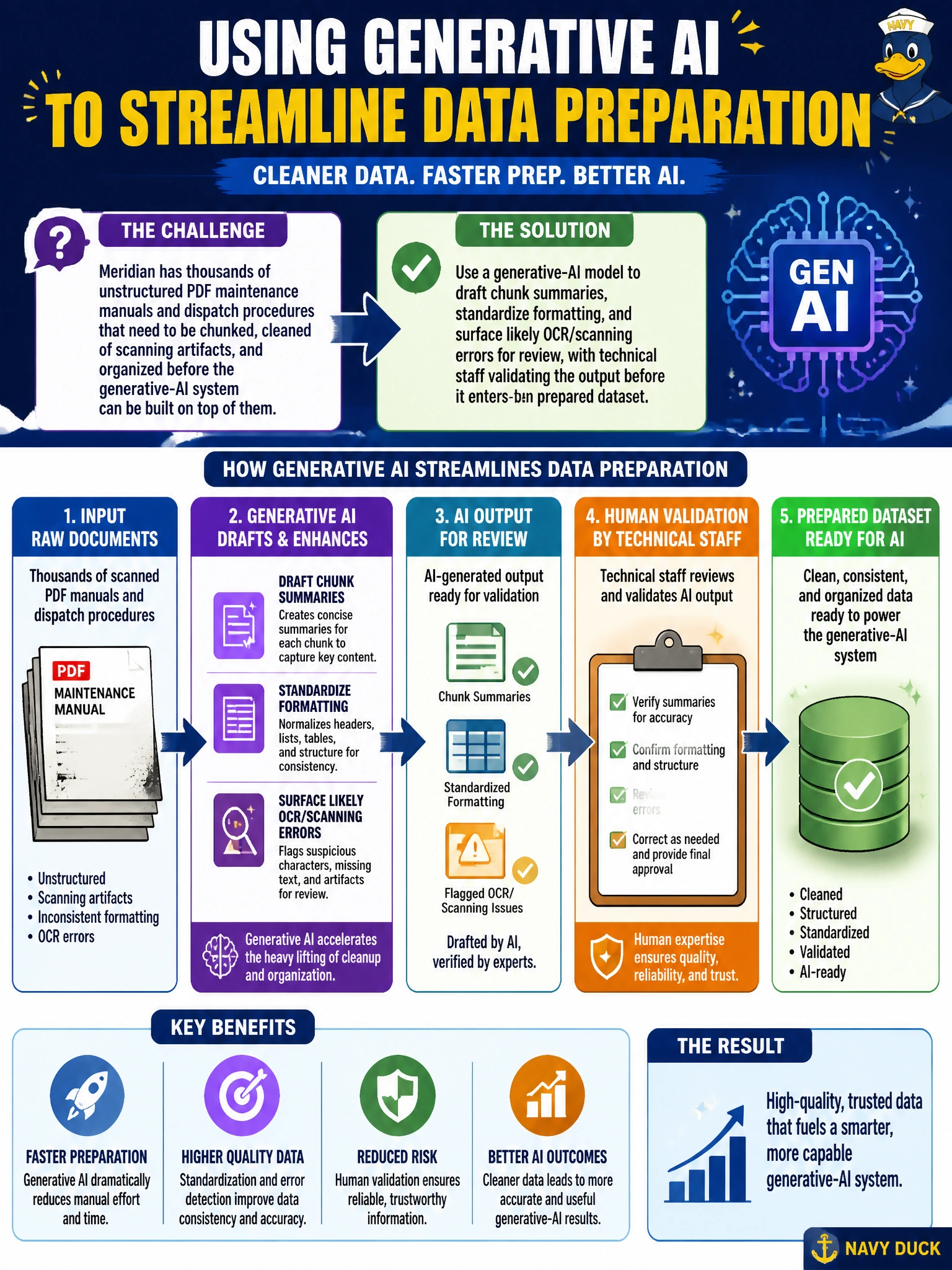
Meridian's knowledge-assistant project has thousands of unstructured PDF maintenance manuals and dispatch procedures that need to be chunked, cleaned of scanning artifacts, and organized before the generative-AI system can be built on top of them. How can generative AI itself be applied to streamline this Data Preparation work?
Select an answer to reveal the explanation.
Short Explanation
GenAI is a legitimate accelerant for grunt-work data prep — drafting summaries, catching OCR garbage, standardizing formatting — as long as a human with technical knowledge signs off before it's trusted for safety-critical manuals.
Full Explanation
Applying generative AI to streamline data preparation is an explicit CPMAI Data Preparation competency, and using it to draft chunk summaries, standardize inconsistent formatting across thousands of PDFs, and flag likely scanning/OCR errors for human review is exactly that kind of acceleration — with technical reviewers validating output before anything enters the prepared dataset, which matters even more for safety-critical maintenance content. Saying GenAI can never ethically touch this data overstates the risk; the risk is managed through human validation, not by banning the accelerator outright — CPMAI explicitly treats GenAI as a cross-phase accelerator, including in data prep. The closely-worded distractor about "summarize, restructure, and flag inconsistencies" sounds right but is vaguer and omits the concrete data-prep mechanics (chunking, formatting standardization, OCR-error surfacing) that make the correct option the more precise, complete answer for this specific data-preparation task. Claiming GenAI use must wait until after Model Development misreads the CPMAI lifecycle entirely — Model Development happens after Data Preparation, and by then the source manuals should already be cleaned and organized; withholding GenAI assistance until then would mean doing the labor-intensive prep work manually first, defeating the purpose of using it as an accelerator.