
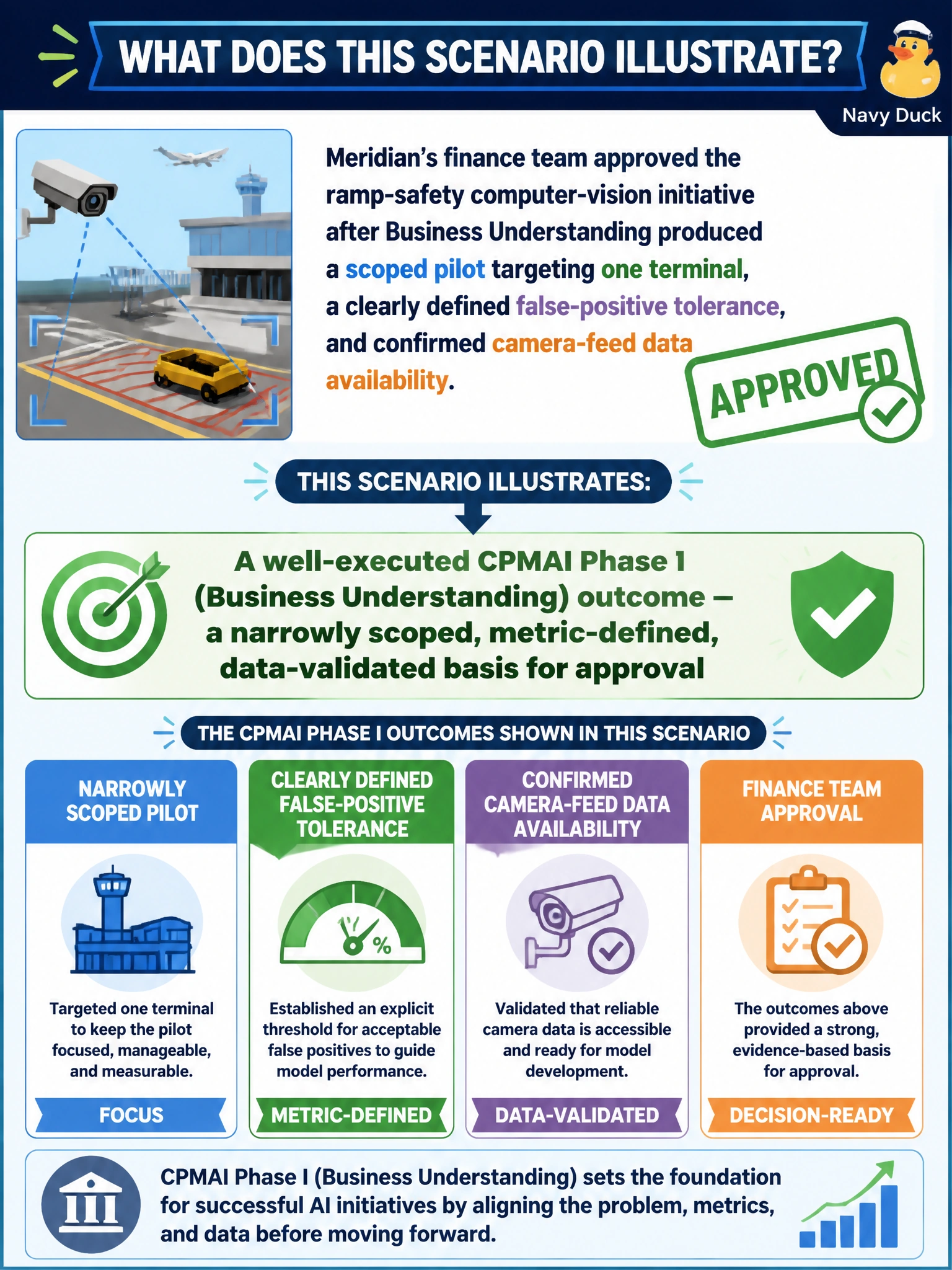
Meridian's finance team approved the ramp-safety computer-vision initiative after Business Understanding produced a scoped pilot targeting one terminal, a clearly defined false-positive tolerance, and confirmed camera-feed data availability. What does this scenario illustrate?
Select an answer to reveal the explanation.
Short Explanation
One terminal, a clear false-positive threshold, confirmed data — that's exactly what a tight, well-run Business Understanding phase is supposed to produce before anyone signs off on funding.
Full Explanation
This scenario illustrates a well-executed CPMAI Phase I (Business Understanding) outcome, and it's worth naming precisely why: the pilot scope is narrow (one terminal, not the whole airport), the success criteria are quantified (a defined false-positive tolerance), and a key data-feasibility question (camera-feed availability) was resolved before approval — exactly the combination of elements Business Understanding's Go/No-Go assessment is designed to produce and validate. This is the kind of real-world CPMAI Phase I implementation example the outline calls out as a task enabler. Option A misplaces this in Data Preparation, a later phase concerned with cleansing, labeling, and enhancing data rather than initial scoping and metric definition. Option B is incorrect; nothing in the scenario addresses how the model will be deployed (on-prem vs. cloud, version control), which is an Operationalization/Domain V concern, not what's described here. Option D is unrelated; data drift concerns a production model's inputs changing over time, not an initial approval decision. Recognizing a strong Phase I outcome in a realistic scenario, and correctly distinguishing it from later-phase activities, is the skill being tested.