
Having received Go approval, the ramp-safety team moves into Data Understanding. What AI-specific question should they now prioritize that a traditional software project would not typically need to ask?
Select an answer to reveal the explanation.
Short Explanation
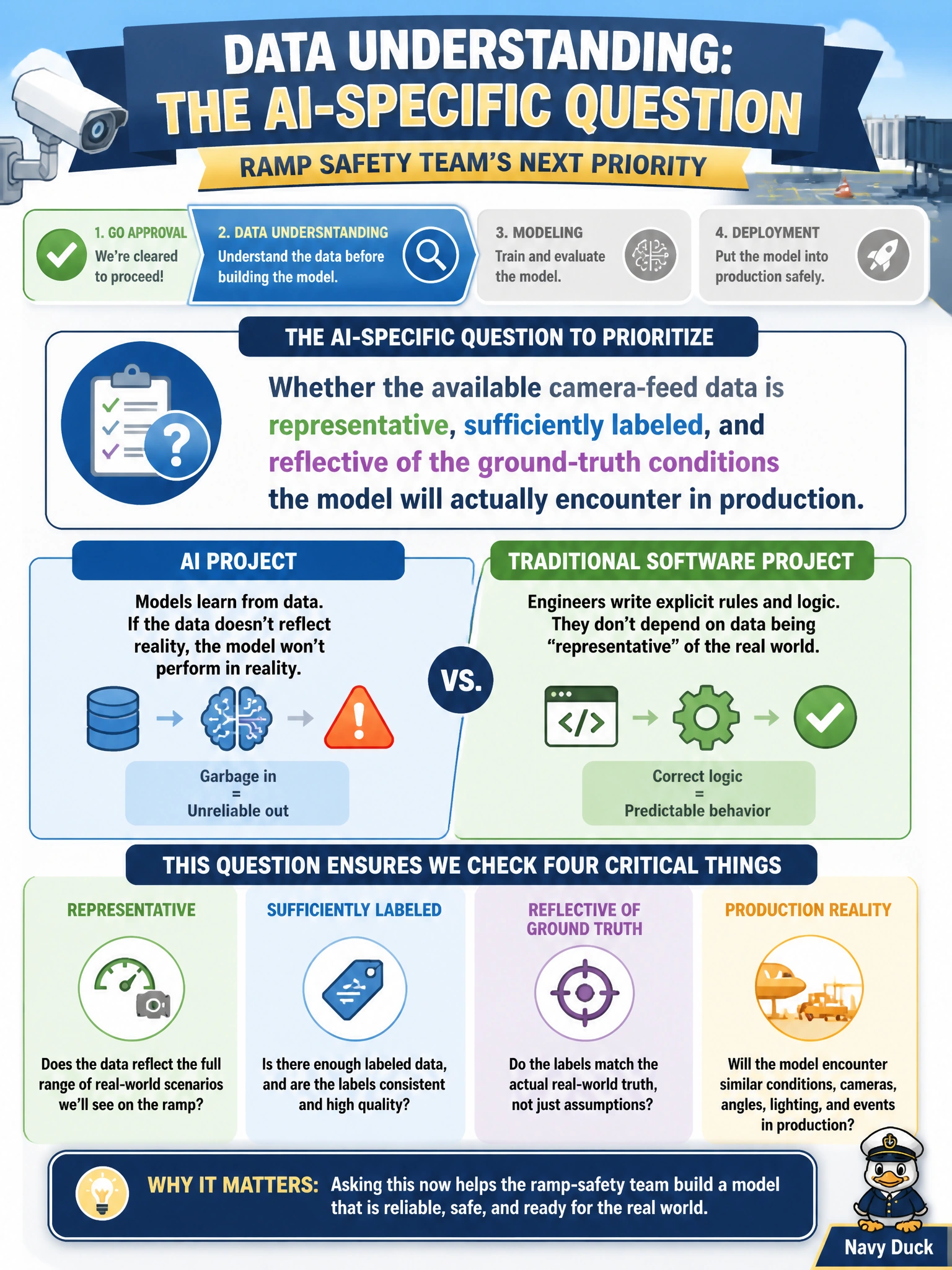
You're in Data Understanding, so you have to ask whether the camera-feed data is representative, sufficiently labeled, and reflective of the ground-truth conditions the model will actually encounter in production. Traditional software doesn't learn from data that way, so if the data is off, the model won't hold up on a rainy Tuesday ramp shift.
Full Explanation
Entering Data Understanding, the team's central task is addressing AI-specific aspects of data understanding—chiefly, whether the available camera-feed data is representative of real operating conditions, adequately and correctly labeled, and validated against ground truth, since these directly determine whether a model trained on it can generalize to production. This is a question a traditional software project simply doesn't need to ask, because traditional software doesn't learn behavior from data in the same way. The programming-language choice for the user interface, the dashboard color-scheme question, and the sprint staffing question are all legitimate project-management or engineering questions at some point, but none of them are unique to, or even particularly important for, an AI initiative specifically; they apply equally to any software project and don't touch the AI-specific risk this phase exists to manage. The camera-feed representativeness, labeling, and ground-truth question reflects the Domain II Task 3 enablers around identifying appropriate datasets, evaluating training-data requirements, and validating ground truth—the foundational work that determines whether the ramp-safety model built later in the lifecycle will actually be trustworthy once deployed.
Prefer to study offline? Printable PDF study book + test engine ($7.50, unofficial). These questions stay free here.