
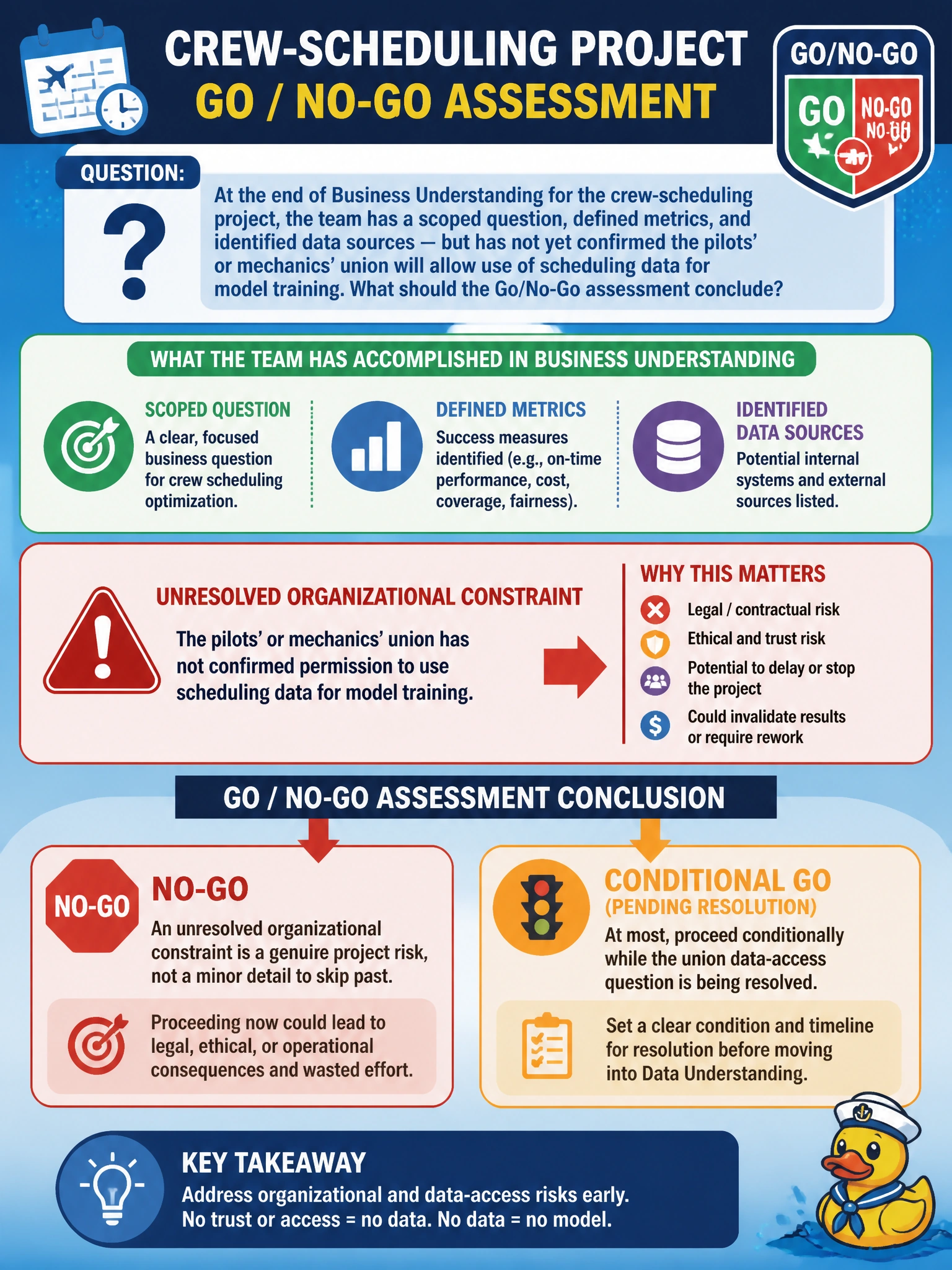
At the end of Business Understanding for the crew-scheduling project, the team has a scoped question, defined metrics, and identified data sources — but has not yet confirmed the pilots' or mechanics' union will allow use of scheduling data for model training. What should the Go/No-Go assessment conclude?
Select an answer to reveal the explanation.
Short Explanation
Great scoping doesn't matter if you can't legally or contractually get the data. An open union question about scheduling data isn't a footnote — it's exactly the kind of thing a Go/No-Go exists to catch before real money gets spent.
Full Explanation
Conducting AI Go/No-Go assessments is a core Business Understanding enabler, and a properly run assessment weighs organizational and data-access constraints, not just technical scoping completeness. Here, the unresolved question of whether the union will permit use of scheduling data for model training is a material risk to the entire premise of the project — if access is denied or restricted, the scoped approach may be unworkable. The appropriate conclusion is No-Go, or at best a conditional Go explicitly contingent on resolving that access question, rather than proceeding as if it were a formality. Option A treats only the technical scoping dimension as relevant and ignores a governance/access risk that could invalidate the whole plan. Option C defers a foundational, potentially project-blocking issue until far too late — Operationalization is the deployment phase, long after data would already need to have been used for training in earlier phases. Option D is incorrect on principle: sponsor enthusiasm does not substitute for a structured Go/No-Go review, which exists precisely to catch risks that enthusiasm alone would overlook.