
Before development begins on the fraud-detection model, the PM asks the business sponsor to define what "good enough" performance looks like. Why is establishing acceptable performance metrics during Business Understanding critical?
Select an answer to reveal the explanation.
Short Explanation
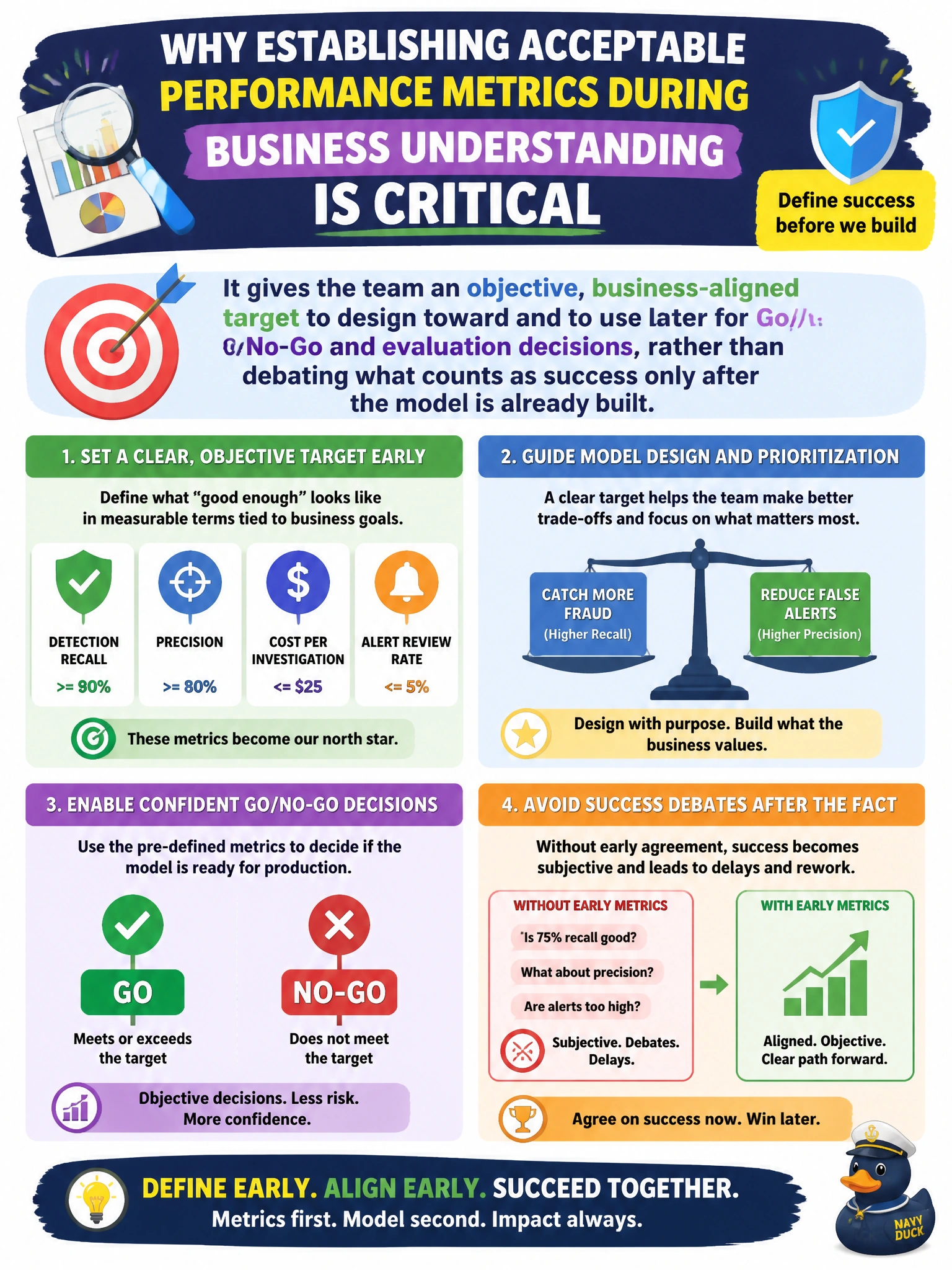
Decide what "good enough" means before you build, not after. Otherwise you're arguing about the finish line while standing on it, with a model already built and a sponsor who's suddenly unhappy.
Full Explanation
Establishing acceptable performance metrics is a distinct Business Understanding enabler, and its purpose is to give the team an objective, business-aligned target to build toward and to anchor later decisions — Go/No-Go checkpoints and model evaluation — against a standard the sponsor agreed to in advance, rather than an after-the-fact debate over whether the delivered model is 'good enough.' Defining this early prevents the scenario where a technically reasonable model is rejected late in the project simply because no shared definition of success ever existed. Option B understates the value of this practice; while metrics may support compliance reporting in some domains, their core purpose here is project management and stakeholder alignment, not regulatory formality. Option C is an unrealistic and incorrect claim — no performance-metric exercise guarantees perfect accuracy, and treating it as such misunderstands what metrics do. Option D directly contradicts CPMAI's emphasis on defining success criteria upfront; deciding metrics only after deployment removes the ability to make a meaningful Go/No-Go decision at all and invites exactly the stakeholder-expectation problems covered elsewhere in Domain II.