
A Meridian business analyst with strong spreadsheet and dashboarding skills wants to help with the demand-forecasting project but has no formal machine-learning training. How should the PM appropriately involve them?
Select an answer to reveal the explanation.
Short Explanation
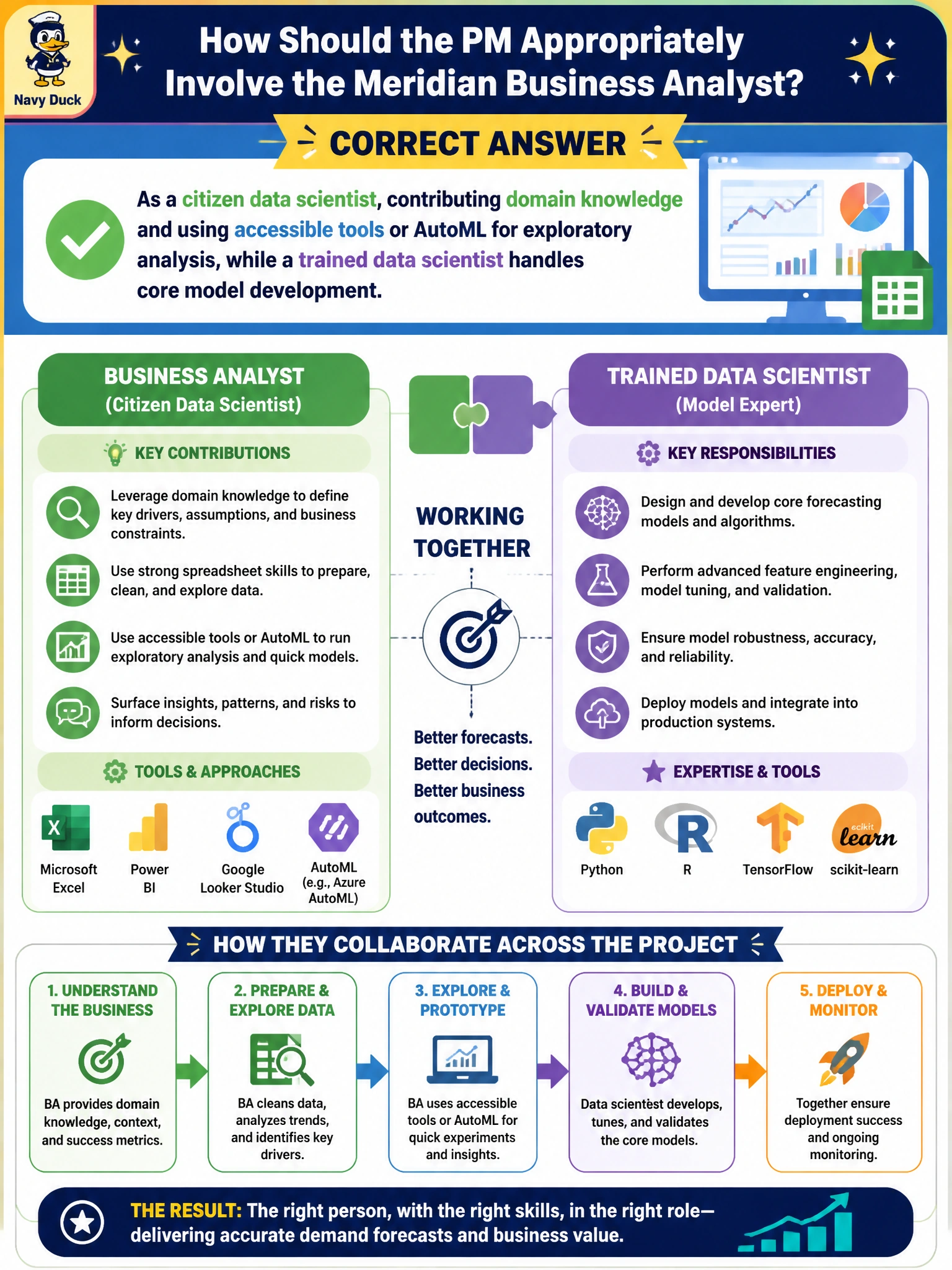
You don't need a PhD to contribute to an AI project — a citizen data scientist brings domain knowledge and can poke around with accessible tools, while the trained data scientist owns the harder model-development work.
Full Explanation
Distinguishing the roles of data scientists and citizen data scientists is an explicit Business Understanding enabler. A citizen data scientist is a role for someone with strong analytical skills and domain knowledge but without deep formal ML training — appropriately involved through accessible tools (dashboards, AutoML, exploratory analysis) that let them contribute meaningfully without being handed core model-development responsibilities that require deeper technical expertise. This scenario's business analyst fits that role well, and pairing them with a trained data scientist for core development gets the benefit of both domain familiarity and technical rigor. Option A assigns a task — neural-network architecture design — that requires exactly the formal ML training this analyst lacks, risking a poorly designed model. Option B wastes a genuinely useful contributor and ignores CPMAI's recognition of the citizen-data-scientist role as legitimate and valuable. Option C similarly misassigns a technically rigorous validation task to someone without the statistical background to perform it reliably. The correct answer matches the person's actual skill set to an appropriate, well-scoped contribution.