
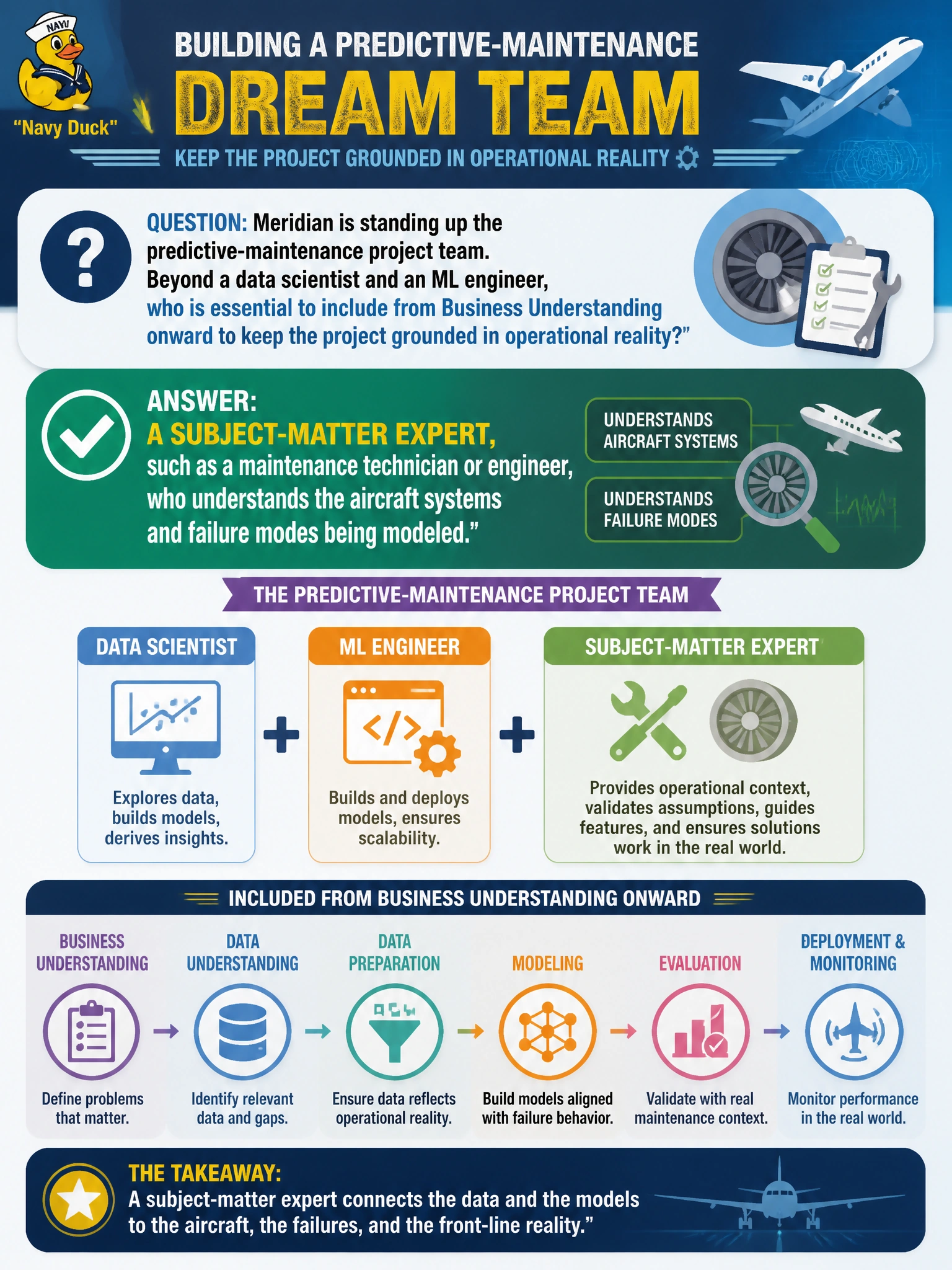
Meridian is standing up the predictive-maintenance project team. Beyond a data scientist and an ML engineer, who is essential to include from Business Understanding onward to keep the project grounded in operational reality?
Select an answer to reveal the explanation.
Short Explanation
A model can spot a pattern in sensor data. It can't tell you whether that pattern actually means anything mechanically — that's what the maintenance engineer is in the room for.
Full Explanation
Assembling appropriate AI project teams is a distinct Business Understanding enabler, and for a predictive-maintenance initiative, a subject-matter expert — a maintenance technician or engineer familiar with the actual aircraft systems and realistic failure modes — is essential alongside the technical roles. This expert grounds the business question, helps validate whether flagged patterns correspond to genuine mechanical issues, and prevents the model from optimizing for a statistically interesting but operationally meaningless signal. Option A excludes internal expertise entirely in favor of outside consultants, which sacrifices exactly the domain grounding this scenario calls for and is not a sound staffing principle on its own. Option B is a non sequitur; marketing has no relevant role in a predictive-maintenance initiative's core team. Option D is directly contradicted by CPMAI's emphasis on cross-functional teams — technical skill alone, without domain expertise, is a recognized project-failure risk factor because the team may build something technically sound but operationally irrelevant. The correct team composition pairs technical and domain expertise from the start.