
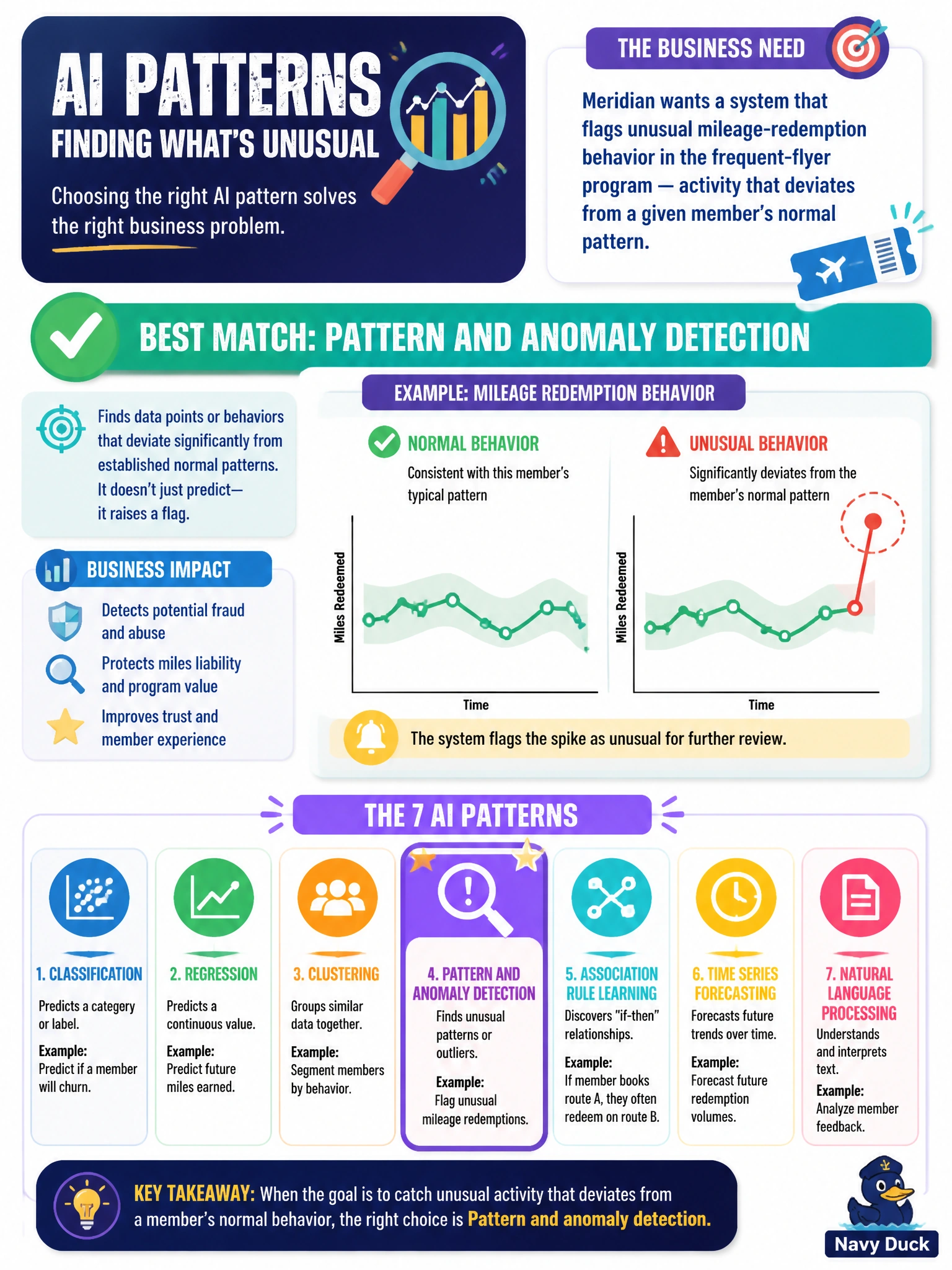
Meridian wants a system that flags unusual mileage-redemption behavior in the frequent-flyer program — activity that deviates from a given member's normal pattern. Which of the seven AI patterns best matches this business need?
Select an answer to reveal the explanation.
Short Explanation
Flagging behavior that deviates from someone's normal pattern is the textbook definition of anomaly detection — not a chatbot, not a recommendation engine, just "this doesn't look like this person."
Full Explanation
Matching business needs to the seven patterns of AI is an explicit Business Understanding enabler, and detecting mileage-redemption behavior that deviates from a member's established norm is a direct fit for the pattern and anomaly detection pattern — the system learns what 'normal' looks like for an account and flags meaningful deviations, which is exactly how fraud and anomaly-detection systems are framed within CPMAI's pattern taxonomy. Option A, the conversational pattern, covers natural-language interaction such as chatbots (like Meridian's rebooking assistant) and doesn't fit a behind-the-scenes fraud-monitoring capability with no user-facing dialogue. Option C, goal-driven systems, involves an AI working toward a defined objective through planning or optimization (closer to crew-scheduling optimization), not flagging deviations from an established pattern. Option D, hyper-personalization, is about tailoring content or offers to an individual's preferences and behavior, which is a related but distinct use case from detecting anomalous behavior — a loyalty-offers recommendation engine would be hyper-personalization, while this fraud-flagging capability is anomaly detection. Correctly mapping business needs to the right pattern early prevents the team from designing the wrong kind of system.