
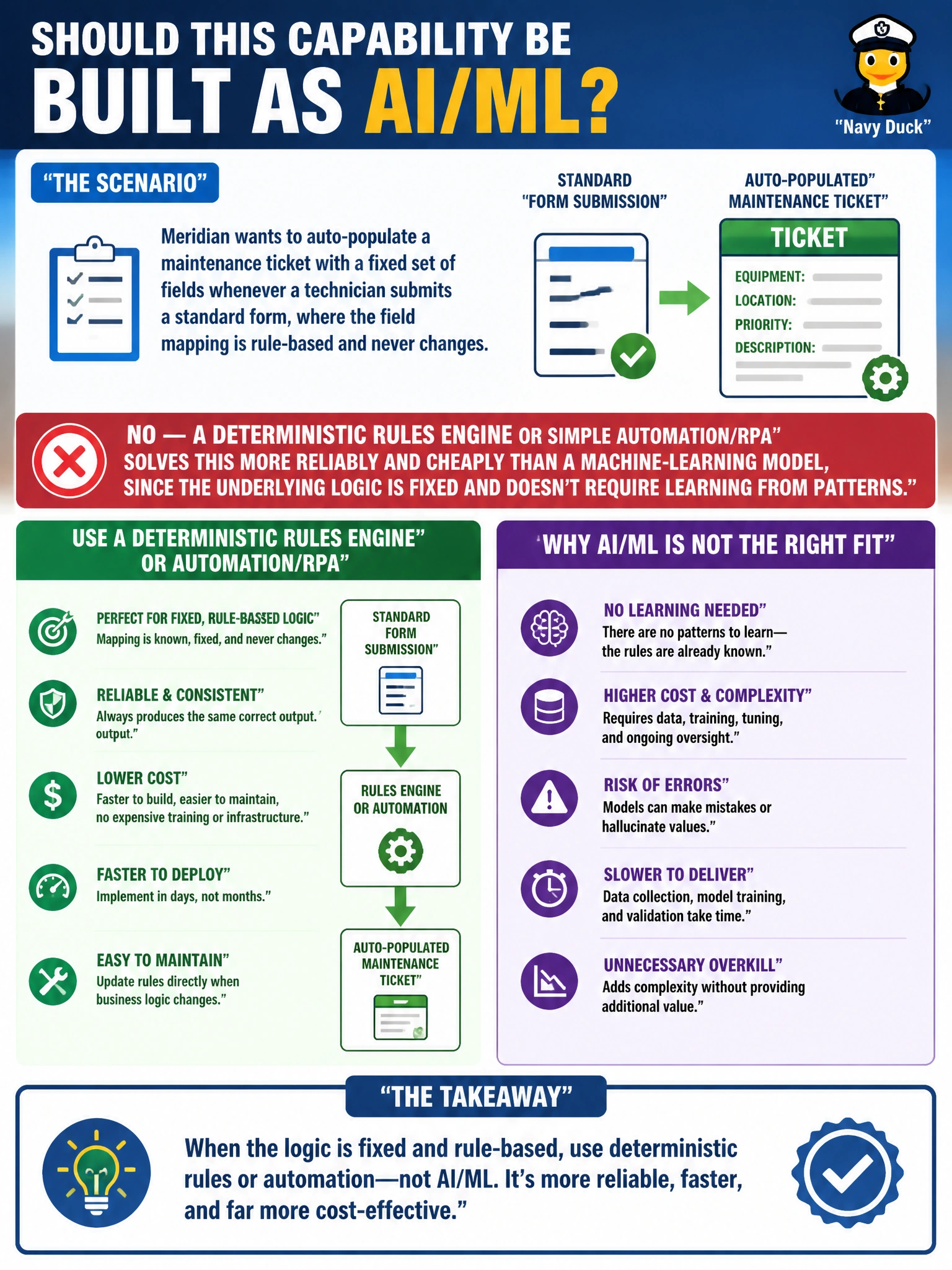
Meridian wants to auto-populate a maintenance ticket with a fixed set of fields whenever a technician submits a standard form, where the field mapping is rule-based and never changes. Should this capability be built as an AI/ML solution?
Select an answer to reveal the explanation.
Short Explanation
If the mapping never changes, there's nothing to "learn." That's what RPA is for — fixed rules, fast and cheap. Save the machine learning for problems that actually vary.
Full Explanation
Determining when to implement automation versus AI is a distinct Business Understanding enabler, and this scenario is a clean case for automation over machine learning: the field-mapping logic is fixed and rule-based, with no pattern variability for a model to learn from. A deterministic rules engine or RPA bot handles this task more reliably, more cheaply, and with fully predictable behavior than an ML model would, and avoids the ongoing overhead of monitoring for model drift on a task that fundamentally has none. Option B applies unnecessary AI complexity to a problem that doesn't call for it — a common and costly overuse of machine learning where simple automation is the better engineering choice. Option C misunderstands the situation entirely; there is no ML output here needing a data scientist's certification, since no model or probabilistic judgment is involved. Option D is simply incorrect — the task is highly automatable, just not through AI/ML. This enabler tests the judgment to recognize when the 'AI' answer is actually the wrong answer for a genuinely deterministic task.