
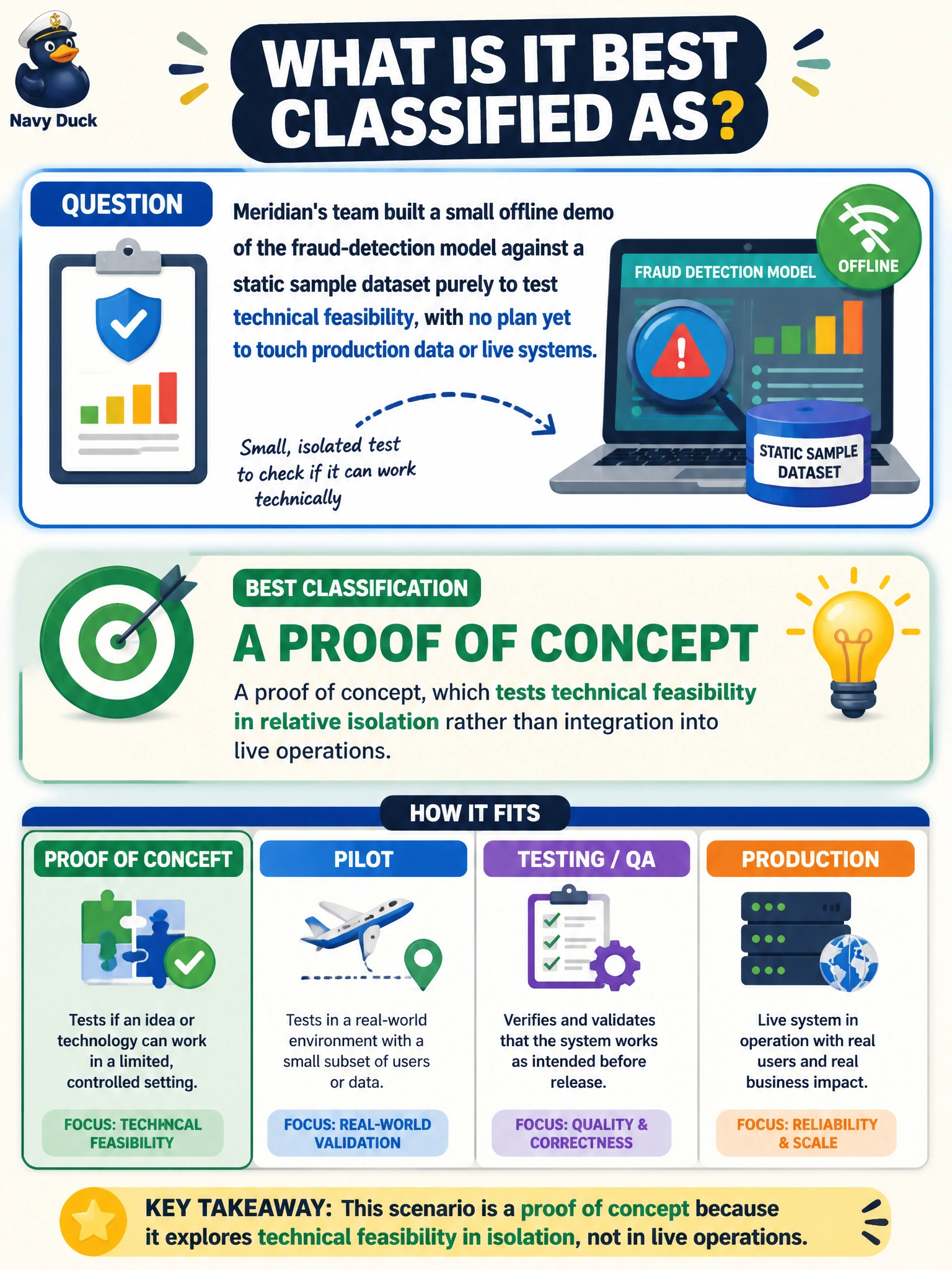
Meridian's team built a small offline demo of the fraud-detection model against a static sample dataset purely to test technical feasibility, with no plan yet to touch production data or live systems. What is this best classified as?
Select an answer to reveal the explanation.
Short Explanation
A pilot touches the real system on a small scale. A POC doesn't touch the real system at all — it just proves the idea can technically work off to the side. This one's a POC.
Full Explanation
Differentiating between pilots and proofs of concept is an explicit CPMAI Business Understanding enabler. A proof of concept is characterized by testing technical feasibility in isolation — using a static sample dataset, with no integration into live production systems or operational processes — which matches this scenario exactly. A pilot, by contrast, involves a smaller-scale but real integration into live operations, typically with real-time or near-real-time data and actual users, to validate not just technical feasibility but operational fit. Option B is the closest distractor and the one candidates most often get wrong: using real historical fraud data does not make something a pilot if it isn't integrated into live systems or workflows — the defining line is production integration, not data realism. Option C is clearly premature; nothing here has touched production. Option D confuses a project-management checkpoint (Go/No-Go) with a type of validation activity (POC vs. pilot); these are different concepts entirely. Getting this distinction right matters because POC success alone should never justify skipping straight to full production, as covered in the earlier POC-pitfalls enabler.