
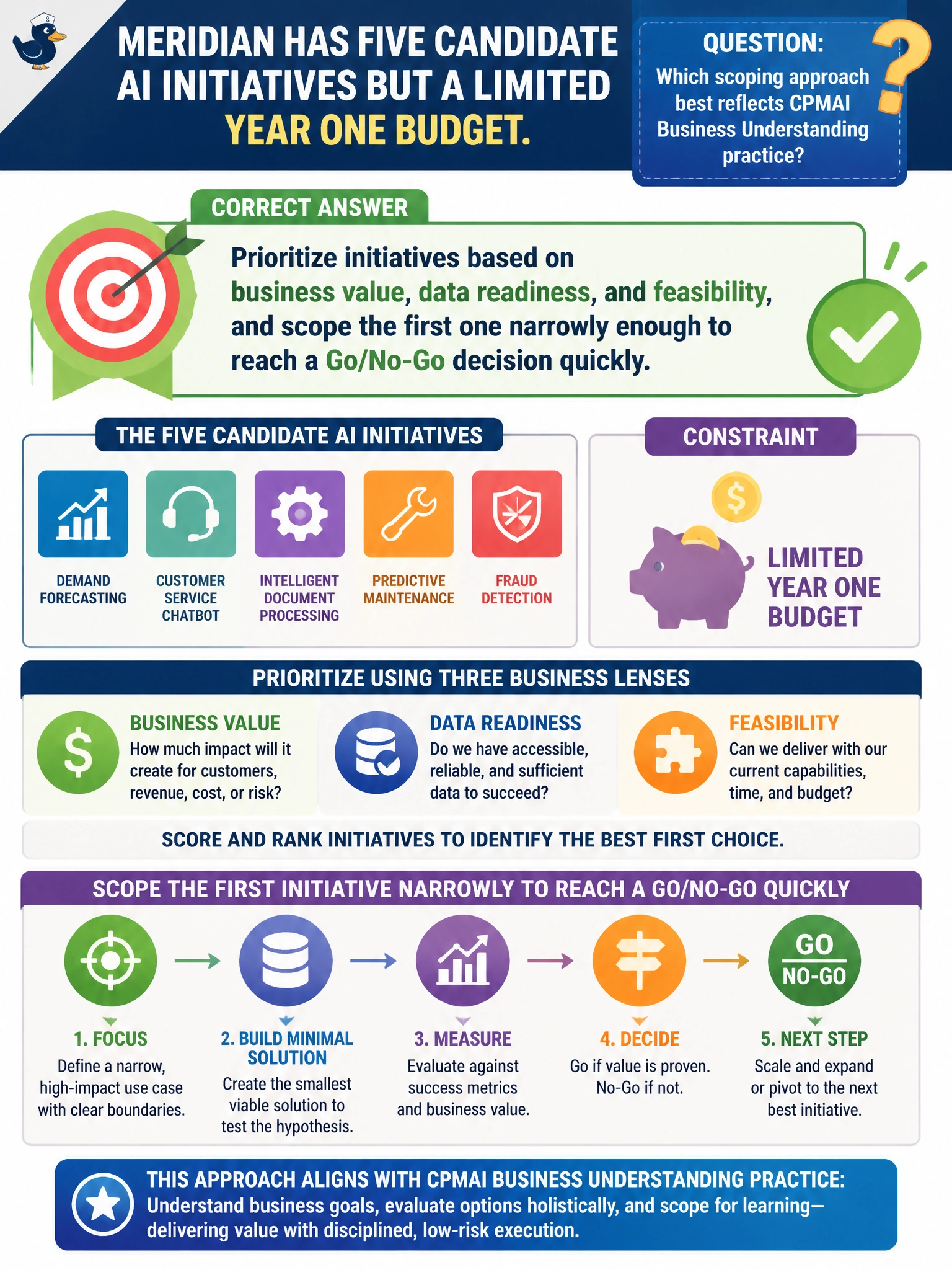
Meridian has five candidate AI initiatives but a limited Year One budget. Which scoping approach best reflects CPMAI Business Understanding practice?
Select an answer to reveal the explanation.
Short Explanation
Five ideas, one budget: don't chase the loudest voice or the biggest discount. Rank them on value, data readiness, and feasibility, then scope the winner tight enough to get to a real decision fast.
Full Explanation
Prioritizing and scoping AI projects effectively is an explicit CPMAI Business Understanding enabler, and the correct approach weighs business value, data readiness, and feasibility together, then deliberately narrows the scope of the selected initiative so the team can reach a Go/No-Go decision quickly rather than committing broadly on a hunch. This protects the Year One budget by validating one well-chosen initiative before expanding further. Option A substitutes organizational politics or recency bias for an actual prioritization framework, which is a poor basis for committing limited capital. Option B ignores the resource constraint entirely and spreads the budget so thin that no initiative is likely to be properly scoped, staffed, or validated — a recipe for five weak pilots instead of one strong one. Option C lets vendor pricing dictate initiative selection rather than the initiative's actual fit to Meridian's business needs and data situation, inverting the correct decision order. Sound Business Understanding scoping evaluates the initiatives on their own merits first, and budget/vendor factors follow that assessment, not the other way around.