
Comparing two candidate Meridian projects — a chatbot that can reuse an existing pretrained language model, versus a from-scratch predictive-maintenance model requiring months of sensor-data labeling — what should the PM expect regarding time-to-ROI?
Select an answer to reveal the explanation.
Short Explanation
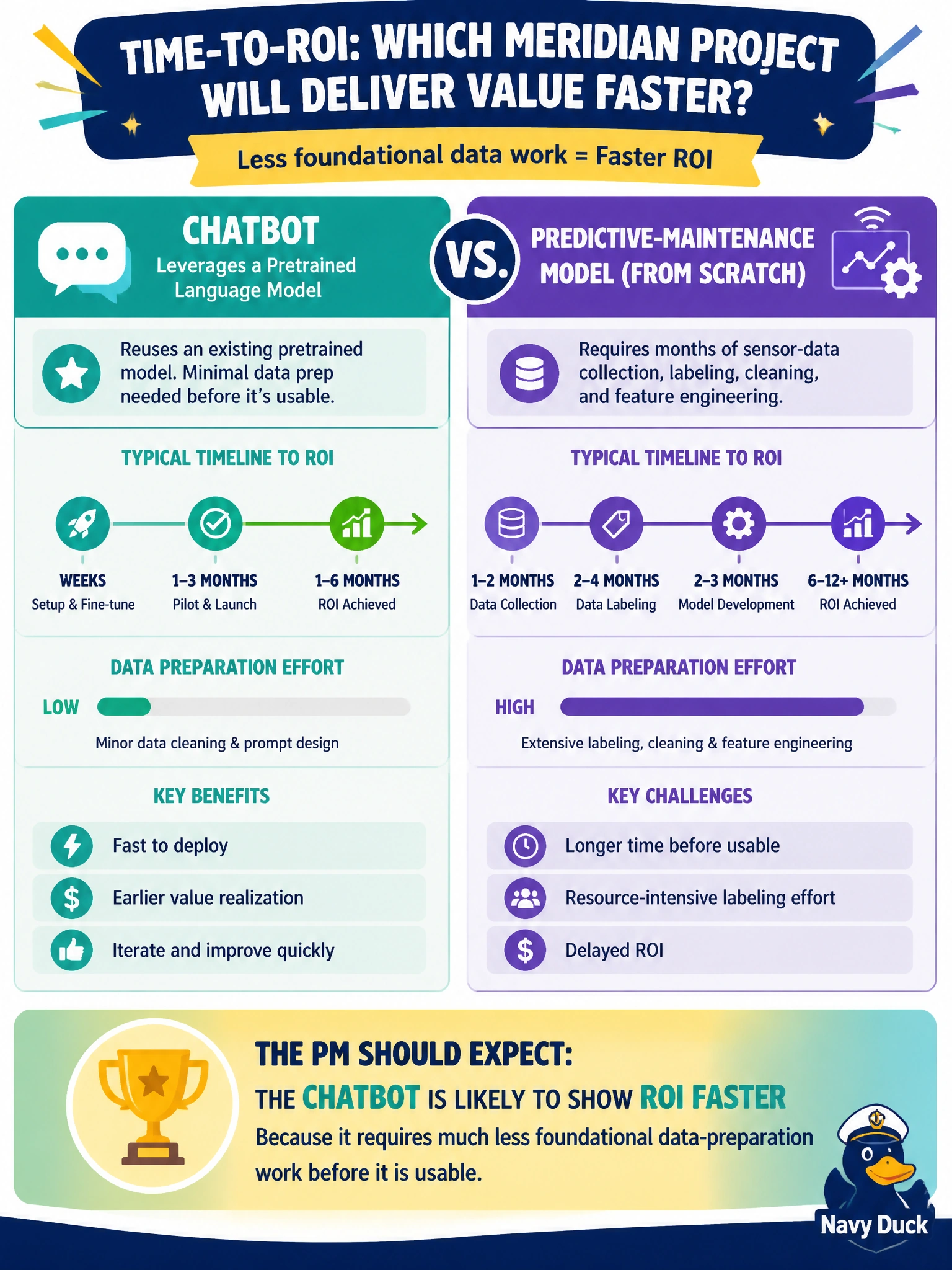
Not all AI projects race at the same speed. A chatbot that reuses a pretrained model can skip most of the slow, expensive data-labeling grind — a from-scratch sensor model can't. That gap shows up directly in time-to-ROI.
Full Explanation
Estimating time-to-ROI for various AI project types is an explicit Business Understanding enabler, and the key factor differentiating these two projects is how much foundational data work each requires before it can deliver value. The chatbot can leverage an existing pretrained language model, meaning much of the heavy data and training investment has already been made elsewhere; Meridian primarily needs to adapt and integrate it. The predictive-maintenance model, by contrast, requires months of sensor-data labeling from scratch before any meaningful model training can even begin, pushing its ROI timeline out considerably further. Option A ignores this real and significant difference and treats 'AI project' as a single undifferentiated category, which is exactly the kind of oversimplified planning CPMAI's ROI-estimation enabler is meant to correct. Option C asserts an unfounded and incorrect generalization about data type and speed — sensor data being numeric doesn't make it faster to prepare, especially when large-scale labeling is required. Option D is an overcorrection; time-to-ROI can and should be estimated, even if imprecisely, using factors like data readiness and reuse of pretrained components.