
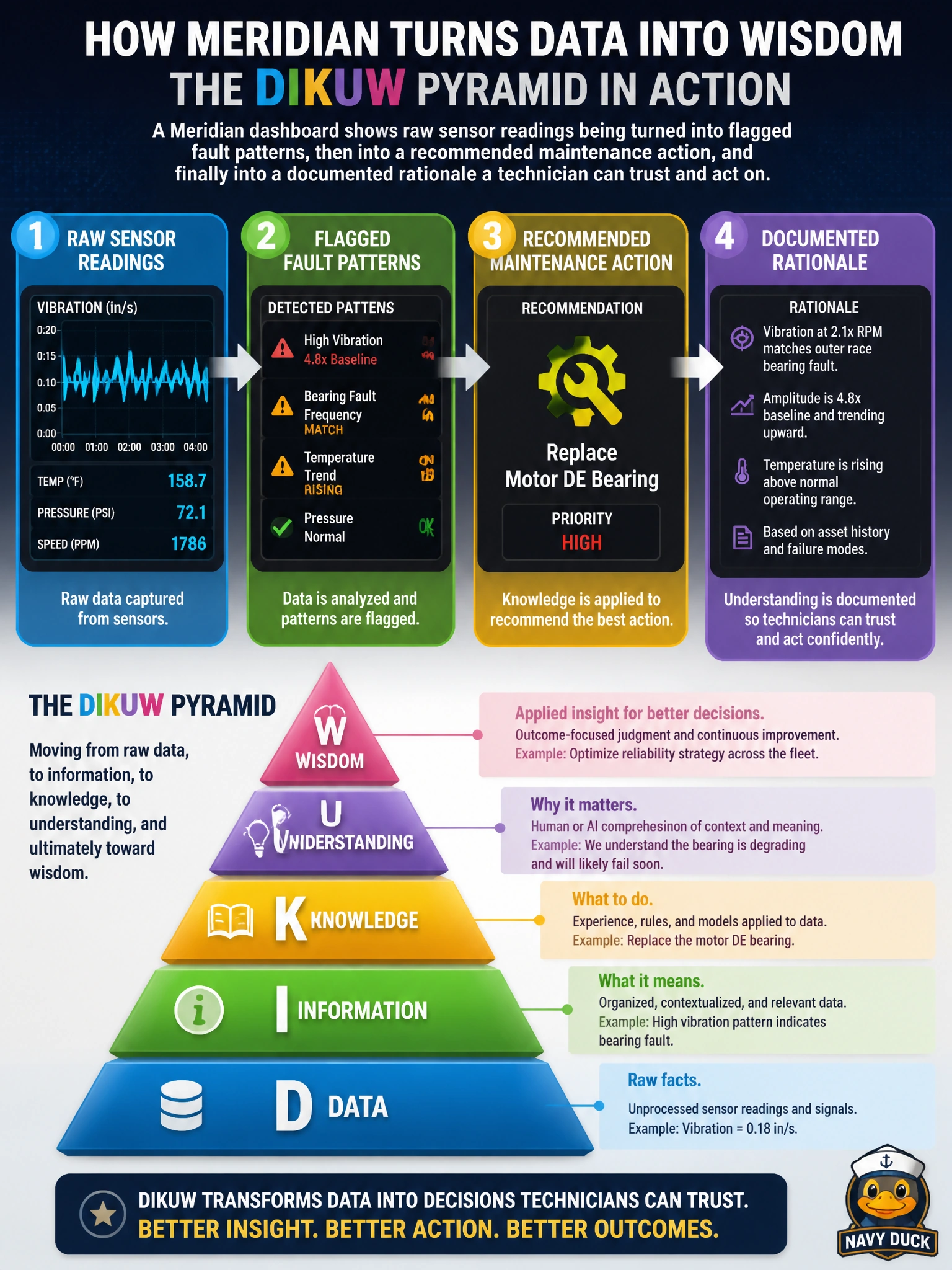
A Meridian dashboard shows raw sensor readings being turned into flagged fault patterns, then into a recommended maintenance action, and finally into a documented rationale a technician can trust and act on. Which CPMAI concept describes this progression?
Select an answer to reveal the explanation.
Short Explanation
Raw numbers become a flagged pattern, the pattern becomes a recommendation, the recommendation becomes something a technician actually trusts — that climb is the DIKUW pyramid in one dashboard.
Full Explanation
The DIKUW pyramid (data, information, knowledge, understanding, wisdom) is a Business Understanding tool for framing how raw inputs get progressively transformed into decision-quality output, and this scenario walks exactly that progression: raw sensor readings (data) become flagged fault patterns (information), which become a recommended action (knowledge), and finally a documented, trustworthy rationale a technician can act on (moving toward understanding/wisdom). Recognizing where a given AI capability sits on this pyramid helps the PM scope what the system actually needs to deliver versus what would be a stretch goal. Option A, the seven patterns of AI, categorizes types of AI capability (conversational, predictive, recognition, etc.) rather than describing a data-to-decision maturation process, so it doesn't fit this scenario. Option B, a Go/No-Go assessment, is a phase-end checkpoint decision, not a framework for describing incremental value creation from data. Option D, data drift, describes a production-monitoring concern about a model's input distribution changing over time, unrelated to this scenario about dashboard output maturation. The DIKUW pyramid is the correct fit.