
A new PM at Meridian asks why the team should adopt CPMAI specifically, rather than continuing to run AI initiatives under the airline's existing generic enterprise project framework. What is the best answer?
Select an answer to reveal the explanation.
Short Explanation
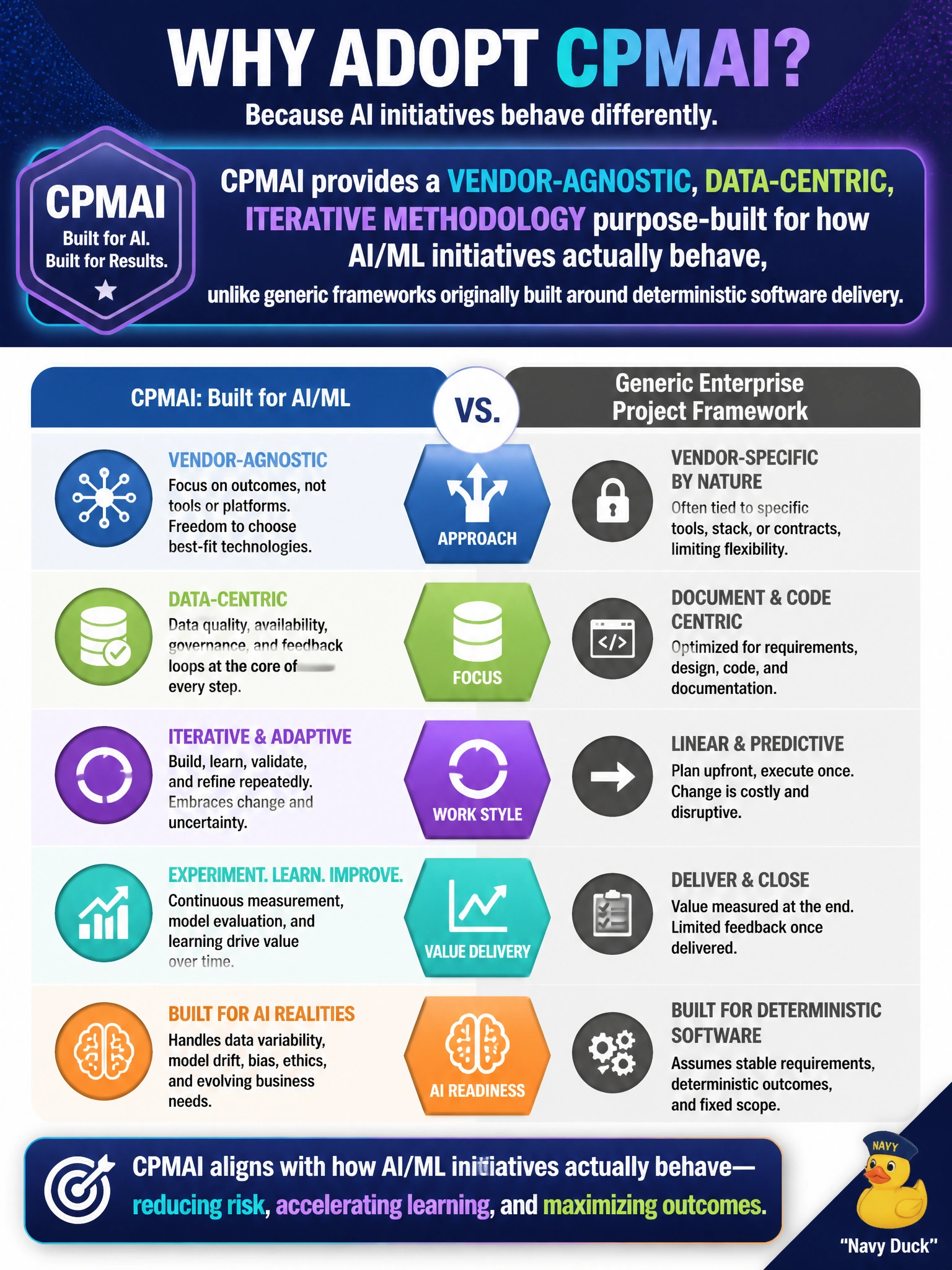
Generic PM frameworks were built for software that behaves predictably once you spec it. CPMAI exists because AI doesn't behave that way — it's built for a world where the data drives the outcome, not just the design doc.
Full Explanation
This question tests the general enabler of applying the CPMAI framework to AI initiatives, and the correct answer captures its actual value proposition: CPMAI is explicitly vendor-agnostic, data-centric, and iterative, designed around the realities of AI/ML/cognitive-technology projects — such as data-dependent outcomes, the need to revisit earlier phases, and Go/No-Go checkpoints tied to data and model readiness — that a generic enterprise framework built for deterministic software delivery does not natively address. Option A is false and actually inverts CPMAI's emphasis; stakeholder management (expectation-setting, team assembly, sponsor engagement) is woven throughout the methodology, not eliminated by it. Option B overstates what any methodology can promise — no framework, including CPMAI, guarantees success; it improves the odds by structuring decision points and reducing common failure patterns. Option C is an unsupported and incorrect regulatory claim; CPMAI is not an FAA-mandated framework. The correct answer is the only one grounded in what CPMAI actually is and why it exists as a distinct methodology.