
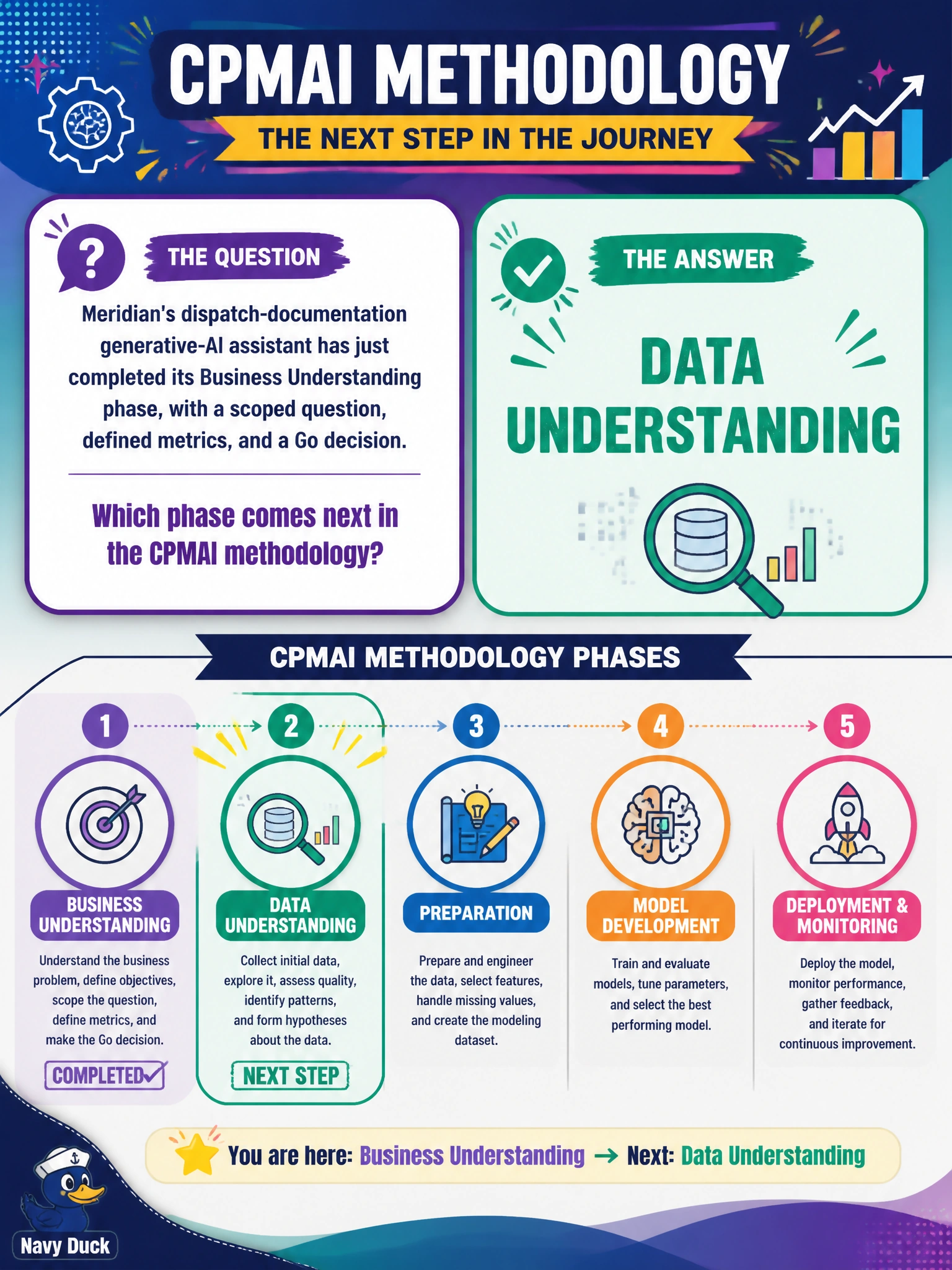
Meridian's dispatch-documentation generative-AI assistant has just completed its Business Understanding phase, with a scoped question, defined metrics, and a Go decision. Which phase comes next in the CPMAI methodology?
Select an answer to reveal the explanation.
Short Explanation
Business Understanding hands off to Data Understanding — you know what question you're asking, now you have to go find out what your data can actually tell you before touching a model.
Full Explanation
The six CPMAI phases proceed in a fixed order: Business Understanding, Data Understanding, Data Preparation, Model Development, Model Evaluation, and Operationalization. Having just completed Business Understanding — scoping the question, setting metrics, and clearing a Go/No-Go checkpoint — the next phase is Data Understanding, where the team identifies appropriate datasets, evaluates training-data requirements, and validates ground truth before any data preparation or modeling work begins. Option B (Model Development) skips two full phases (Data Understanding and Data Preparation) and represents exactly the kind of phase-skipping the intake material calls 'wrong by construction' absent a stated iteration reason. Option C (Operationalization) is the final phase of the lifecycle and is nowhere near next. Option D (Model Evaluation) comes after Model Development, not immediately after Business Understanding. Knowing this fixed sequence — and that skipping ahead without justification is a methodology violation — is foundational to nearly every other Domain II question, since Go/No-Go assessments, phase-specific tasks, and iteration decisions all depend on knowing where in the six-phase order a project currently sits.