
Meridian's PMO wants to reuse its standard enterprise waterfall software-delivery template, unmodified, for the loyalty-program fraud-detection project. What is the key adaptation the PM needs to make for this data-centric AI project?
Select an answer to reveal the explanation.
Short Explanation
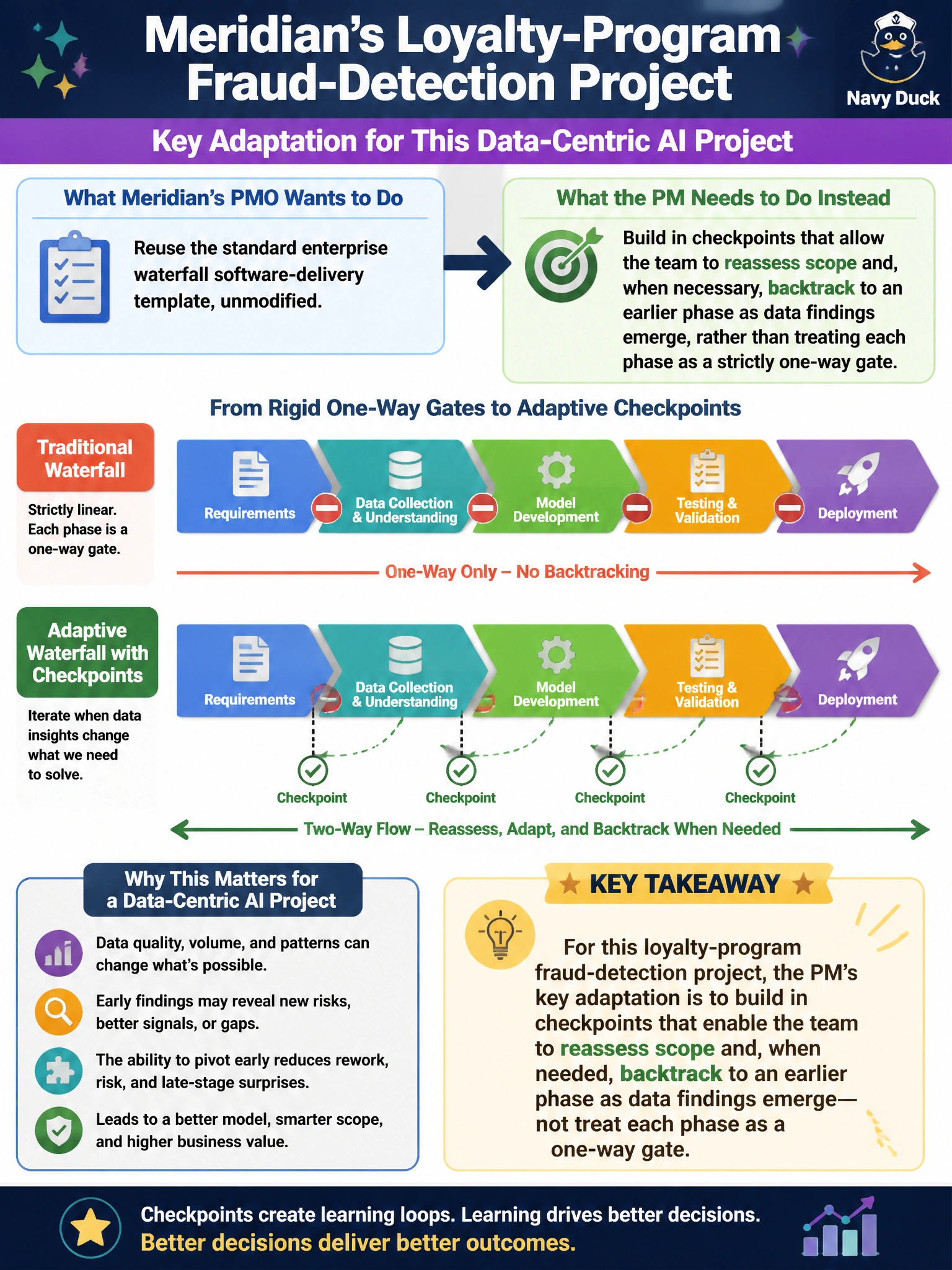
The fix isn't ripping up the whole template — it's adding a way back. Let the team return to an earlier phase when the data says something the plan didn't expect, instead of forcing them to power through on a stale assumption.
Full Explanation
Adapting traditional methodologies for data-centric projects is an explicit CPMAI Task 1 enabler, and the key adaptation is structural: build checkpoints into the plan that permit revisiting and adjusting earlier-phase decisions (such as scope, or even the business question itself) as Data Understanding or Data Preparation reveal new information, rather than treating each phase as an irreversible gate the way a traditional waterfall template typically does. This preserves the discipline and governance value of the PMO's template while accommodating the empirical uncertainty inherent to AI work. Option A and B both propose removing legitimate project controls (documentation and stakeholder sign-off) that have nothing to do with the actual mismatch between waterfall assumptions and data-centric uncertainty — cutting them doesn't fix the core problem and introduces new risk. Option D targets the wrong lever; eliminating testing phases increases risk rather than addressing the sequencing rigidity that is the real issue. The correct adaptation keeps governance intact while making the phase structure iterative where the data genuinely demands it.