
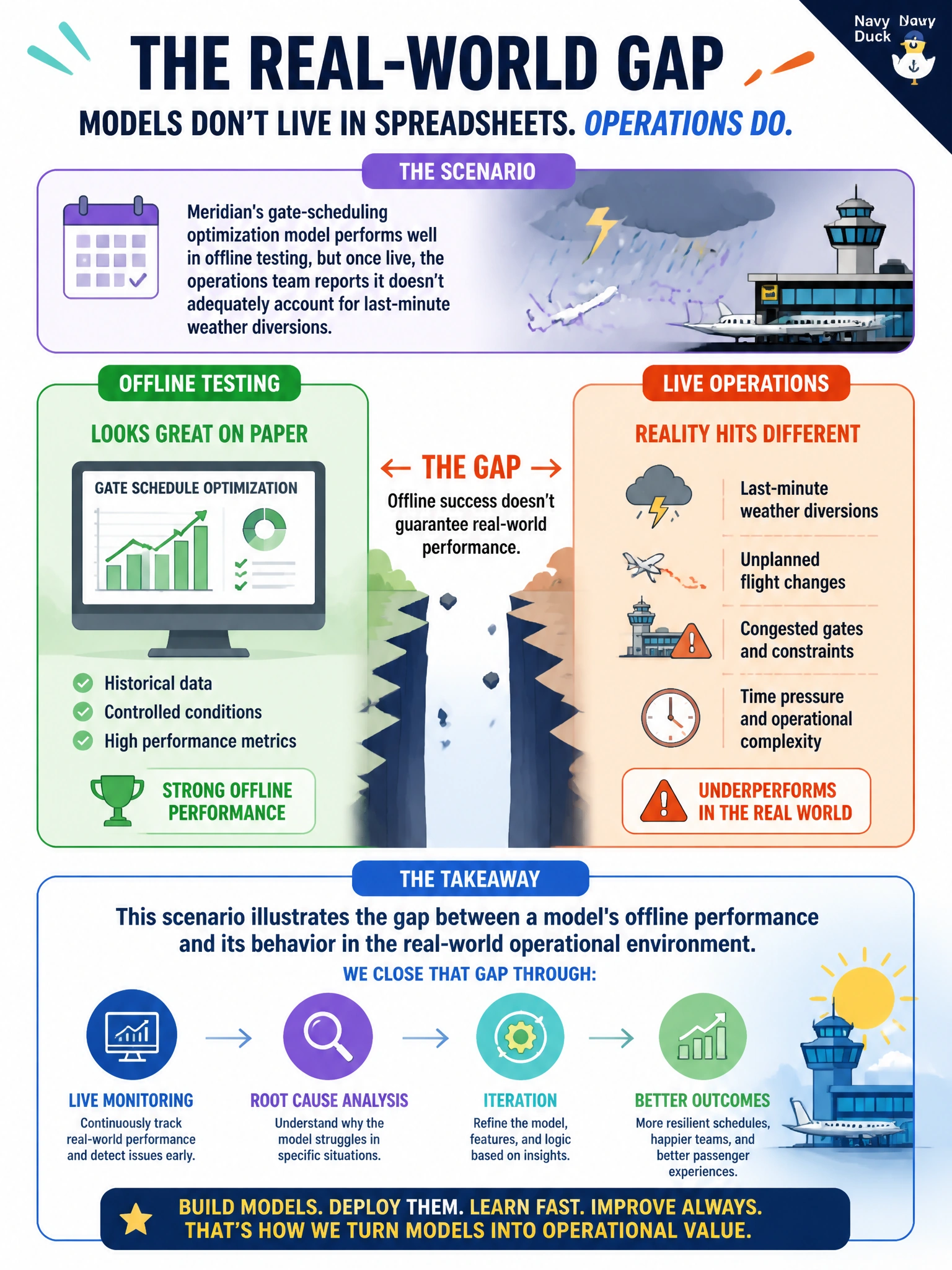
Meridian's gate-scheduling optimization model performs well in offline testing, but once live, the operations team reports it doesn't adequately account for last-minute weather diversions. What does this scenario illustrate?
Select an answer to reveal the explanation.
Short Explanation
Offline test sets are quiet and orderly. The real ramp isn't — weather diverts flights the historical data never fully captured. That mismatch is the model-to-production gap, and it's a normal thing to plan for, not a reason to panic.
Full Explanation
This scenario is a textbook illustration of the gap between a model's validated offline performance and its behavior once deployed into the messier, dynamic real-world environment — here, weather-driven disruptions that the offline test set didn't fully represent. Managing this gap is an explicit CPMAI Task 1 enabler precisely because offline metrics are necessary but not sufficient evidence of production readiness. The correct response is ongoing live monitoring, feedback collection, and model iteration to close that gap, not to declare the model broken or the users at fault. Option A misattributes the issue to insufficient training when the real problem is a mismatch between training/test conditions and live operating conditions — more epochs on the same unrepresentative data won't fix that. Option C blames the operations team for a modeling gap that isn't a training or usage issue. Option D is an overreaction; a production gap of this kind is expected and manageable through iteration, not grounds for abandoning the project outright. This is exactly why CPMAI frames AI project delivery as continuous rather than a single one-time cutover.