
After the customer-service chatbot launches, a Meridian stakeholder asks when the project will be "finished" so the team can be reassigned elsewhere. Consistent with CPMAI's view of AI project lifecycles, how should the PM respond?
Select an answer to reveal the explanation.
Short Explanation
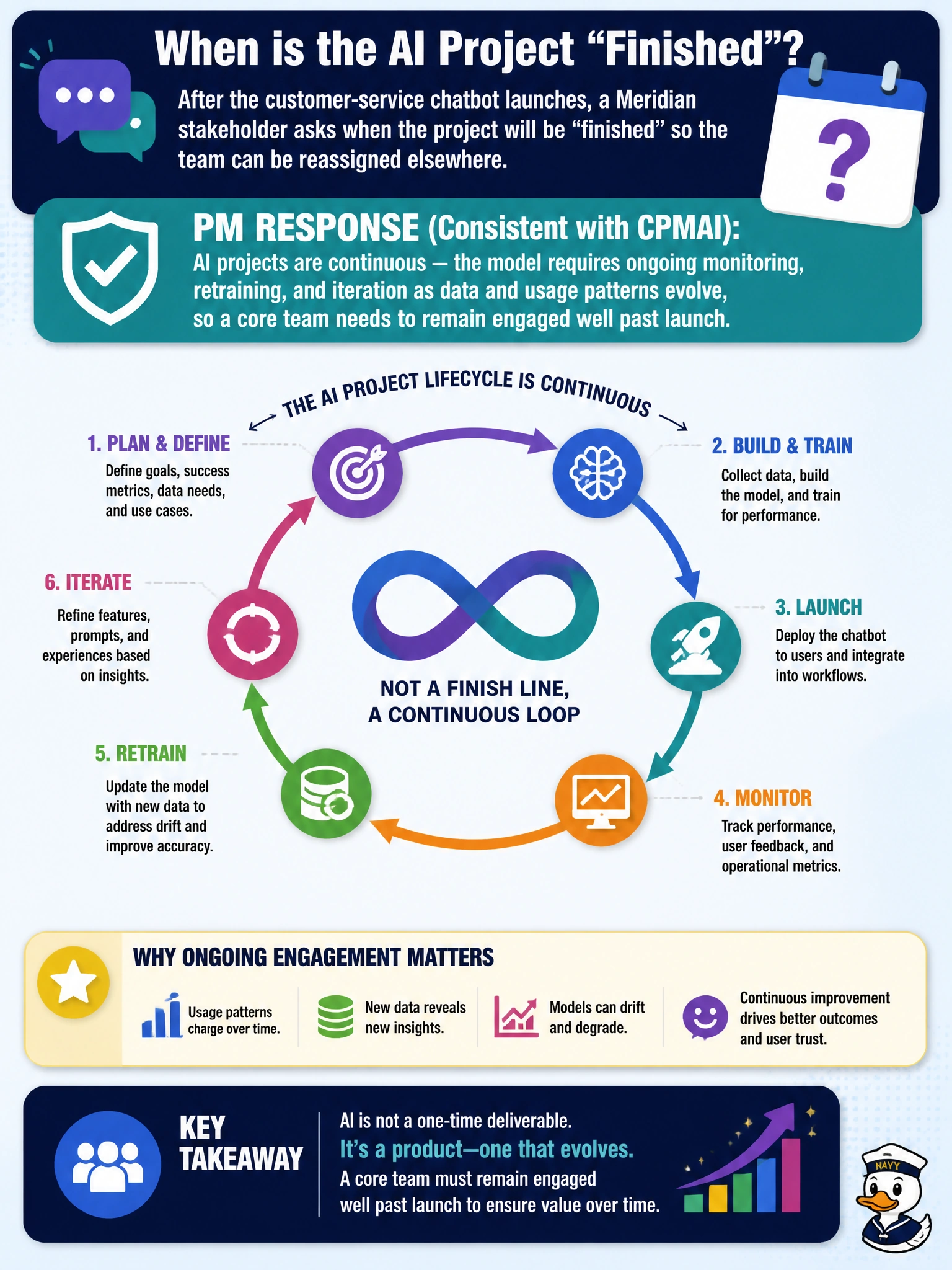
AI projects don't have a finish line the way a website launch does. The model keeps meeting new passengers, new phrasing, new edge cases — someone has to keep watching it, or it quietly gets worse.
Full Explanation
CPMAI treats AI initiatives as continuous lifecycles rather than one-time deliveries, because a deployed model's performance can degrade over time as real-world data drifts away from what it was trained on, and because usage patterns and business needs keep evolving. The PM's job is to set that expectation clearly at (or before) launch: go-live is a milestone, not a finish line, and a smaller ongoing team is needed for monitoring, periodic retraining, and iteration. Option A applies a traditional-software mental model that doesn't fit AI initiatives and sets up the stakeholder for a nasty surprise when performance eventually degrades without maintenance. Option B is an unwarranted and disruptive overreaction with no stated justification for a full rewrite. Option D imposes an arbitrary fixed rebuild cadence untethered to actual performance signals like data drift or model drift, which is not how CPMAI recommends managing production models. Recognizing this continuous-lifecycle principle is central to Task 1's enabler on implementing continuous AI project lifecycles, and it also foreshadows the Model Evaluation and Operationalization phases later in the methodology.