
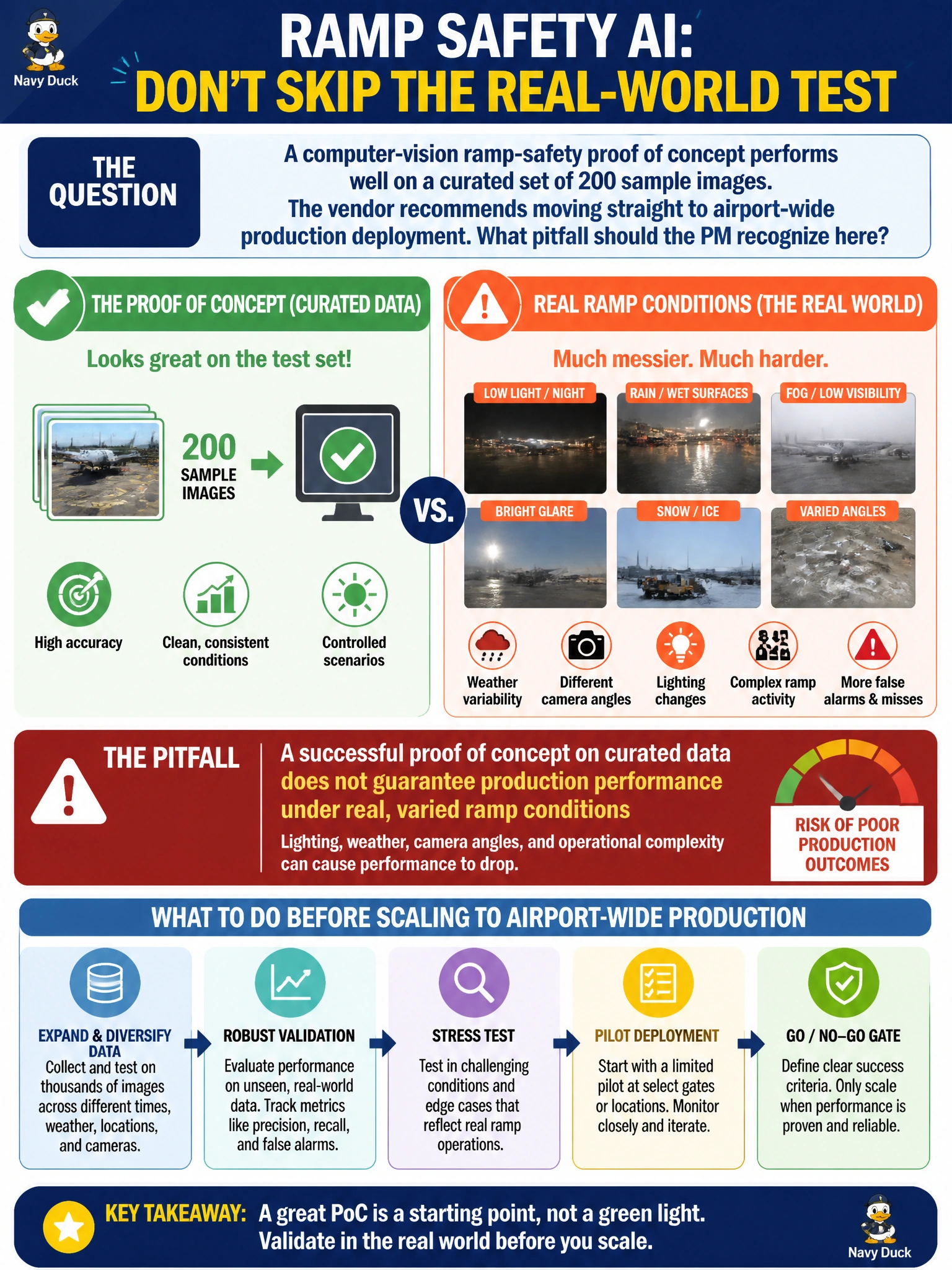
A computer-vision ramp-safety proof of concept performs well on a curated set of 200 sample images. The vendor recommends moving straight to airport-wide production deployment. What pitfall should the PM recognize here?
Select an answer to reveal the explanation.
Short Explanation
A POC proves the idea can work in a controlled lab, not that it will survive a rainy ramp at 5am with glare on the camera lens. That gap is exactly what a pilot, not a full rollout, is for.
Full Explanation
One of the most common proof-of-concept pitfalls is mistaking success on a small, curated dataset for readiness to scale into full production. The 200 sample images were likely selected or filtered in ways that don't represent the full diversity of real ramp conditions — lighting changes, precipitation, varied camera placement, unusual object types — so strong POC results say relatively little about production-grade reliability. The correct response is to insist on broader validation, likely via a pilot on a wider but still bounded dataset, before committing to airport-wide rollout. Option B is a meaningless test — repeating the same 200 images only confirms determinism, not generalization, and tells the team nothing new. Option C is the vendor-hype trap itself, stated as if it were sound practice; CPMAI explicitly calls out POC-to-production overconfidence as a named failure pattern. Option D is irrelevant to the technical/methodological question being asked. This scenario tests the Domain II Task 1 enabler on recognizing POC limitations and pitfalls, a theme that recurs across CPMAI's whole approach to phased validation.