
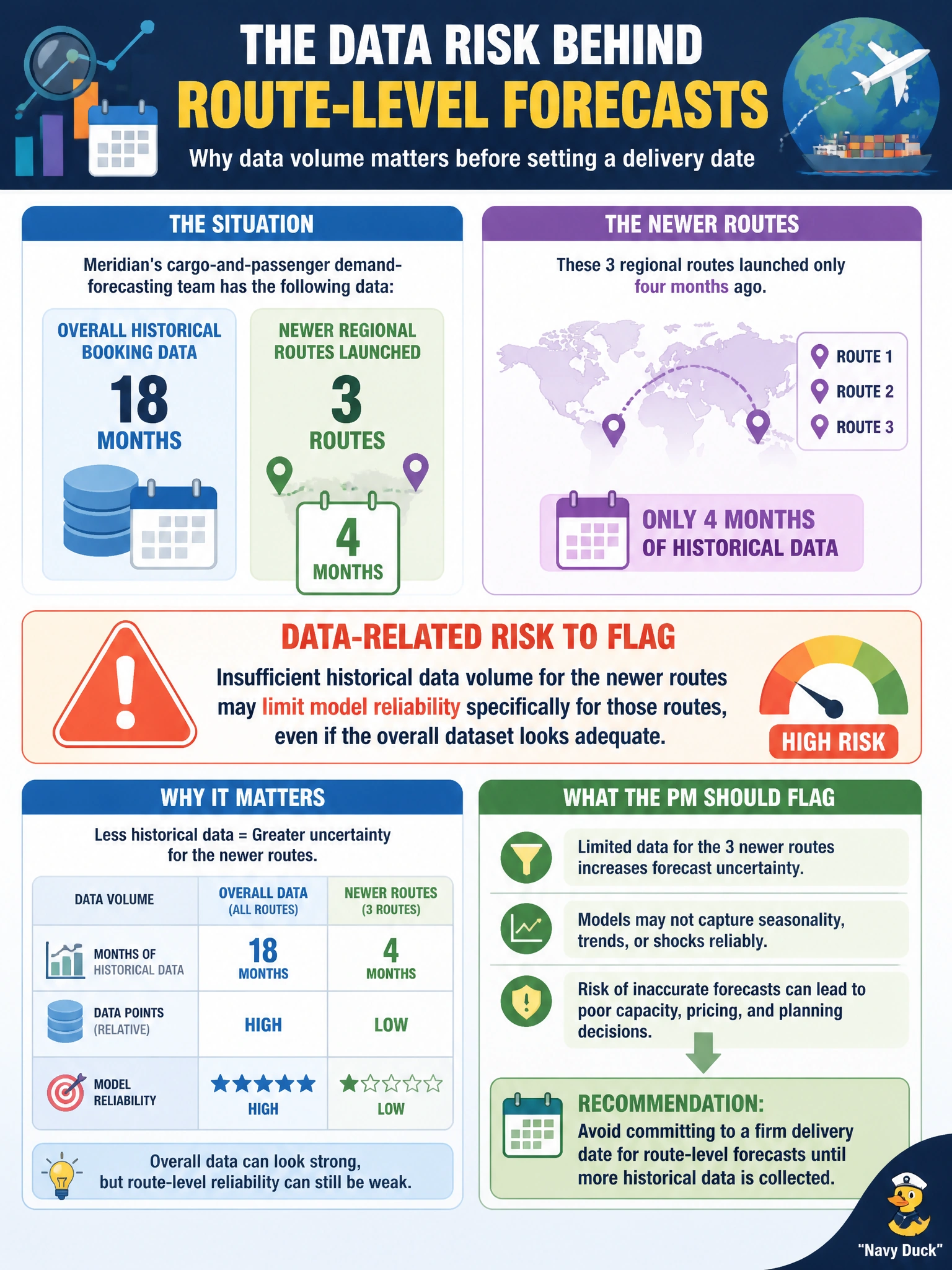
Meridian's cargo-and-passenger demand-forecasting team has eighteen months of historical booking data overall, but three regional routes launched only four months ago. What data-related risk should the PM flag before committing to a firm delivery date for route-level forecasts?
Select an answer to reveal the explanation.
Short Explanation
Eighteen months sounds like plenty of data — until you realize three routes only have four months of it. Averages hide the weak spots; always check coverage route by route, not just in aggregate.
Full Explanation
Data quantity and quality challenges must be assessed at the granularity the model will actually be asked to predict at, not just in aggregate. An overall dataset of eighteen months can mask the fact that specific segments — here, three newly launched routes — have far less history, which directly limits how reliable forecasts for those particular routes will be, regardless of how strong the airline-wide dataset looks. Options A, B, and C are all real project considerations at some point, but none of them are data-quantity/quality risks, which is specifically what CPMAI's Business/Data Understanding tasks ask the PM to surface before locking in delivery commitments. Raising the licensing cost, implementation language, or dashboard aesthetics does nothing to protect the project from over-promising accuracy on routes where the model has almost no history to learn from. The correct PM response is to flag this data-coverage gap explicitly, and likely propose either a longer data-accumulation window for those routes or an explicitly lower-confidence forecast for them, rather than presenting a single blended accuracy expectation to the business.