
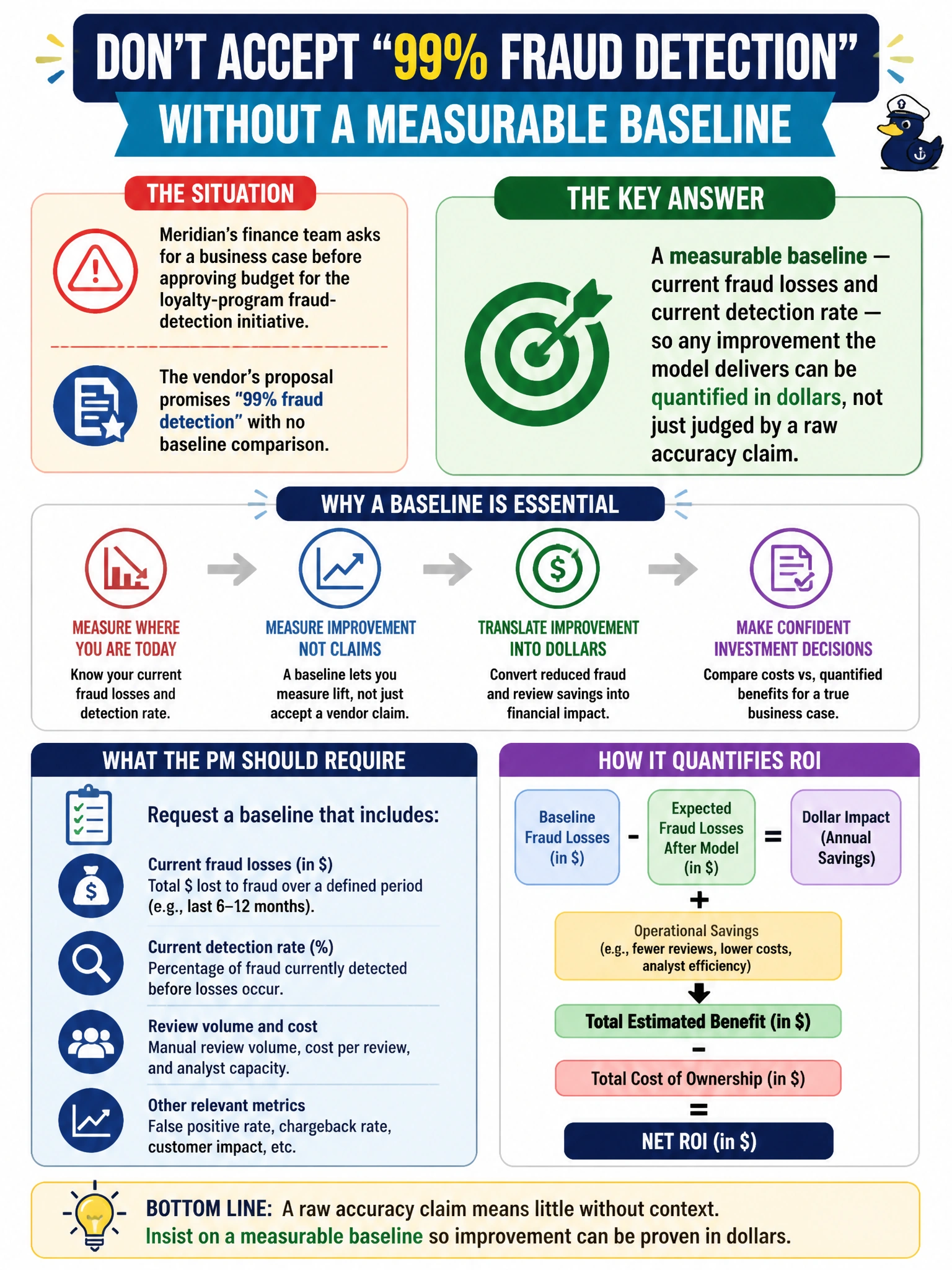
Meridian's finance team asks for a business case before approving budget for the loyalty-program fraud-detection initiative. The vendor's proposal promises "99% fraud detection" with no baseline comparison. What should the PM require before accepting this as a valid ROI justification?
Select an answer to reveal the explanation.
Short Explanation
"99% accuracy" means nothing without a baseline to compare it to. Ninety-nine percent of what? Get the current numbers first, or the whole ROI case is just a marketing slide.
Full Explanation
A defensible ROI justification requires a measurable baseline against which improvement can be evaluated, because an isolated accuracy figure — however impressive-sounding — says nothing about business value without context. If Meridian doesn't already know its current fraud-loss dollar amount and current detection rate, "99% detection" cannot be translated into an ROI figure finance can actually evaluate. Option A addresses vendor risk management, not ROI justification, and is a separate (later) negotiation concern. Option B conflates staffing decisions with the business case; hiring commitments should follow from a validated need, not substitute for one. Option D is an unrealistic and inappropriate ask — no fraud-detection model can guarantee zero false positives, and demanding that guarantee reflects a misunderstanding of how classification models perform rather than a sound ROI practice. This question tests the CPMAI Business Understanding task of evaluating ROI justifications: proposals must be interrogated for baseline comparability, not accepted on the strength of a headline accuracy number, which is a common vendor-hype pattern.