
Meridian's data-science lead says, 'once we have a working algorithm, feature set, and enough labeled data, the project is basically done — deployment is just a formality.' As the AI project manager applying CPMAI's ML-fundamentals view, how should this claim be evaluated?
Select an answer to reveal the explanation.
Short Explanation
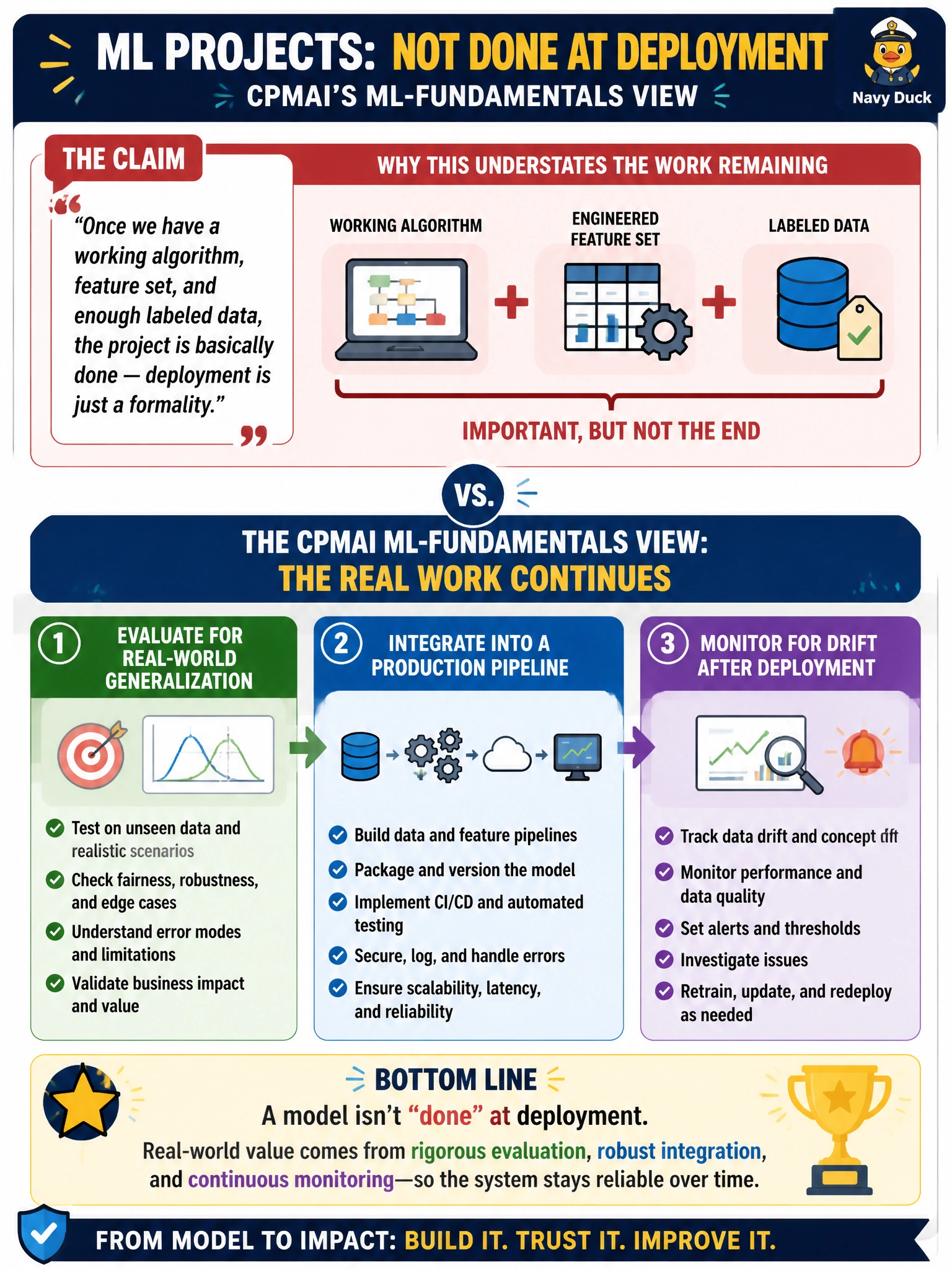
Having good ingredients — algorithm, features, labeled data — doesn't mean the cake bakes itself. There's still testing it on situations it hasn't seen, wiring it into real production systems, and watching it after launch so it doesn't quietly go stale. 'Basically done' undersells three more real phases of work.
Full Explanation
This question ties together several CPMAI Task 3 and cross-domain concepts to test whether the PM correctly resists an oversimplified claim. Having a sound algorithm, engineered features, and sufficient labeled data are necessary ingredients, but CPMAI's broader methodology view (and the ML-fundamentals concepts of generalization and model evaluation) makes clear that real work remains: verifying the model generalizes to new, unseen situations; integrating it into a production data pipeline distinct from the training pipeline; and monitoring for data drift and model drift once deployed. None of that is a 'formality' — it is where many AI projects actually fail, which is exactly the gap-between-model-and-real-world-implementation risk CPMAI's Methodology domain names directly. The 'claim is correct, deployment is automatic and risk-free' distractor accepts the overpromising the PM should be catching. The 'correct only because Meridian is regulated' distractor implies an unregulated company could skip real evaluation and monitoring, which is false regardless of regulatory status — generalization testing and drift monitoring are technical necessities, not regulatory-only obligations. The 'wrong only because more labeled data is always needed' distractor narrows a broad problem (skipping evaluation, integration, and monitoring) down to a single, incorrect fix, missing the real deployment-and-monitoring gap entirely. Catching this claim early protects the project timeline and the board's expectations.