
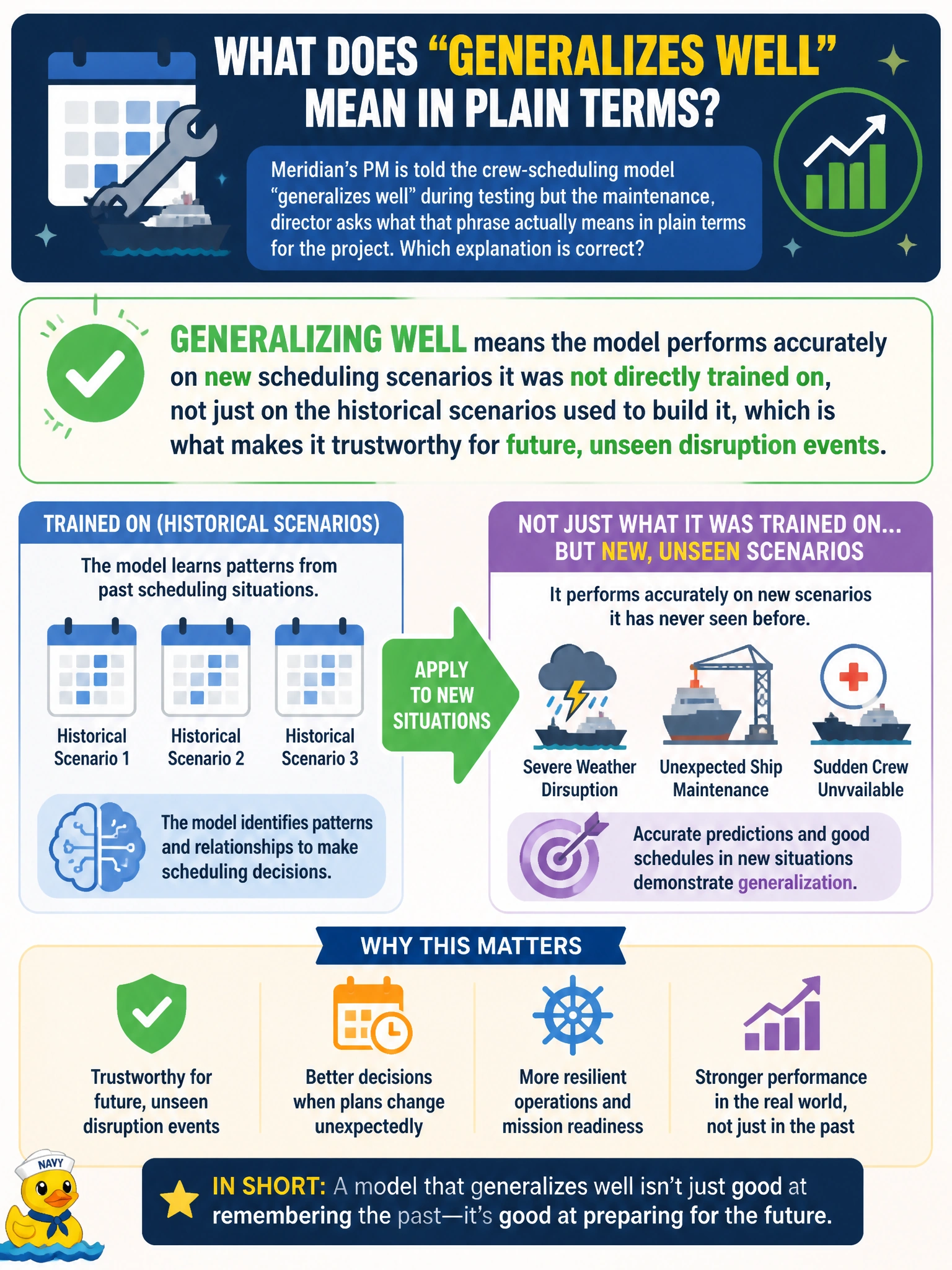
Meridian's PM is told the crew-scheduling model 'generalizes well' during testing but the maintenance director asks what that phrase actually means in plain terms for the project. Which explanation is correct?
Select an answer to reveal the explanation.
Short Explanation
'Generalizes well' is the difference between a model that just memorized last year's disruptions versus one that actually learned the underlying pattern well enough to handle a disruption it's never seen before. That second kind is the one worth trusting for next winter's storm.
Full Explanation
CPMAI Task 3 requires distinguishing prediction, inference, and generalization, and generalization specifically means a model's ability to perform accurately on new, unseen situations rather than just the data it was trained on — for Meridian's crew-scheduling model, that means handling a genuinely new weather-disruption pattern well, not just replaying scenarios similar to its training history. This is the property that actually determines whether the maintenance director should trust the model for a future, unforeseen event. The 'generalizing well means only unsupervised learning was used' distractor confuses generalization (a performance property) with a specific learning paradigm (a training-method category); a supervised model can generalize well or poorly, and the training method alone does not determine that. The 'runs faster on cloud infrastructure' distractor substitutes an infrastructure/speed detail for an accuracy-on-new-data concept, which is an unrelated Managing AI topic. The 'memorized every historical schedule exactly' distractor actually describes the opposite of good generalization — a model that has memorized its training data (overfitting) typically performs poorly on new, unseen scenarios precisely because it has not learned the generalizable underlying pattern. Explaining generalization correctly helps the PM set the right confidence level with leadership about how the model will behave in a disruption nobody has seen before.