
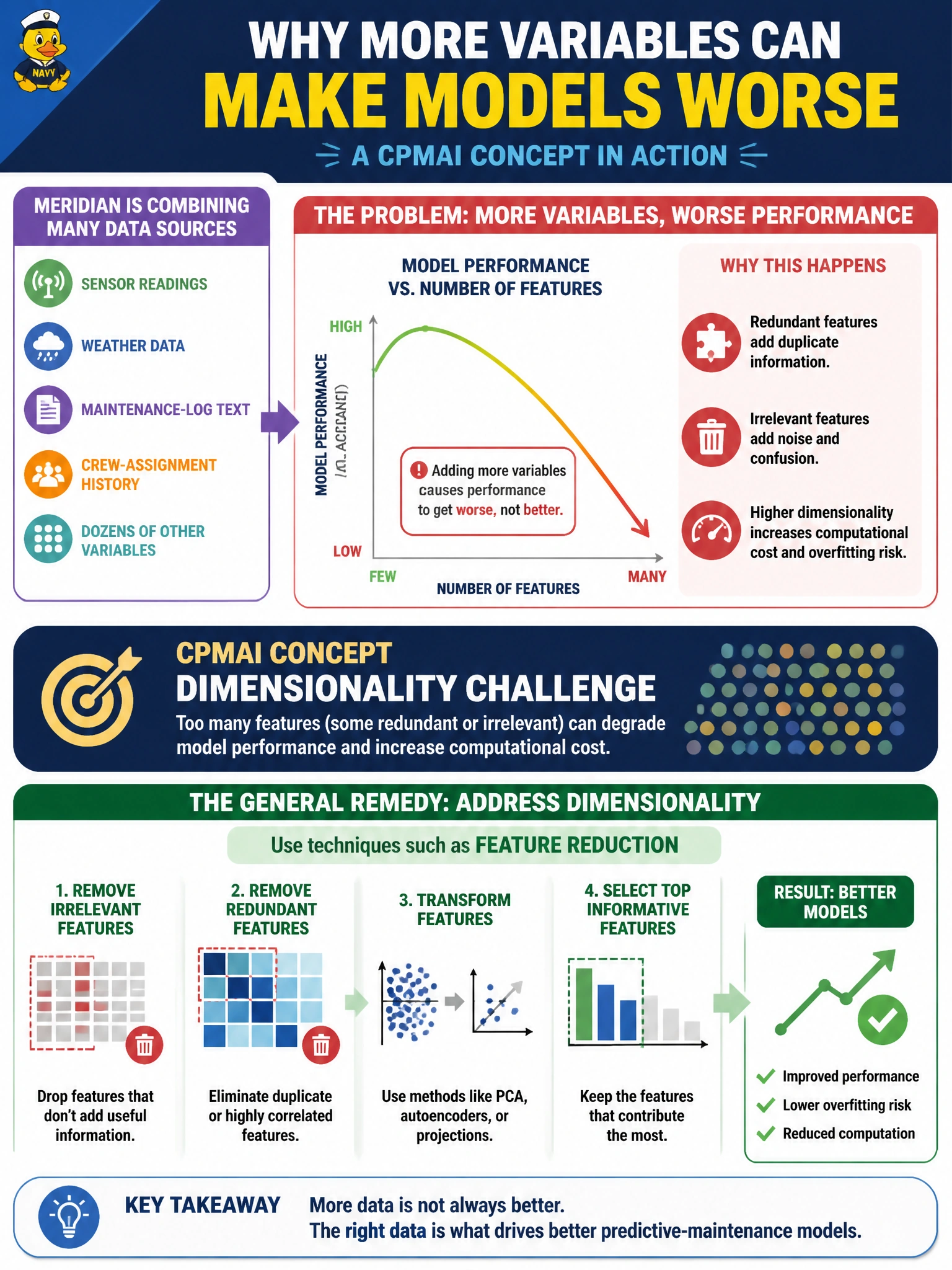
Meridian's data-science team wants to combine sensor readings, weather data, maintenance-log text, crew-assignment history, and dozens of other variables into one predictive-maintenance model, but the model's performance gets worse, not better, as more variables are added. What CPMAI concept explains this, and what is the general remedy category?
Select an answer to reveal the explanation.
Short Explanation
More columns of data isn't automatically better — past a point, extra features add noise and cost without adding signal, and performance can actually get worse. That's a dimensionality problem, and the fix is trimming down to the features that actually matter (feature reduction), not piling on more.
Full Explanation
CPMAI Task 3 requires addressing dimensionality challenges in machine-learning solutions, and this scenario is the classic symptom: as more features (variables) are added, especially redundant, noisy, or irrelevant ones, model performance can degrade and computation becomes more expensive — a pattern sometimes called the 'curse of dimensionality.' The general remedy category CPMAI points to is dimensionality reduction / feature reduction — identifying and keeping the features that actually carry predictive signal rather than simply adding every available variable. The 'data-drift, retrain weekly' distractor misdiagnoses the problem; data drift describes a deployed model's input distribution shifting over time in production, not a feature-count problem present even before deployment. The 'overfitting specific to reinforcement learning, switch to expert system' distractor misapplies overfitting (a related but distinct concept about a model memorizing training data rather than generalizing) to a reinforcement-learning-only framing that does not fit this supervised maintenance-prediction scenario, and recommending abandoning ML for a rigid rule-based system throws away the legitimate modeling opportunity. The 'no known remedy, more data always helps' distractor directly contradicts the dimensionality concept CPMAI explicitly teaches. Recognizing this lets the PM ask the data-science team to prioritize feature selection work rather than just piling on more raw variables.