
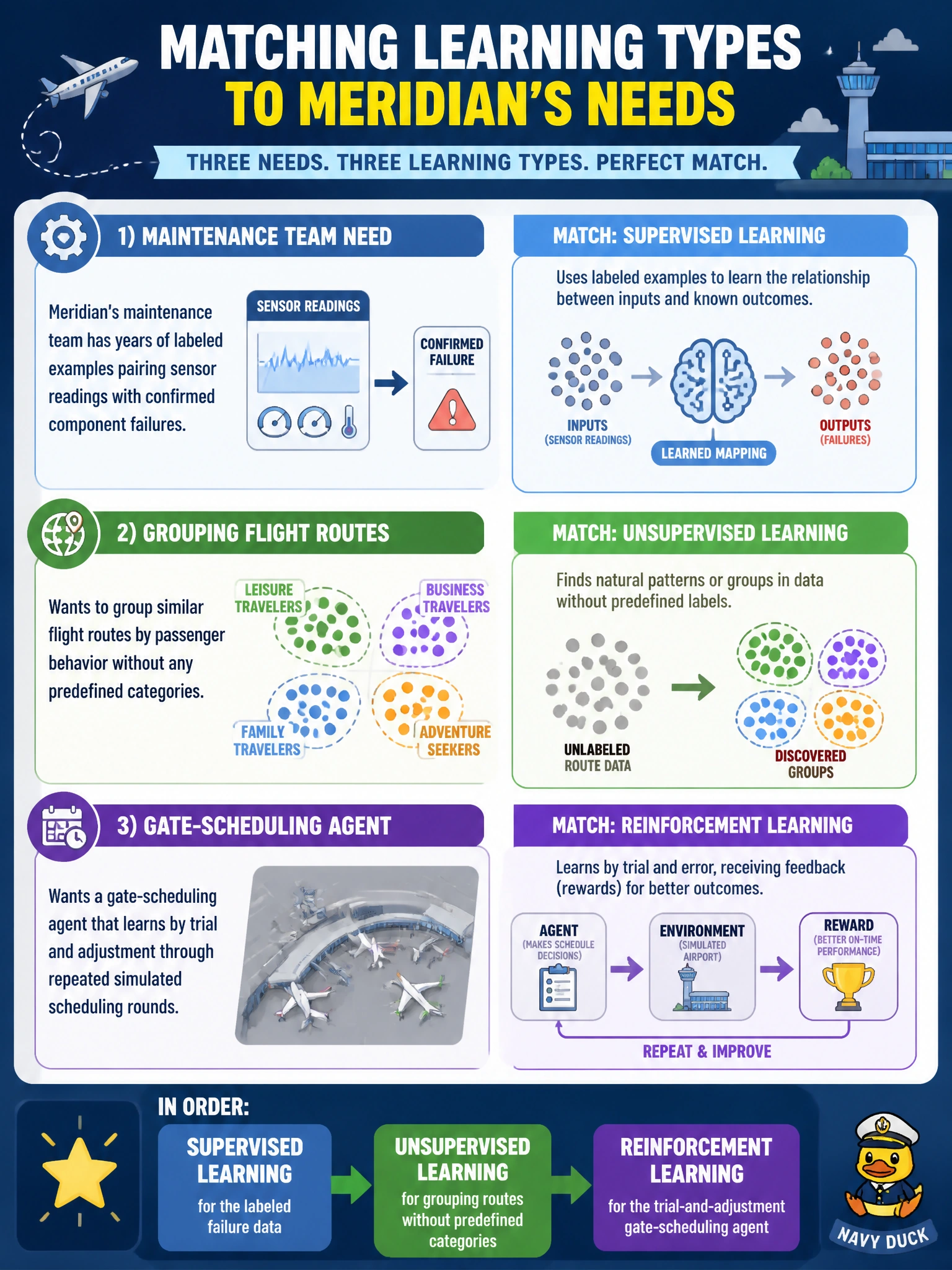
Meridian's maintenance team has years of labeled examples pairing sensor readings with confirmed component failures, wants to group similar flight routes by passenger behavior without any predefined categories, and wants a gate-scheduling agent that learns by trial and adjustment through repeated simulated scheduling rounds. Which learning types correctly match these three needs, in order?
Select an answer to reveal the explanation.
Short Explanation
Match the method to what data you actually have: labeled failures with known answers → supervised. Grouping things with no predefined buckets → unsupervised (clustering). Learning by trying, getting feedback, and adjusting → reinforcement. Three different data situations, three different learning types.
Full Explanation
CPMAI Task 3 requires implementing supervised, unsupervised, and reinforcement learning correctly matched to their respective data situations. Labeled sensor-to-failure pairs are exactly the supervised-learning case: known input-output examples the model learns to predict from. Grouping flight routes by passenger behavior with no predefined categories is the unsupervised-learning case (clustering), since there are no labels telling the model what the 'right' groups are in advance — it discovers structure on its own. A gate-scheduling agent that improves through repeated trial, feedback, and adjustment across simulated rounds is the reinforcement-learning case, where an agent learns a policy through interaction with an environment and reward signal rather than from a fixed labeled dataset. The first distractor swaps supervised and unsupervised, mismatching labeled failure data (which has clear labels) with the 'no predefined categories' method, and vice versa. The 'supervised learning for all three' distractor ignores that supervised learning fundamentally requires labeled examples, which the clustering and trial-and-adjustment scenarios do not have. The final distractor scrambles all three pairings, putting reinforcement learning on labeled data (where it does not fit) and unsupervised learning on an agent-and-reward scenario (which is reinforcement learning's definition, not unsupervised learning's). Correct matching determines which technique the data-science team should even attempt to build.