
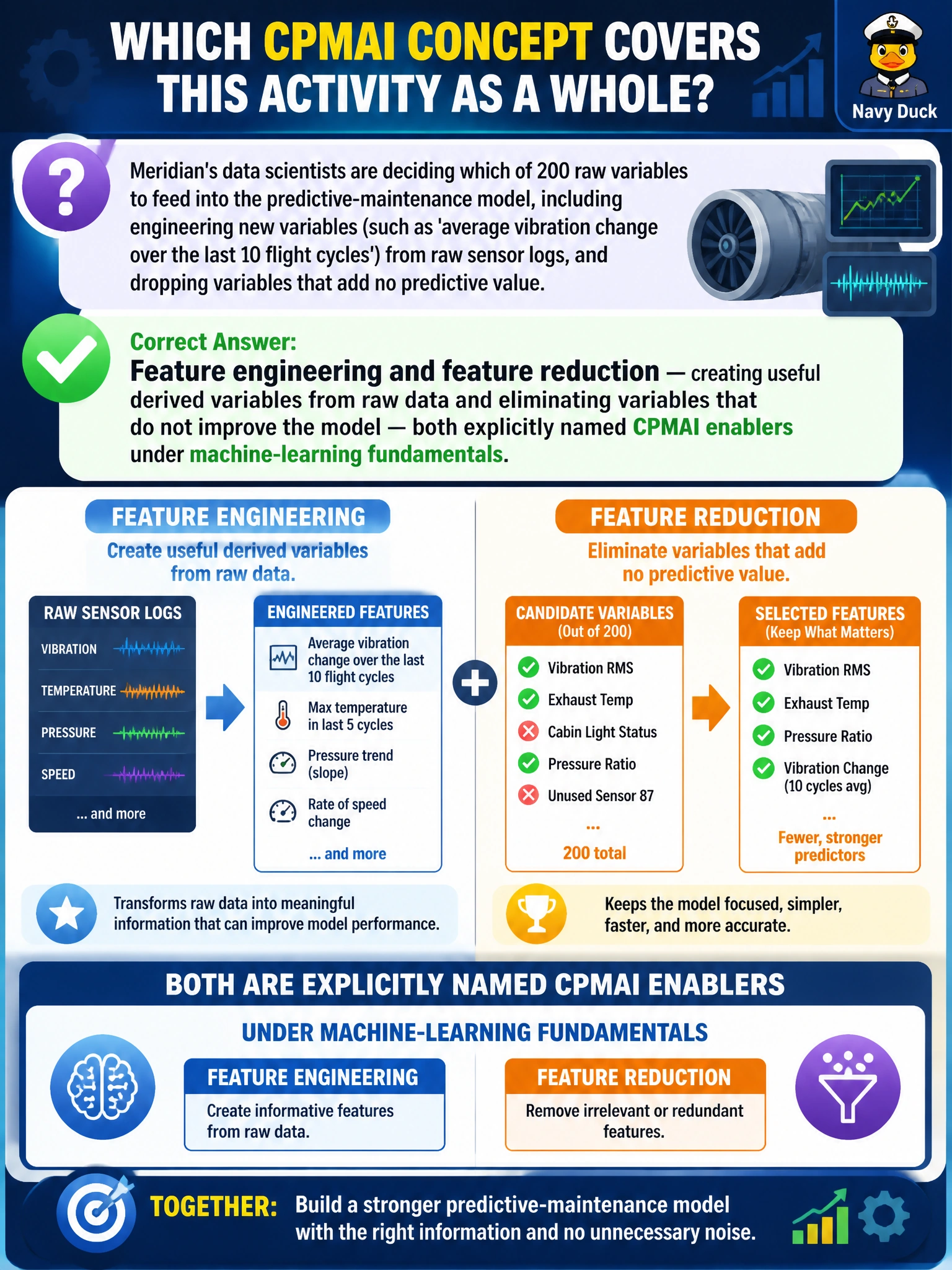
Meridian's data scientists are deciding which of 200 raw variables to feed into the predictive-maintenance model, including engineering new variables (such as 'average vibration change over the last 10 flight cycles') from raw sensor logs, and dropping variables that add no predictive value. Which CPMAI concept covers this activity as a whole?
Select an answer to reveal the explanation.
Short Explanation
Turning raw log entries into a smarter derived signal (like a rolling vibration trend) and cutting the variables that don't help: that's feature engineering plus feature reduction, working together — build what helps, drop what doesn't.
Full Explanation
CPMAI Task 3 explicitly lists performing feature engineering and feature reduction as an AI-fundamentals enabler, and this scenario matches both halves directly: engineering a new derived variable (a rolling average vibration-change metric) from raw sensor logs is feature engineering, while eliminating variables that add no predictive value is feature reduction. Even though this exam is PM-focused, CPMAI still expects candidates to recognize this activity at a conceptual level well enough to plan for it, staff it, and evaluate whether the data-science team is doing it — which is exactly why the 'entirely outside CPMAI's scope' distractor is wrong; the exam outline names it directly as an in-scope enabler, at PM depth rather than implementation depth. The 'exclusively a data-governance activity' distractor misclassifies feature engineering/reduction as belonging only to Domain IV's data-governance topics, when it is specifically named under Domain I's machine-learning-fundamentals task, distinct from (though related to) broader data-governance work. The 'this is model deployment' distractor confuses feature preparation — which happens well before and during model development — with the separate, later concept of transitioning a trained model into a production/inference environment (a Managing AI topic). Recognizing feature work as its own named activity helps the PM sequence it correctly in the project timeline, ahead of model development.