
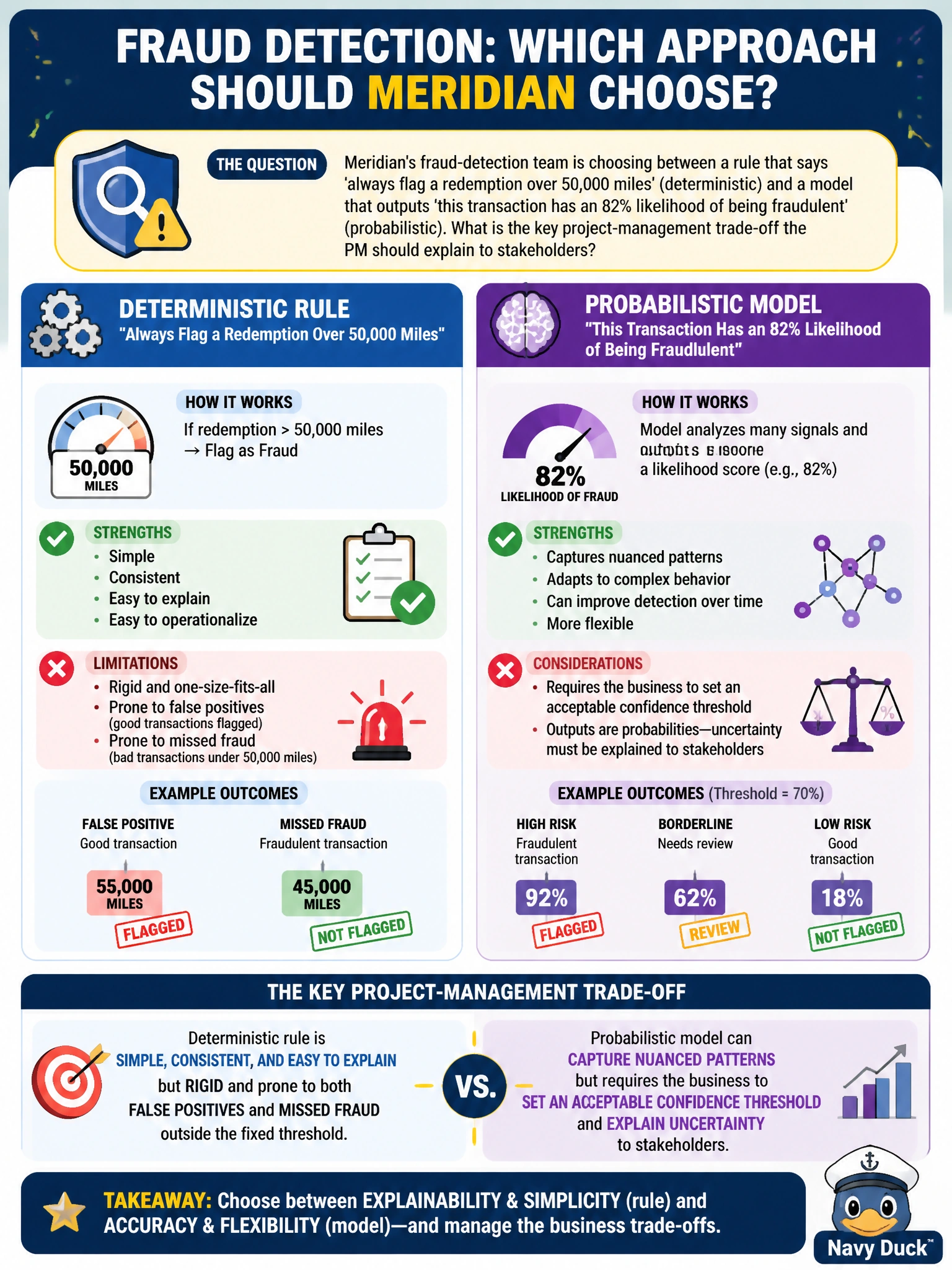
Meridian's fraud-detection team is choosing between a rule that says 'always flag a redemption over 50,000 miles' (deterministic) and a model that outputs 'this transaction has an 82% likelihood of being fraudulent' (probabilistic). What is the key project-management trade-off the PM should explain to stakeholders?
Select an answer to reveal the explanation.
Short Explanation
A hard rule ('over 50,000 miles, always flag') is simple but blunt — it'll miss clever fraud that stays just under the line. A probability score ('82% likely fraud') is smarter but forces you to decide: how sure is sure enough to act? That threshold decision is a business call, not a technical one.
Full Explanation
CPMAI Task 3 requires differentiating probabilistic and deterministic approaches, and the practical trade-off is exactly what a PM needs to explain to non-technical stakeholders: a deterministic rule is transparent and predictable but rigid, missing fraud patterns that fall outside its fixed threshold and potentially flagging legitimate high-mileage redemptions unnecessarily. A probabilistic model can capture more nuanced, learned patterns, but it produces a confidence score rather than a certainty, requiring the business to set and justify an action threshold (e.g., investigate anything above 70% likelihood) and to communicate that uncertainty honestly. The 'no meaningful difference, both produce yes/no' distractor glosses over a real and consequential design choice — how the flag is generated and how much nuance it captures differ substantially. The 'probabilistic is strictly worse because it's not 100% certain' distractor sets an impossible bar; almost no real-world predictive system offers certainty, and demanding it would make most of Meridian's AI portfolio unusable. The 'deterministic is unsupervised learning, probabilistic is reinforcement learning' distractor misclassifies both — a fixed threshold rule is not a learning approach at all, and a probability-output classifier is typically supervised learning, not reinforcement learning. This distinction directly informs how the PM sets acceptance criteria with the fraud team.