
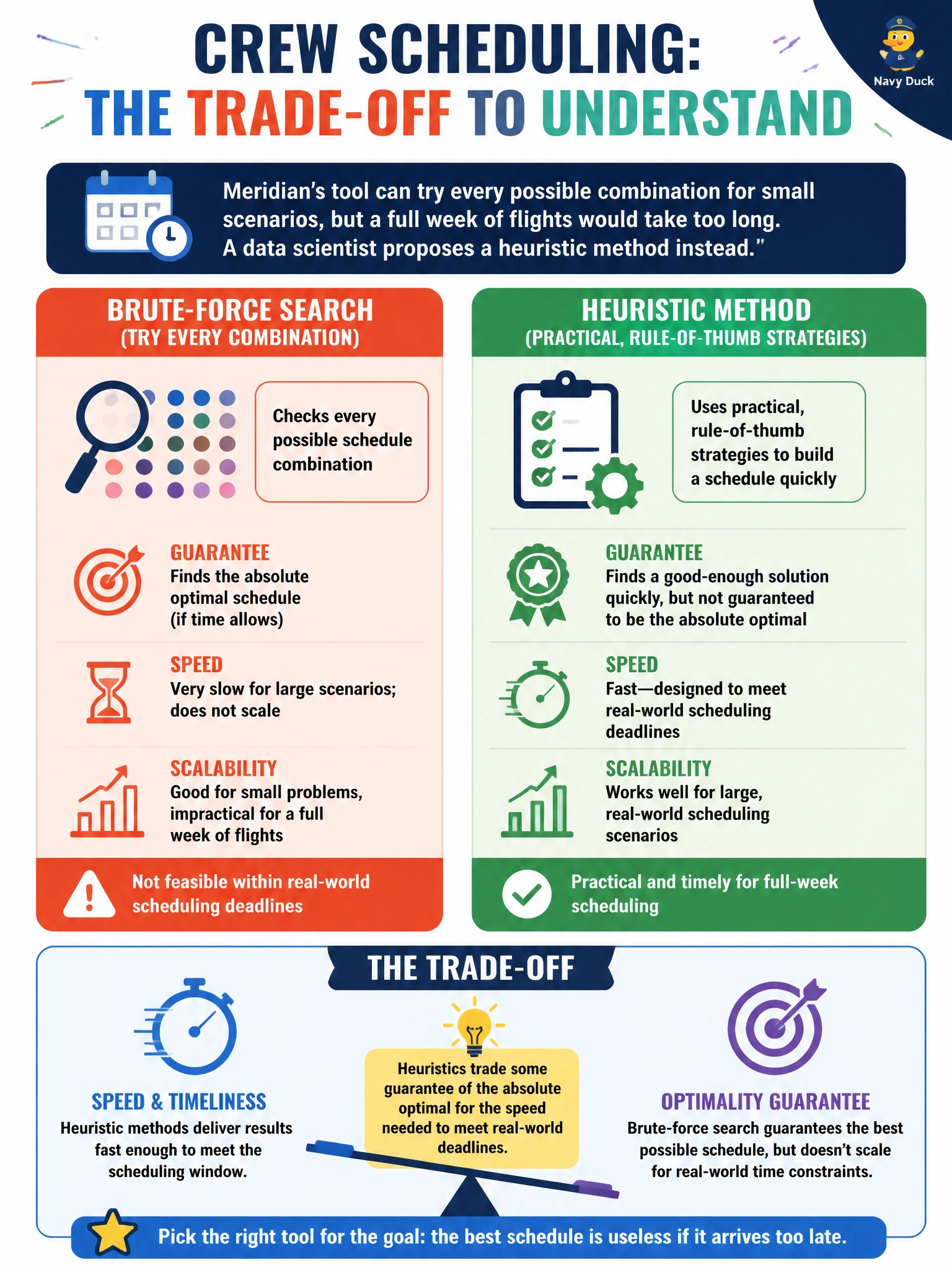
Meridian's crew-scheduling optimization tool can solve small scheduling scenarios by trying every possible combination, but for a full week of flights, that approach would take longer than the scheduling window allows. A data scientist proposes a heuristic method instead. What should the PM understand about this trade-off?
Select an answer to reveal the explanation.
Short Explanation
Brute force checks literally everything, which guarantees the best answer but doesn't scale — a full week of flights would take forever to fully enumerate. A heuristic is a smart shortcut: good enough, fast enough, in time to actually publish next week's schedule. That trade is the whole point.
Full Explanation
CPMAI Task 3 requires applying heuristic methods versus brute-force search techniques, and crew scheduling under FAA duty-time and connection constraints is a classic combinatorial problem where brute-force search (checking every possible combination) becomes computationally infeasible at real airline scale, even though it would guarantee the optimal answer for a tiny scenario. A heuristic method trades the guarantee of a perfectly optimal schedule for a practical, fast-enough approach that produces a good schedule within the actual planning window — exactly the trade-off the PM needs to explain to scheduling stakeholders who might otherwise expect a 'perfect' answer. The 'heuristic always strictly better than brute-force, never use brute-force' distractor overstates heuristic guarantees; heuristics are a scalability trade-off, not a strictly superior technique, and brute-force remains appropriate for small enough problems. The 'both take exactly the same time regardless of size' distractor denies the entire computational-scaling problem that motivates using a heuristic in the first place. The 'heuristic is reinforcement learning requiring labeled data' distractor misclassifies heuristic search as a specific learning paradigm with data requirements it does not inherently have; heuristics are algorithmic strategies, not necessarily learned from labeled examples at all. This trade-off is exactly what the PM should set stakeholder expectations around before the tool ever ships.