
Meridian's new PM is drafting a one-slide explainer for the maintenance director and writes, 'AI is built on top of machine learning, which is its cornerstone.' A skeptical engineer disputes the ordering. Which statement is accurate?
Select an answer to reveal the explanation.
Short Explanation
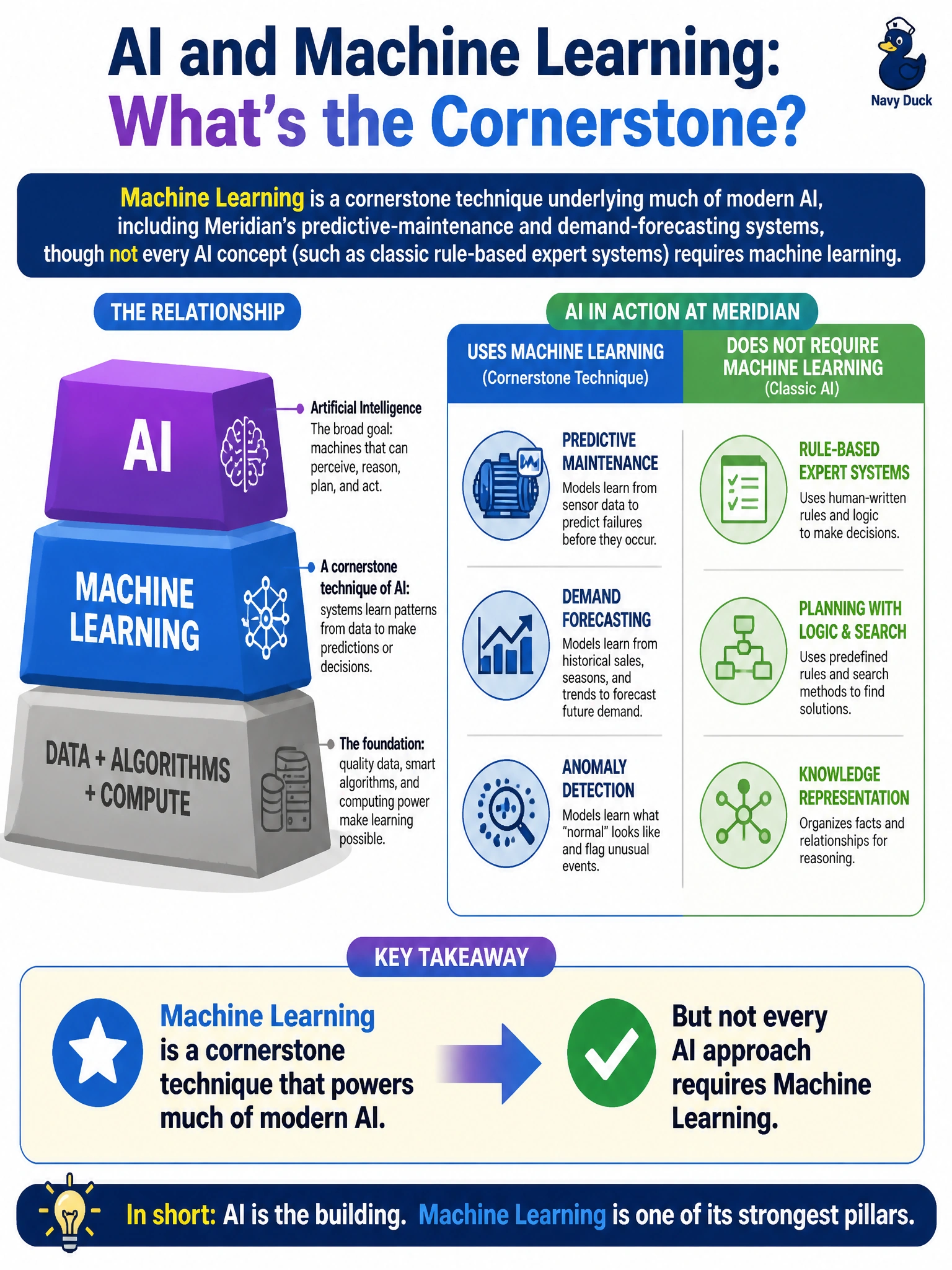
ML is the engine under the hood of most modern AI — that's the cornerstone relationship. But not every AI system is ML-powered (a rigid rule-based expert system is AI without ML), so 'cornerstone' doesn't mean 'the only ingredient.'
Full Explanation
CPMAI Task 3 opens by asking candidates to explain machine learning as the cornerstone of modern AI — meaning ML is the dominant, foundational technique behind most of today's practical AI capability (including Meridian's predictive-maintenance forecasting and demand-prediction systems), while still recognizing that AI is the broader field and not every AI system uses machine learning (a hand-coded rule-based expert system, discussed earlier in Domain I, is AI without ML). The 'completely unrelated fields' distractor denies the well-established cornerstone relationship CPMAI explicitly teaches. The 'AI is a subset of ML' distractor inverts the actual hierarchy — ML is a subset/technique within the broader field of AI, not the other way around, and treating every ML project as automatically a full AI initiative would misstate project scope. The 'only became relevant after 2025' distractor is simply false and irrelevant — machine learning's role predates the exam outline by decades and is a matter of technical history, not exam publication dates. Getting the relationship right keeps the board slide accurate: ML explains most of what Meridian's systems do, but 'AI' is the larger umbrella the project sits under.