
Meridian's operations team wants an unattended bot to automatically rebook a passenger whenever their connecting flight is cancelled, without requiring a human to trigger it, but wants a human gate agent to manually approve any exception involving a passenger with a disability accommodation. How should the PM describe this design using RPA terminology?
Select an answer to reveal the explanation.
Short Explanation
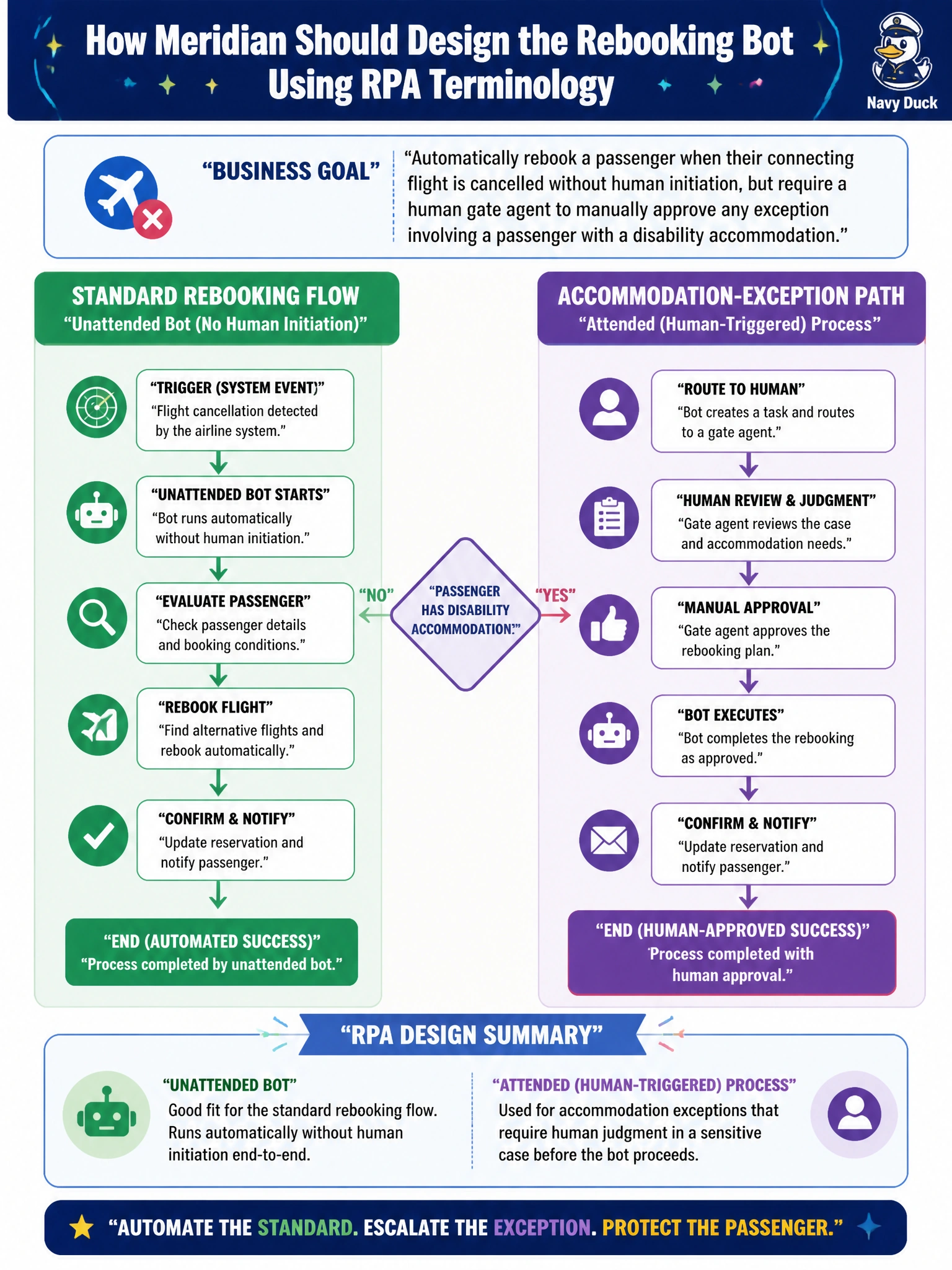
Routine, no-judgment-needed rebooking: let the unattended bot run itself. A case involving a disability accommodation, where judgment and sensitivity matter: put a human in the loop before anything happens. 'Attended vs. unattended' is exactly the dial CPMAI wants you to turn based on how much judgment a case needs.
Full Explanation
CPMAI Task 2 requires distinguishing RPA, attended bots, and unattended bots, and this scenario is a good test of applying that distinction correctly by risk and judgment level. An unattended bot runs on a trigger without a human present, which fits the standard, low-judgment rebooking flow well. An attended (human-triggered or human-supervised) process fits the accommodation-exception path, where a sensitive, individualized judgment call benefits from a human agent's involvement before an action is taken. The 'must use the same unattended configuration, no distinction exists' distractor denies a real and exam-tested distinction between attended and unattended bots. The 'reverse the assignment — routine attended, exception unattended' distractor gets the risk logic backwards: it removes human oversight from exactly the case that most needs it (a disability accommodation) while adding unnecessary friction to the routine, low-risk case. The 'never automate anything involving accessibility' distractor overcorrects into blanket avoidance rather than a properly designed human-in-the-loop step, and nothing in CPMAI treats RPA and accessibility as inherently incompatible. Matching bot type to case sensitivity is exactly the judgment-shaped decision this exam rewards.