
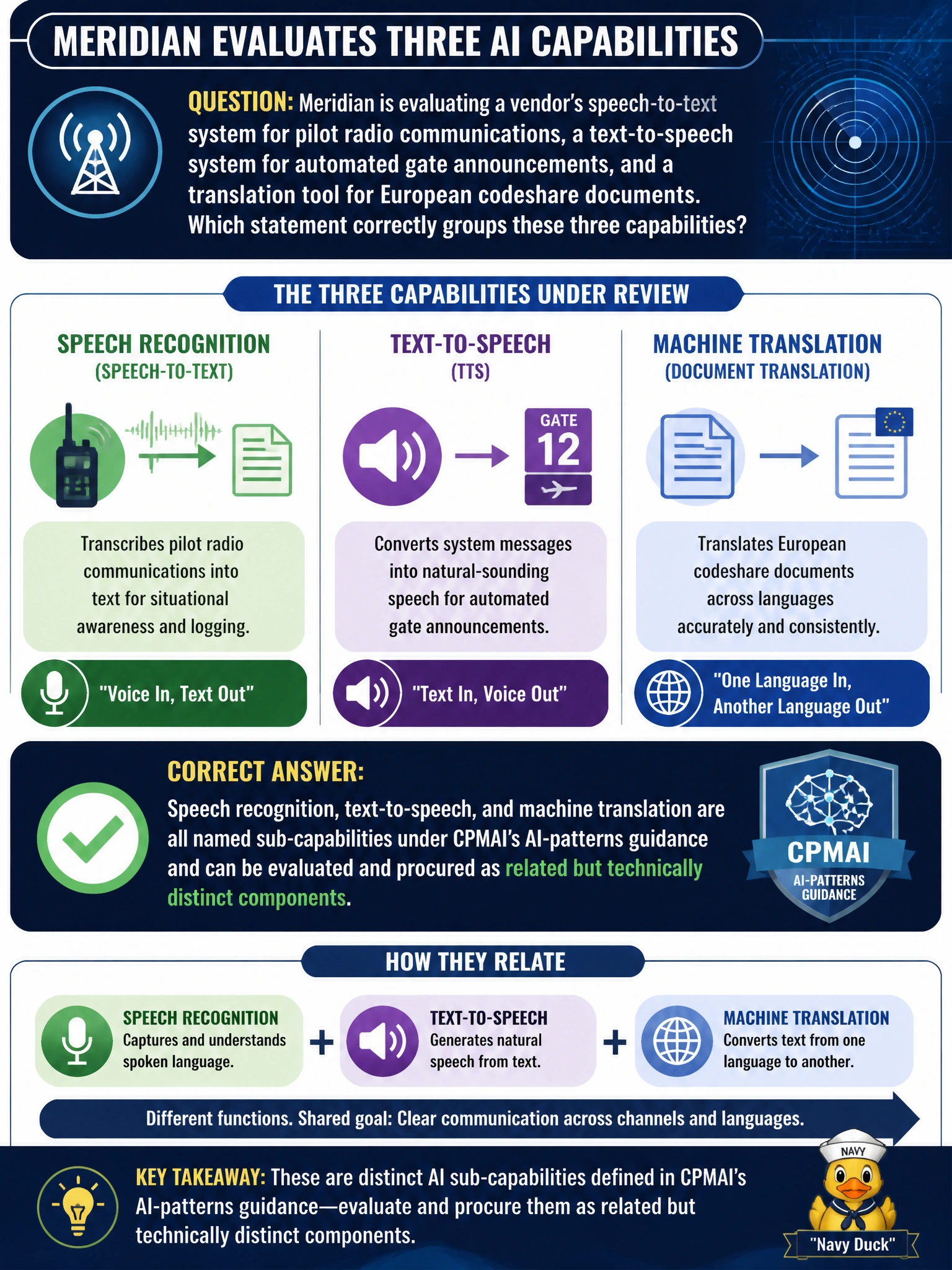
Meridian is evaluating a vendor's speech-to-text system for pilot radio communications, a text-to-speech system for automated gate announcements, and a translation tool for European codeshare documents. Which statement correctly groups these three capabilities?
Select an answer to reveal the explanation.
Short Explanation
These are cousins, not twins: converting speech to text, text to speech, and one language to another are three different technical jobs, even though they often show up together in the same voice-enabled product. Benchmark and buy them separately.
Full Explanation
CPMAI Task 2 explicitly names speech recognition, text-to-speech, and machine translation as distinct capabilities the PM should be able to identify and utilize appropriately, which matters here because Meridian is evaluating three separate vendor capabilities for three separate problems (pilot radio transcription, automated announcements, and codeshare document translation). Treating them as interchangeable, as the 'same underlying technology, single benchmark' distractor does, would produce a flawed procurement process — each has different accuracy metrics, failure modes, and safety stakes (misheard pilot radio is a much higher-stakes failure than a translated brochure). The 'all examples of RPA' distractor misclassifies these as workflow-automation bots; RPA replays a scripted business process, whereas these three are perception/generation capabilities operating on language and audio, a different pattern family. The 'only machine translation is in scope' distractor is simply wrong — speech recognition and text-to-speech are explicitly listed CPMAI enablers under Task 2. Recognizing these as related-but-distinct lets the PM write separate acceptance criteria and safety reviews for the pilot-radio use case versus the lower-stakes announcement and translation use cases.