
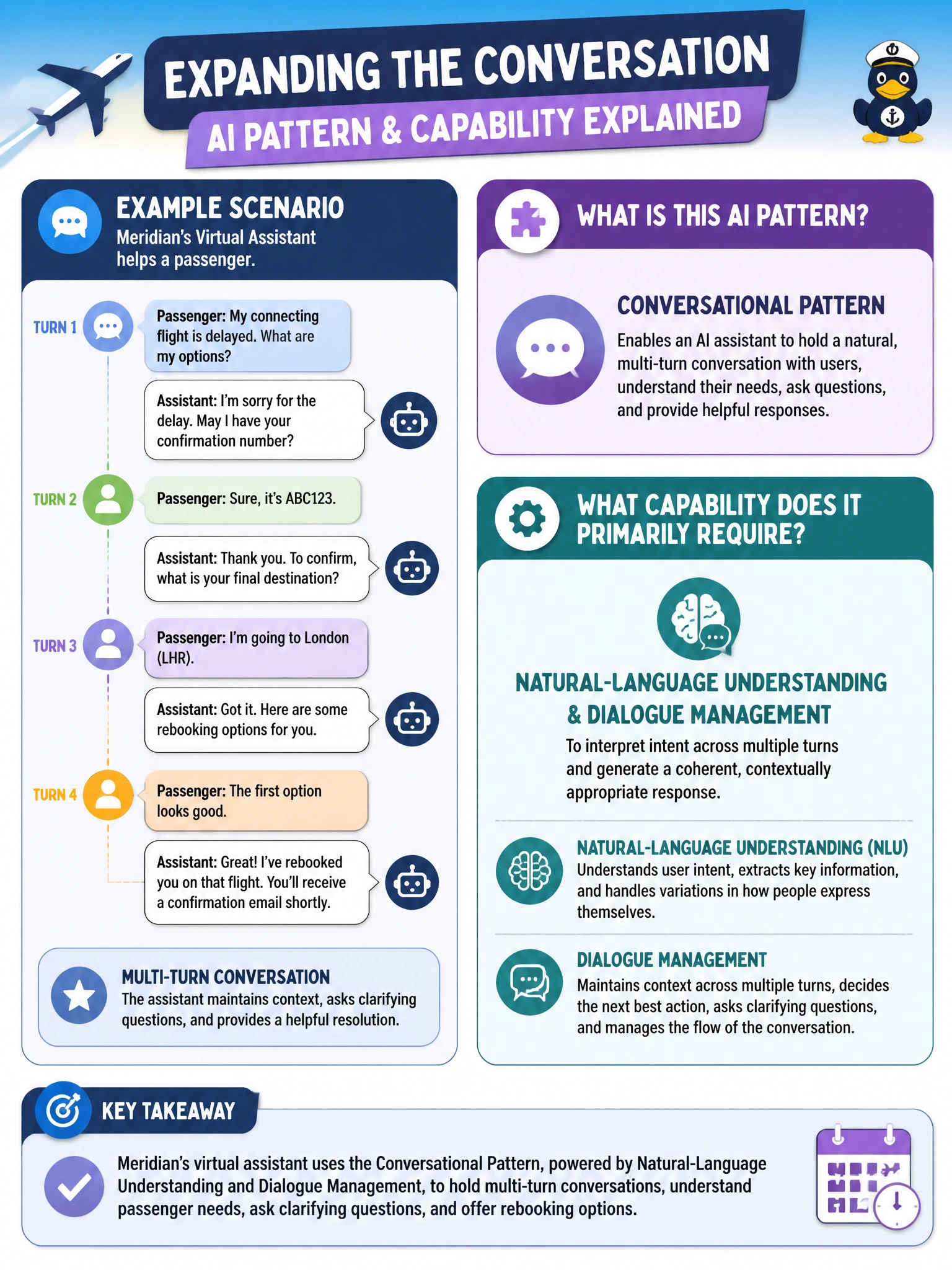
Meridian wants to deploy a virtual assistant that can hold a multi-turn conversation with a passenger about a delayed connecting flight, ask clarifying questions, and offer rebooking options. Which AI pattern is this, and what capability does it primarily require?
Select an answer to reveal the explanation.
Short Explanation
Multi-turn back-and-forth with a passenger, asking clarifying questions, understanding what they actually want: that's the conversational pattern, full stop. It needs language understanding and dialogue memory, not a fixed optimization formula or a click-replay script.
Full Explanation
CPMAI Task 2 requires implementing conversational patterns as a distinct and central use of AI, and this scenario is a textbook example: a multi-turn dialogue that must track context across turns, interpret evolving passenger intent, and generate an appropriate rebooking response. That capability set — natural-language understanding plus dialogue management — is exactly what defines the conversational pattern. The 'goal-driven pattern' distractor describes a different pattern focused on autonomously pursuing an objective through a sequence of decisions (e.g., an optimization or planning problem), which does not require the language interaction described here — goal-driven systems can exist without any conversational interface at all. The 'recognition pattern' distractor misapplies pattern/anomaly detection (built for spotting deviations in data, like fraud) to a task that is fundamentally about dialogue, not deviation detection. The 'robotic process automation' distractor describes rule-based replaying of a fixed workflow (e.g., clicking through a booking system) with no language understanding — the opposite of what a conversational assistant needs, since RPA bots do not interpret open-ended passenger language. Correctly naming the pattern tells the PM what kind of team and model (NLU/dialogue specialists, not just a rules engine) the project actually needs.