
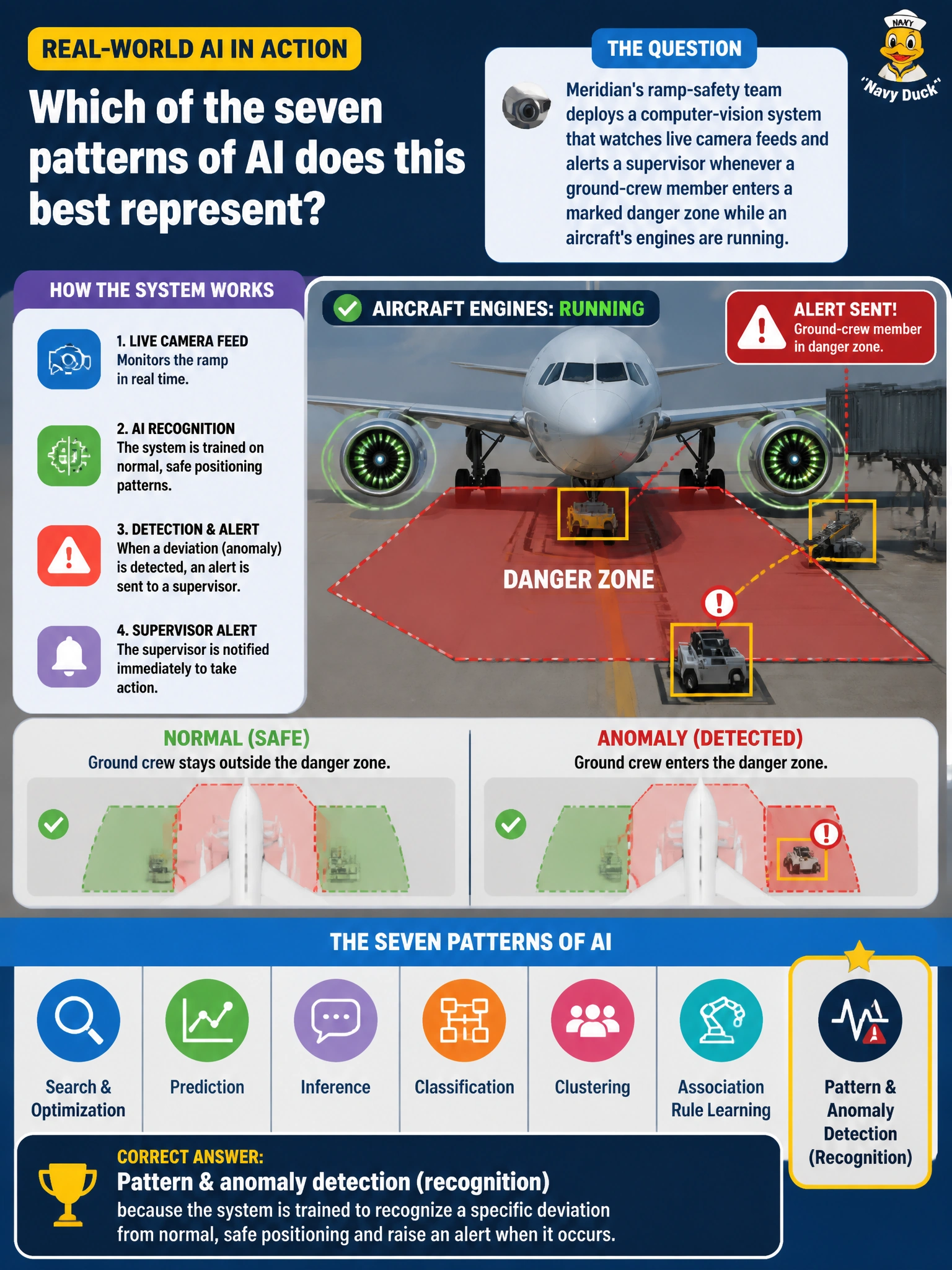
Meridian's ramp-safety team deploys a computer-vision system that watches live camera feeds and alerts a supervisor whenever a ground-crew member enters a marked danger zone while an aircraft's engines are running. Which of the seven patterns of AI does this best represent?
Select an answer to reveal the explanation.
Short Explanation
Watching for 'someone stepped where they shouldn't have' is a deviation-from-normal problem — textbook anomaly/pattern detection. It's not chatting with anyone, not personalizing to an individual's taste, and it's not predicting the future; it's catching an unsafe event as it happens.
Full Explanation
CPMAI Task 2 requires developing pattern and anomaly detection capabilities and correctly matching them to business problems, and a ramp-safety zone-violation alert is a canonical example: the system is trained on what 'normal' safe positioning looks like and flags the anomaly (a person in a danger zone during engine operation) in real time. This is recognition/anomaly detection, not a different pattern. The 'conversational pattern' distractor confuses the downstream notification channel (an alert message a supervisor reads) with the core AI task, which is visual anomaly detection, not dialogue — the same mistake as pairing a detection system with a chat interface elsewhere in this domain. The 'hyper-personalization' distractor invents individualized preference-tuning that has no place in a safety-alert system, where the threshold should be a consistent safety standard, not a per-employee preference — personalizing safety thresholds would itself be a questionable and inconsistent safety practice. The 'predictive analytics, predicts the exact minute' distractor overstates the system's actual function; it detects a present-moment safety-zone violation as it occurs, it does not forecast a future accident time. Correct pattern identification also drives the right model type (vision-based anomaly detection) and the right response workflow (immediate alert, not a forecast report).