
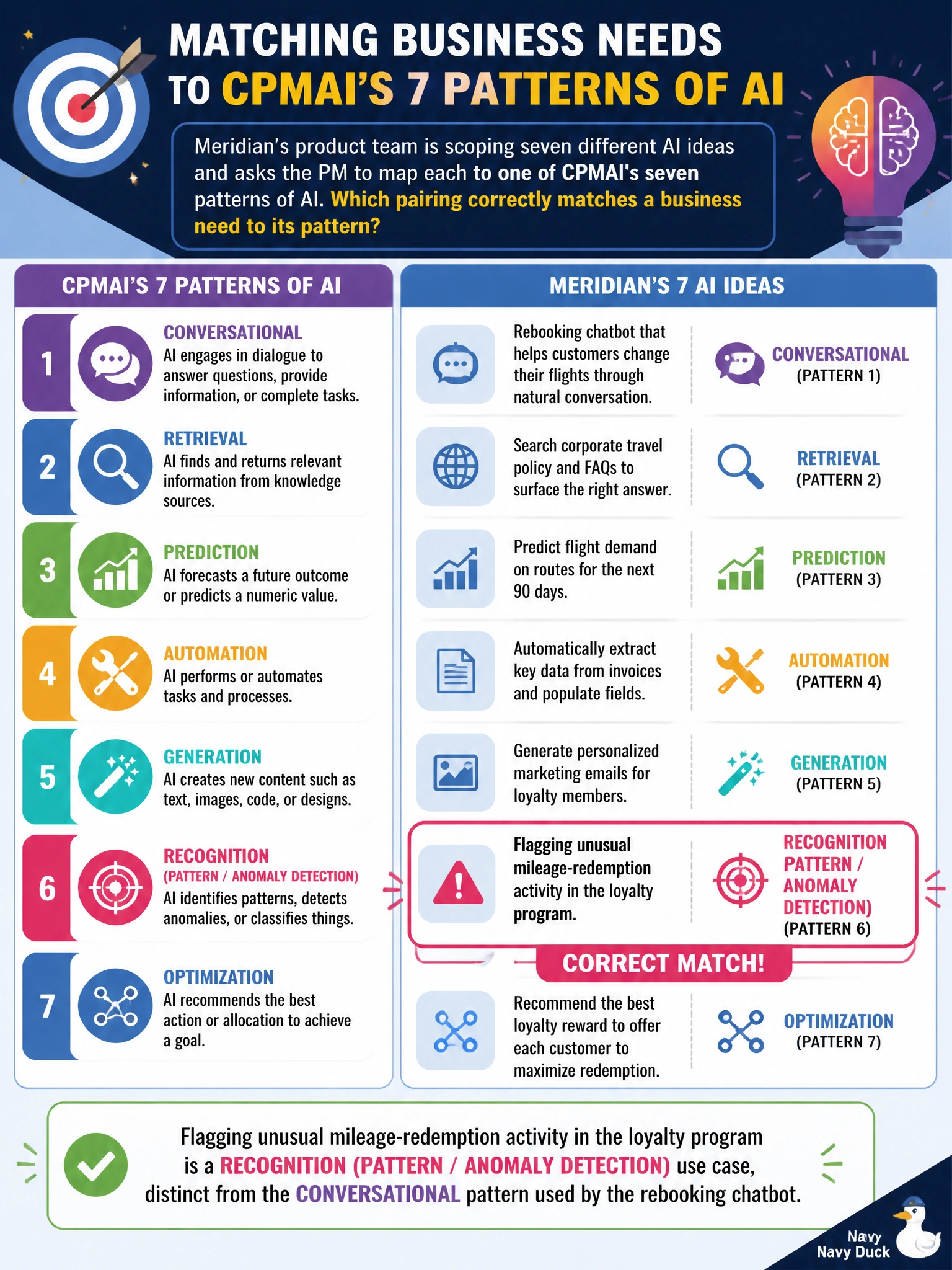
Meridian's product team is scoping seven different AI ideas and asks the PM to map each to one of CPMAI's seven patterns of AI. Which pairing correctly matches a business need to its pattern?
Select an answer to reveal the explanation.
Short Explanation
Each of the seven patterns is a distinct 'shape' of business problem. Spotting weird account activity is pattern/anomaly detection. Chatting with a customer is the conversational pattern. They can both touch the same customer, but they're solving different problems with different techniques — don't lump them together.
Full Explanation
CPMAI Task 2 requires applying the seven patterns of AI to distinct business problems, and part of that skill is correctly separating problems that might feel adjacent but map to different patterns. Loyalty-fraud detection — flagging suspicious mileage-redemption or account-takeover activity — is a recognition/anomaly-detection problem: the system learns what 'normal' account behavior looks like and flags deviations. The rebooking assistant is a conversational-pattern problem: natural-language interaction handling requests and escalating appropriately. These are genuinely different patterns even though both eventually touch the same loyalty-program customer. The 'both are the same pattern because both process customer data' distractor over-generalizes; almost every AI application 'processes customer data' at some level, which is not a meaningful way to differentiate patterns. The 'the seven patterns only apply to computer vision' distractor is factually wrong — the seven patterns span conversational, recognition, predictive, goal-driven, hyper-personalization, RPA-related, and other categories, most of which are not computer vision at all. The 'anomaly detection should be conversational because customers eventually ask about it' distractor confuses a downstream customer-service interaction with the core detection mechanism itself; the detection logic runs on transaction data, not dialogue. Correct pattern-mapping drives correct staffing and tooling choices for each initiative.