
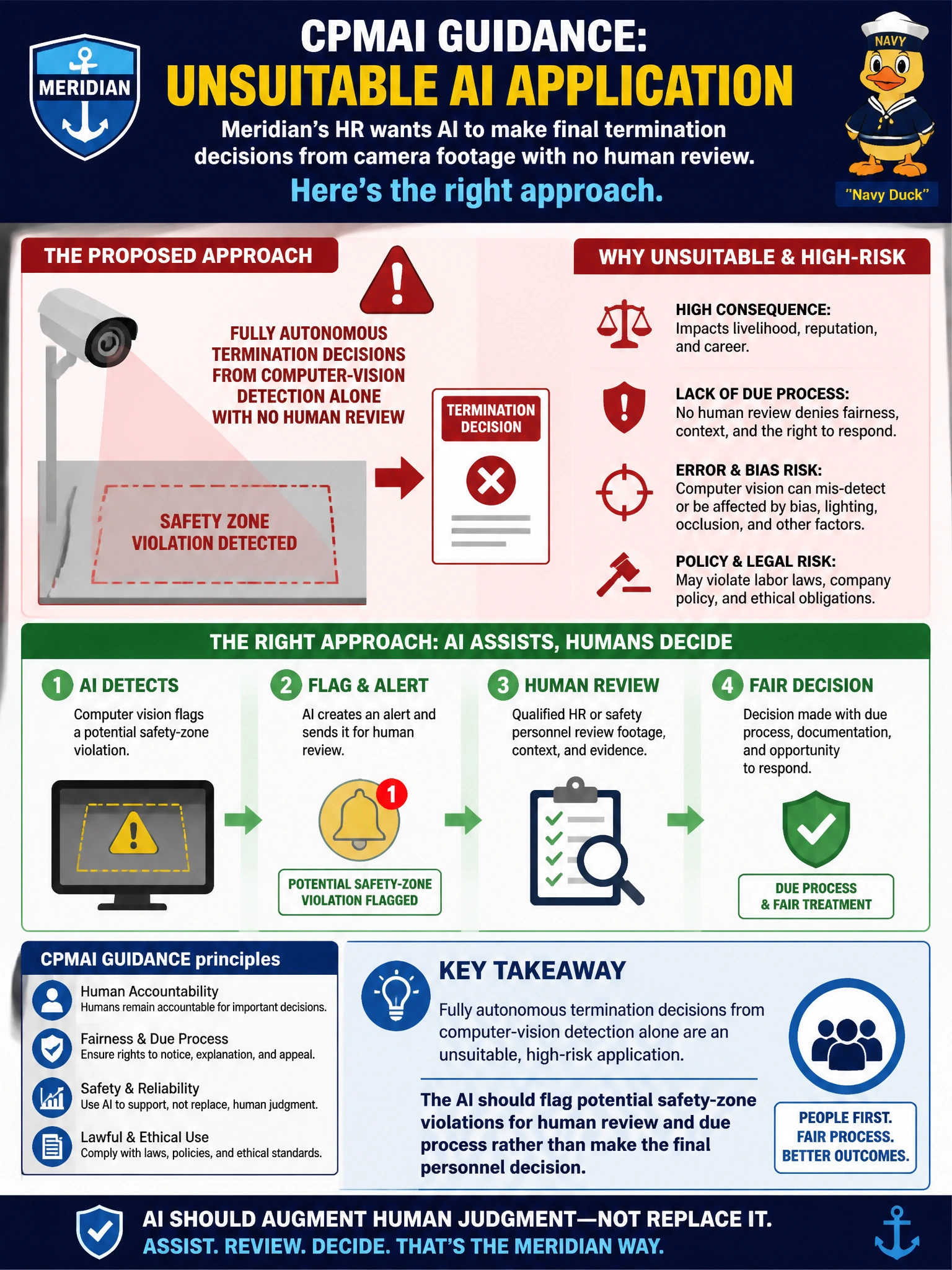
Meridian's HR department wants an AI system to make final termination decisions about ground-crew safety violations based solely on camera footage, with no human review. Which response correctly applies CPMAI's guidance on identifying unsuitable AI applications?
Select an answer to reveal the explanation.
Short Explanation
Flagging a possible violation for a human to review: great use of computer vision. Letting the camera fire someone with no human in the loop: a due-process and safety-consequence disaster waiting to happen. The pattern is right; the autonomy level is wrong.
Full Explanation
CPMAI Task 2 explicitly requires identifying limitations and unsuitable applications for AI, not just the good use cases. Computer-vision detection of safety-zone violations is a legitimate recognition-pattern application, but letting the system make a final, irreversible personnel decision (termination) with zero human review is inappropriate: cameras can misread context, false positives carry serious consequences for a real employee, and due-process and union-consultation obligations apply to any tool touching disciplinary action. The correct design keeps AI in a flagging/recommendation role, with a human reviewing evidence before any consequence. The 'ideal application, fully replace human judgment' distractor ignores the real risk of false positives and the seriousness of the outcome, exactly the kind of unsuitable application CPMAI wants a PM to catch. The 'unsuitable only because of unionization' distractor is too narrow — the due-process and accuracy concerns would exist even in a non-union shop; treating it as a purely contractual issue misses the substantive risk. The 'unsuitable only because of camera cost' distractor substitutes a budget objection for the real ethical/technical objection, which is not the reasoning CPMAI is testing. This is also a preview of Trustworthy AI concerns (unintended consequences, human oversight) surfacing inside an applications-and-patterns decision.