
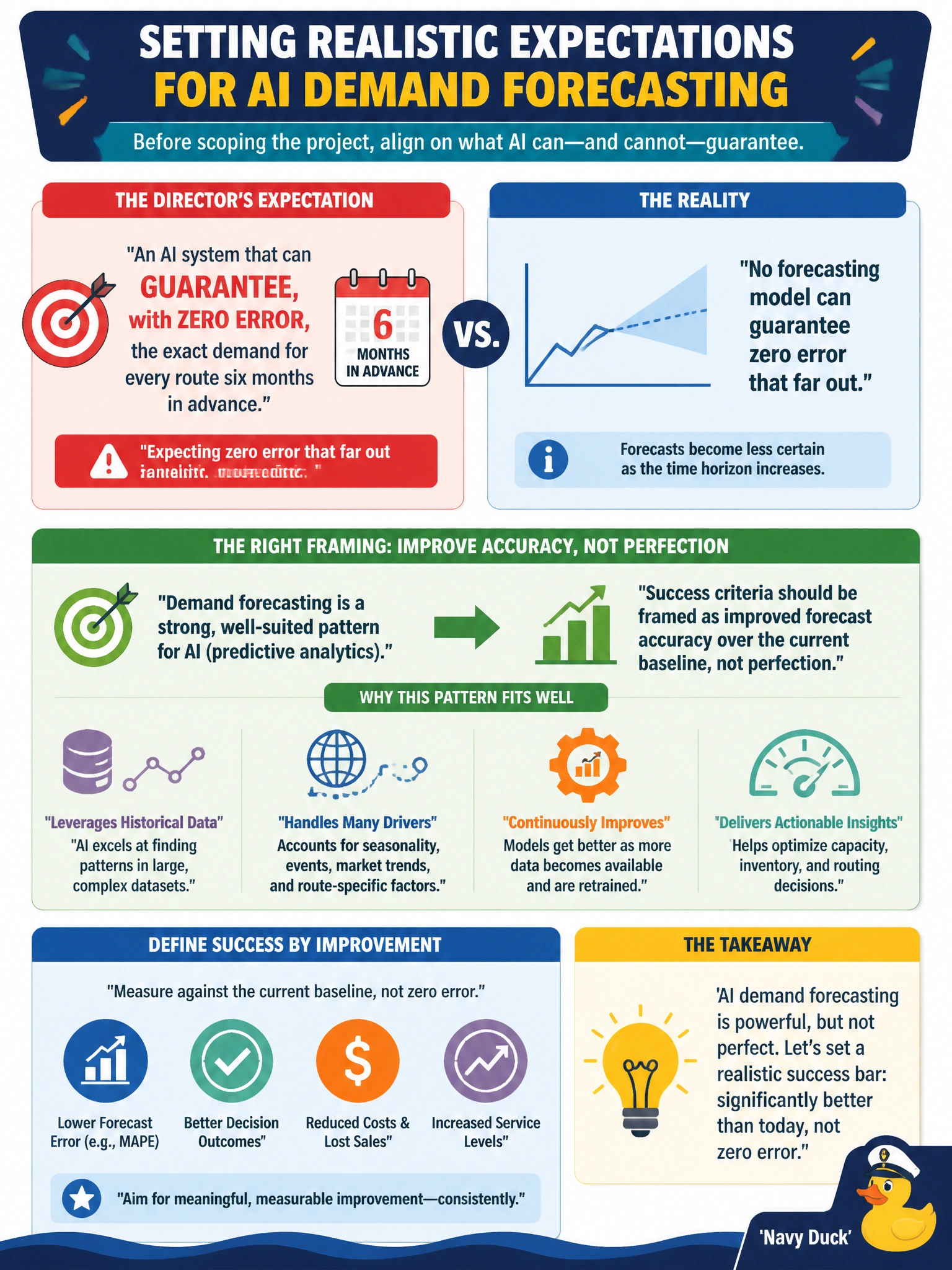
Meridian's cargo-planning director wants an AI system that can guarantee, with zero error, the exact demand for every route six months in advance, and expects to cancel the project if it cannot hit that guarantee. What should the PM tell the director about this expectation before scoping the project?
Select an answer to reveal the explanation.
Short Explanation
AI is genuinely good at forecasting demand — that's a textbook fit — but 'zero error, six months out' is a fantasy nobody's model delivers. The real pitch is 'meaningfully better than what you have now,' not perfection.
Full Explanation
CPMAI Task 2 requires determining appropriate use cases for AI while also identifying limitations and unsuitable expectations. Demand forecasting is squarely a good fit for AI's predictive-analytics pattern, so the PM should not talk Meridian out of the use case — but the director's zero-error, six-month-out guarantee is an unrealistic acceptance criterion that no statistical model can meet, and accepting it would set the project up to fail by design. The correct move is reframing success as measurable improvement over the current baseline (e.g., reduced forecast error percentage), consistent with CPMAI's emphasis on realistic ROI and expectation management. The 'expectation is reasonable, scope around zero error' distractor walks straight into the overpromising trap CPMAI explicitly warns against. The 'AI is unsuitable, use spreadsheets' distractor overcorrects — demand forecasting is one of AI's strongest, most proven applications, so abandoning it wastes a legitimate opportunity. The 'can only ever match manual accuracy' distractor understates AI's actual capability; well-built forecasting models routinely outperform manual spreadsheet planning at scale, which is exactly why there is a business case. The PM's job is separating a good use case from a bad acceptance criterion.