
Meridian's board asks the PM to distinguish, in one sentence, 'strong AI' from 'weak AI' as those terms are used in the exam content the PM studied. Which statement is accurate?
Select an answer to reveal the explanation.
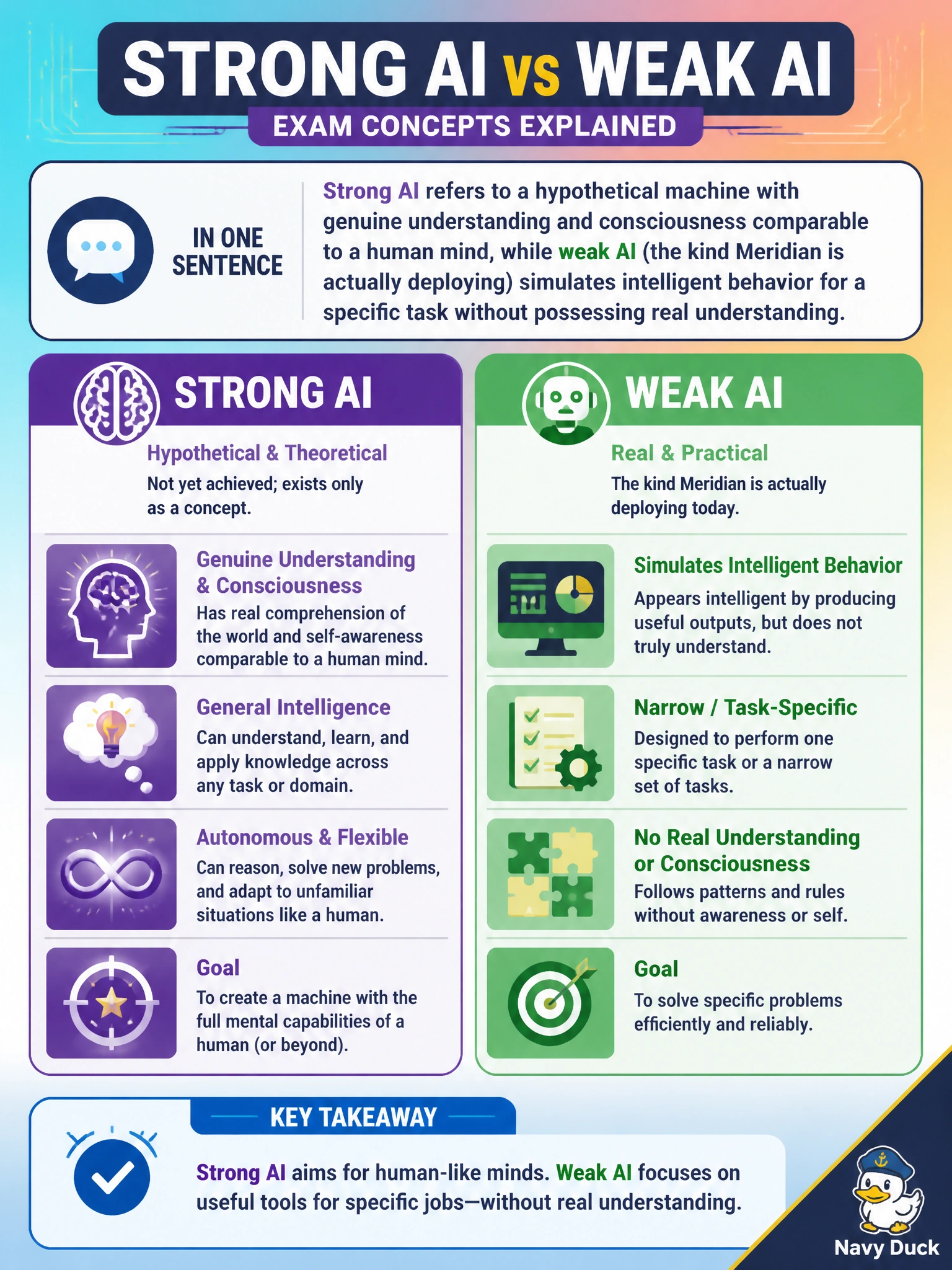
Short Explanation
'Strong' versus 'weak' is about whether the machine truly understands what it's doing (strong, hypothetical) versus just simulates the behavior convincingly (weak, what you actually have). Every real Meridian system — maintenance forecasting, the chatbot — is weak AI, and that's fine; it's what works today.
Full Explanation
CPMAI requires distinguishing AGI, Strong AI, Weak AI, and Narrow AI as related-but-separate concepts. Strong AI is a philosophical/hypothetical category describing a machine that genuinely understands and is conscious in a way comparable to a human mind — no deployed system, including anything Meridian operates, meets this bar. Weak AI (often used alongside 'narrow AI') describes systems that convincingly simulate intelligent behavior on a bounded task, such as forecasting maintenance needs or handling a rebooking chat, without any claim of real understanding — this is what Meridian is actually buying and deploying. The 'dataset size' distractor invents a criterion (training-data volume) that has nothing to do with the strong/weak distinction, which is about the nature of the intelligence, not the size of the training set. The 'hardware/cloud-vs-laptop' distractor similarly substitutes an irrelevant infrastructure detail for the actual philosophical distinction. The 'same thing, just marketing' distractor collapses a meaningful conceptual line CPMAI tests directly, and would leave the PM unable to correct a vendor who implies their weak-AI product has strong-AI capabilities. Precision here keeps Meridian's public claims about its AI honest and defensible.