
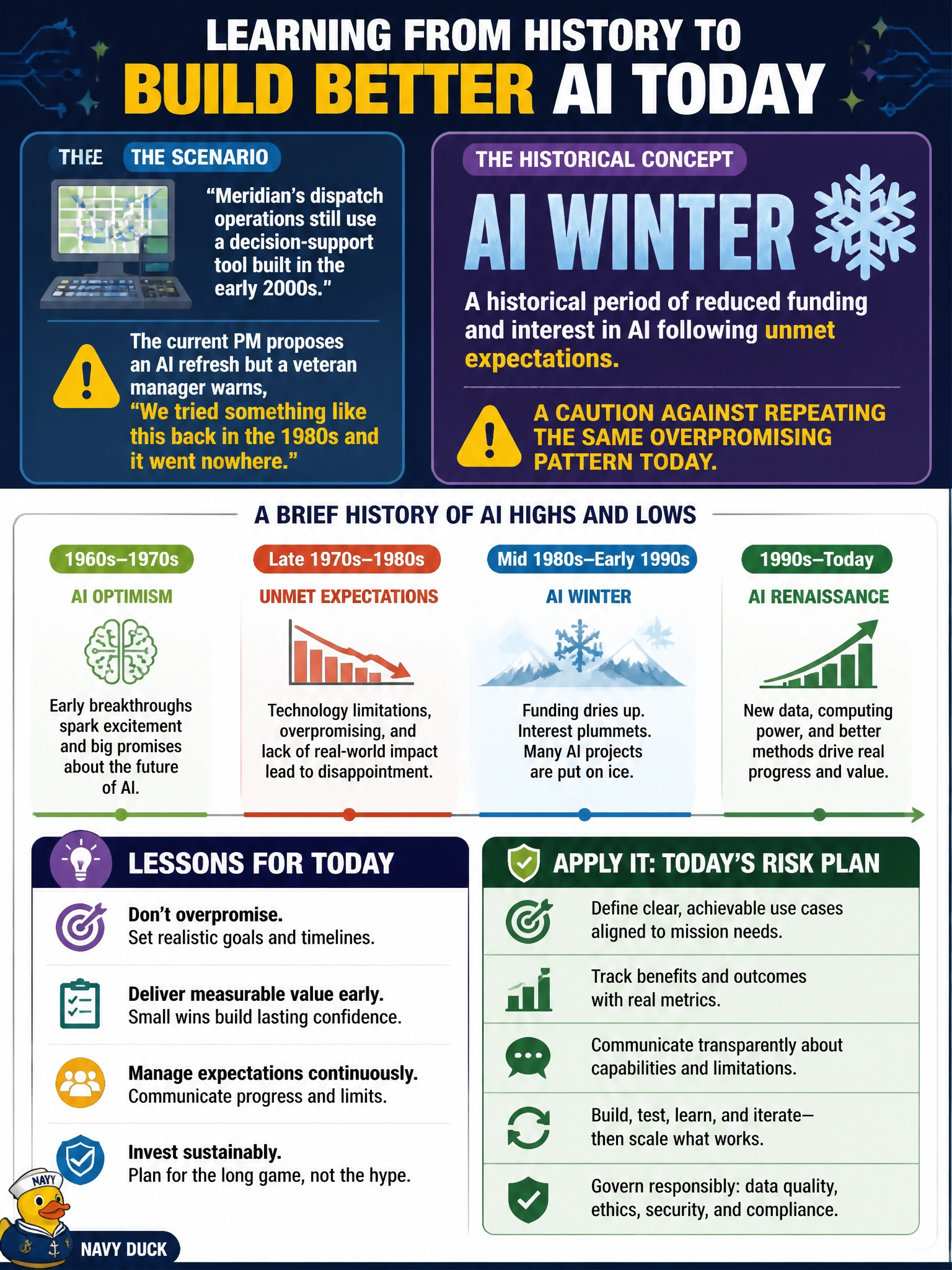
Meridian's dispatch operations still use a decision-support tool built in the early 2000s. The current PM proposes an AI refresh but a veteran manager warns, 'We tried something like this back in the 1980s and it went nowhere.' What historical AI concept explains that earlier failure and should inform today's risk plan?
Select an answer to reveal the explanation.
Short Explanation
'AI winter' is the term for what happens when AI gets oversold, underdelivers, and funding dries up for years — it happened at least twice in AI history. The lesson for Meridian: promise only what the current model can actually do, or you risk your own mini-winter.
Full Explanation
CPMAI Task 1 requires tracing AI's historical development including AI winters — periods (notably in the late 1970s/1980s and again in the early 1990s) when inflated expectations for symbolic AI and expert systems collided with real technical limits, causing funding and enthusiasm to collapse for years. The veteran manager's story about a 1980s dead end is a textbook AI-winter reference, and the lesson for the current project is to avoid the same overpromising-underdelivering pattern that caused it — directly reinforcing CPMAI's ROI-realism and expectation-management themes in the Methodology domain. The 'network bandwidth' distractor invents a technical cause unrelated to what actually drove AI winters (funding pullback after unmet hype, not infrastructure limits that didn't yet exist at scale). The 'GDPR' distractor is anachronistic — GDPR dates to 2018, decades after the 1980s AI winter, and privacy law was not the historical cause. 'Model drift' is a real, testable concept but describes a deployed model's accuracy degrading over time in production, not the historical funding/interest collapse the manager is describing about an entire research era. Framing the past correctly lets the PM set realistic expectations now rather than repeating the cycle.