
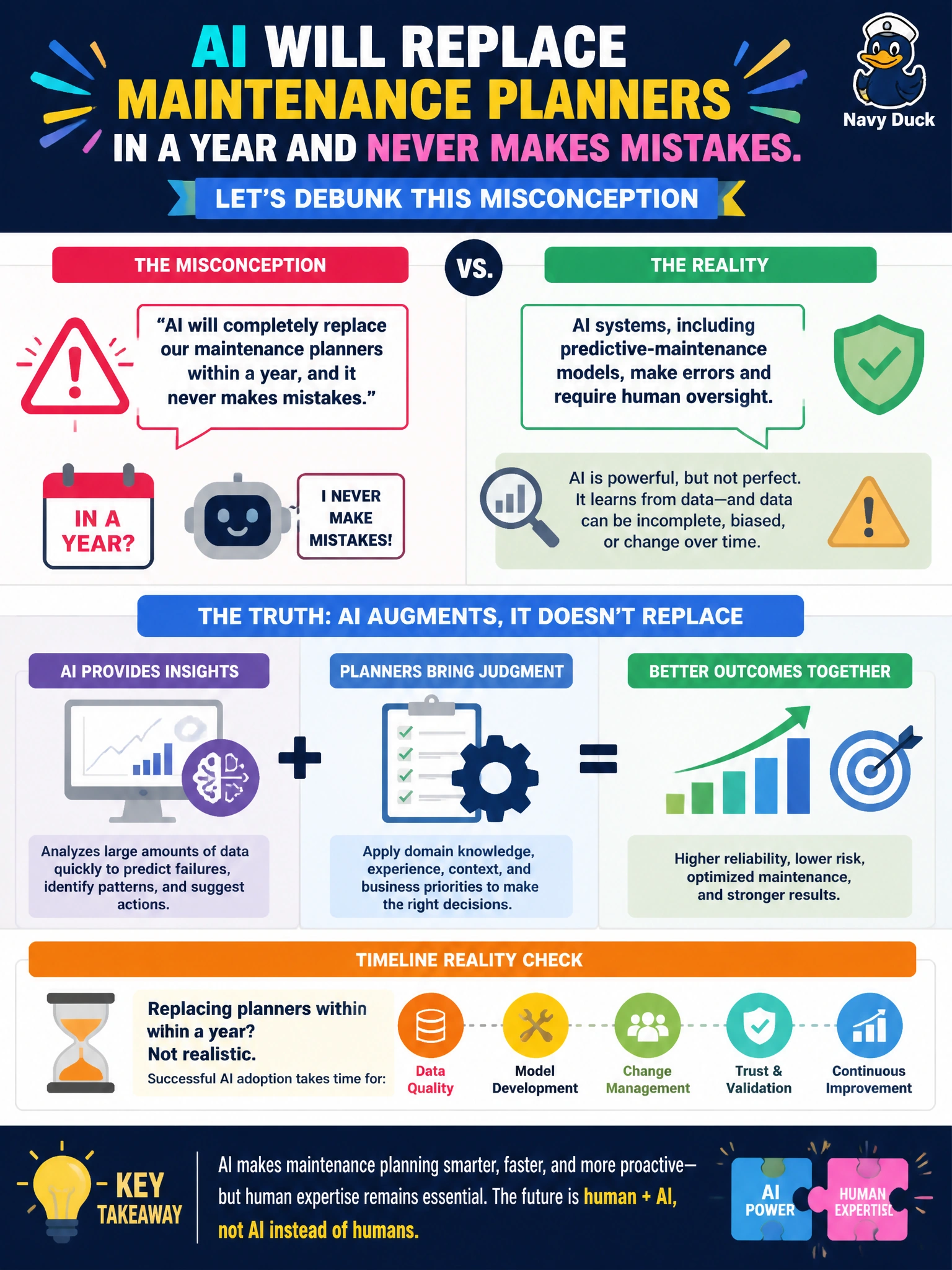
During a steering-committee meeting, a finance executive says, 'AI will completely replace our maintenance planners within a year, and it never makes mistakes.' As the AI project manager, which response correctly debunks this common misconception?
Select an answer to reveal the explanation.
Short Explanation
Every AI myth has the same fix: reality-check it against what the model actually does. 'Never wrong, replaces everyone fast' is a myth checklist, not a project plan. The honest pitch is augmentation plus oversight, on a realistic timeline.
Full Explanation
Debunking common AI myths and misconceptions is an explicit CPMAI Task 1 objective, and this stem hits two myths at once: infallibility ('never makes mistakes') and imminent full replacement of skilled labor. The correct response corrects both: predictive-maintenance models produce false positives and false negatives and need human validation, and realistic AI adoption augments planner judgment on a longer, iterative timeline rather than eliminating the role in a year. The 'executive is correct, eliminate the role' distractor is the overpromising trap CPMAI specifically warns project managers to resist — it would also blow past union-consultation obligations that apply to any tool touching maintenance sign-off. The 'never makes mistakes once trained' distractor restates the infallibility myth rather than correcting it; all statistical models retain error rates, and model drift can increase them over time. The 'only union contracts prevent replacement' distractor is a subtler trap — it implicitly concedes the technical infallibility myth and reframes the issue as purely a labor-relations obstacle, when in fact the technical case for full unsupervised replacement is not there either. Naming both realities — imperfect accuracy and augmentation-not-replacement — is what actually protects the project's credibility with the board.